
Summarize this post with AI
Singapore maintained its position as ASEAN's top fintech funding recipient in 2025, securing over US$725 million in the first nine months alone, representing 87 percent of ASEAN's total fintech funding. That capital concentration comes with a regulatory expectation: Singapore-based fintech and RegTech firms operate under one of the most structured AI governance ecosystems in the world. ai transformation fintech singapore is therefore not just a technology decision; it is a governance, compliance, and competitive positioning decision made inside a defined regulatory architecture. This guide covers what ai transformation fintech singapore requires in 2026, from IMDA's Agentic AI Framework through to MAS's AI Risk Management Toolkit and the ASEAN Guide on AI Governance and Ethics.
AI Transformation Fintech Singapore
ai transformation fintech singapore operates within a layered governance architecture: IMDA develops AI governance frameworks and technical tools, PDPC administers data protection obligations under PDPA across the AI lifecycle, and MAS shapes expectations for AI-driven analytics and decision-making in financial services. IMDA's Model AI Governance Framework for Agentic AI, launched at the World Economic Forum on 22 January 2026, is the world's first governance framework specifically for agentic AI systems, and Singapore leads the ASEAN Working Group on AI Governance to develop a trusted AI ecosystem across Southeast Asia. For fintech and regtech ai transformation firms, compliance with this framework architecture is a de facto market access condition, not an optional governance overhead.
What AI Transformation Means for Fintech and RegTech Firms
Fintech trends in singapore in 2026 cluster around three AI-driven capabilities: automated compliance and AML monitoring, AI-powered credit and underwriting decisioning, and agentic AI systems that process transactions, payments, and customer interactions autonomously. regtech ai transformation is the fastest-growing segment within this cluster. RegTech providers in Singapore specialise in technology-based solutions that help financial institutions comply with regulations, and while there is no standalone licensing regime for RegTech providers, those performing outsourced functions for regulated financial institutions or handling regulated data become indirectly subject to MAS regulatory requirements. This means RegTech firms carry compliance obligations, not just their regulated clients. For the foundational enterprise AI transformation framework that applies before any fintech-specific layer, the how modern enterprises build AI-ready operations guide and the AI transformation consulting Singapore guide provide the sequencing baseline.
Make Confident AI Decisions with a Free Assessment Report
Why 2026 Is the Defining Year for Fintech AI Governance in Singapore and ASEAN
Three regulatory developments in 2026 make governance a first-order concern for every fintech and RegTech AI deployment.
1. IMDA's Agentic AI Framework is now the global reference standard: IMDA developed the Model AI Governance Framework for Agentic AI as a first-of-its-kind framework for reliable and safe agentic AI deployment, building on governance foundations introduced in 2020 and designed to function as a living document that evolves as new use cases and risks emerge. For fintech firms deploying autonomous transaction agents or payment processing AI, this framework sets the baseline.
2. MAS's AI Risk Management Toolkit is now the financial sector's operational standard: The MindForge AI Risk Management Toolkit, published 20 March 2026 and developed collaboratively by a consortium of 24 banks, insurance companies, and capital market firms, provides financial institutions with resources for managing AI risks across traditional AI, generative AI, and agentic AI technologies. Fintech and RegTech firms operating within MAS-regulated supply chains are expected to meet the same standards as the institutions they serve.
3. ASEAN AI governance is converging around Singapore's framework architecture: Singapore leads the ASEAN Working Group on AI Governance and IMDA has developed a crosswalk mapping Singapore's AI governance frameworks to international standards such as the NIST AI Risk Management Framework, reducing compliance friction for multinational organisations. The Expanded ASEAN Guide on AI Governance and Ethics provides the regional baseline, and Singapore's frameworks increasingly function as its operational implementation layer.
Firms building ai transformation asean programs from a Singapore base have the most complete governance architecture in the region to work with. The agentic AI transformation guide covers what agentic AI specifically introduces in terms of deployment requirements beyond traditional AI governance.
The Fintech AI Transformation Framework: Step by Step
Use this sequence to build a compliant ai transformation fintech singapore program aligned to 2026 regulatory expectations.
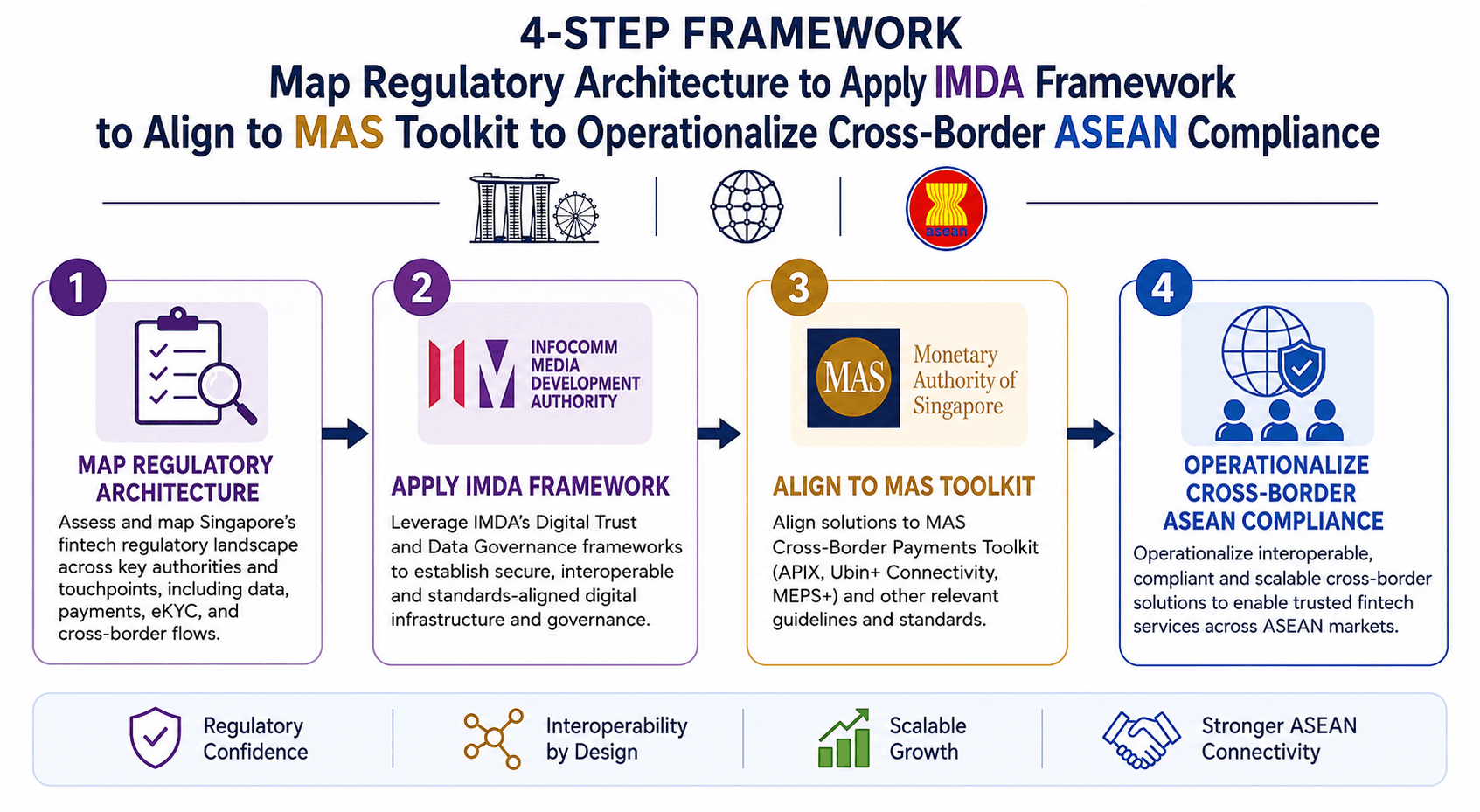
Step 1: Map Your AI Systems Against the Regulatory Architecture
Identify which regulator governs each AI system: IMDA frameworks apply broadly; MAS requirements apply where the system touches financial services decisions; PDPC obligations apply where personal data is processed.
Classify every AI system by type: traditional AI, generative AI, or agentic AI, since governance requirements differ materially across these three categories under both IMDA and MAS frameworks.
Apply RegTech-specific scope check: RegTech firms performing outsourced compliance functions for regulated institutions or handling regulated data become indirectly subject to MAS outsourcing guidelines, AML and CFT requirements, and PDPA data protection obligations.
Step 2: Apply the IMDA Model AI Governance Framework
For traditional and generative AI: align to IMDA's original Model AI Governance Framework and the 2024 Generative AI extension covering hallucinations, bias, intellectual property, and cybersecurity.
For agentic AI: apply the January 2026 Agentic AI Framework's four pillars: assess and bound risks upfront, make humans meaningfully accountable, implement technical controls, and enable end-user responsibility.
Use AI Verify for testing: AI Verify, developed by IMDA, is a testing and assurance framework enabling organisations to assess AI systems against recognised governance principles through process checks and technical tests.
Step 3: Align to MAS AI Risk Management Toolkit for Financial Services
Apply the Operationalisation Handbook: the MindForge AI Risk Management Toolkit's Operationalisation Handbook provides detailed, practical guidance on implementing an AI risk management framework and is the most operationally specific resource available for Singapore financial services firms.
Document proportionate controls by risk tier: high-impact AI in credit or payments requires the most stringent controls; lower-risk systems such as internal productivity tools require lighter-touch documentation.
Build audit trails for every AI-influenced financial decision: explainability documentation must be available on demand for MAS examiners, not reconstructed after the fact.
Step 4: Operationalize Continuous Monitoring and Cross-Border ASEAN Compliance
Cross-border ai transformation asean programs require compliance mapping against multiple jurisdictions simultaneously. IMDA's crosswalk mapping Singapore's AI governance frameworks to international standards including NIST AI RMF reduces compliance friction for multinational organisations and signals that alignment with Singapore's voluntary frameworks supports broader global compliance efforts.
Samta.ai's Veda AI decision analytics platform supports this step by connecting model inventory, bias monitoring, audit trail generation, and multi-framework compliance documentation into a single operational layer, integrated with cloud data platforms including Databricks and Snowflake. The Veda AI decision analytics platform turns cross-border compliance mapping from a manual, jurisdiction-by-jurisdiction exercise into a continuous, automated governance capability. For firms that need to determine when external AI governance support is needed versus building in-house, the when do companies need AI consulting guide and AI consulting vs data consulting guide both address this decision directly.
Fintech vs RegTech AI Transformation: A Comparison
Dimension | Fintech AI Transformation | RegTech AI Transformation | IMDA Governance Layer | MAS Compliance Layer | Samta.ai Integration Point |
Primary AI Use Cases | Credit decisioning, payments automation, fraud detection, robo-advisory | AML monitoring, KYC automation, regulatory reporting, compliance document processing | All AI types: traditional, generative, agentic | Traditional AI, GenAI, and agentic AI under MindForge Toolkit | Unified model inventory across all use cases |
Core Regulatory Exposure | MAS licensing, PDPA, AML/CFT | MAS outsourcing guidelines, AML/CFT requirements, PDPA for secure data handling | IMDA AI Verify testing framework | MAS AI Risk Management Toolkit | AI security compliance documentation |
Governance Framework | IMDA Model AI Governance Framework for Agentic AI, January 2026 | IMDA frameworks plus MAS outsourcing standards | AI Verify testing and assurance, IMDA NIST crosswalk | MindForge Operationalisation Handbook | Continuous audit trail and bias monitoring |
ASEAN Expansion Consideration | Expanded ASEAN Guide on AI Governance and Ethics, jurisdiction-specific licensing | Cross-border data flows, varying AML standards by jurisdiction | Singapore leads ASEAN Working Group on AI Governance | MAS frameworks as de facto ASEAN benchmark | Multi-jurisdiction compliance mapping layer |
Key Risk | Autonomous agent actions in payments without sufficient human oversight | Vendor model used in regulated compliance function without adequate documentation | Agentic AI autonomy bias and cascading failures | Ungoverned third-party AI in regulated supply chain | Mitigated via centralized vendor governance |
Make Smarter AI Decisions with a Comprehensive Risk Scorecard
Enterprise Use Cases: How Singapore Fintech and RegTech Firms Apply This
Use Case 1: Payments Fintech Deploying Agentic AI for Transaction Processing
A Singapore payments fintech deployed an agentic AI system to process transaction routing decisions autonomously within defined parameters. The system could update payment records and trigger escalations without human review for routine transactions, placing it squarely within IMDA's January 2026 Agentic AI Framework scope. The fintech applied all four framework pillars: bounded the agent's tool access to whitelisted payment APIs only, defined human approval checkpoints for transactions above S$10,000, built anomaly detection for prompt injection and unauthorized action attempts, and trained customer-facing teams on agent capabilities and limitations. IMDA noted the agentic AI framework was developed with input from both government agencies and private sector organisations and is intended to function as a living document that evolves as new use cases and risks emerge, with this deployment submitted as a case study to inform future iterations.
Use Case 2: RegTech Firm Building AI-Powered AML Monitoring
A Singapore RegTech firm providing outsourced AML monitoring to three MAS-regulated banks needed to ensure its AI models met the same governance standards as the banks' own internal models, not just general software quality standards. RegTech firms performing outsourced compliance functions for regulated financial institutions become indirectly subject to MAS outsourcing guidelines and AML and CFT requirements. The firm restructured its model documentation to include explainability outputs, bias testing results, and audit trails for every AML flag generated by the AI system. This gave its bank clients the compliance documentation they needed for MAS examiner requests, and gave the RegTech firm a competitive differentiator: provably governed AI, not just functional AI.
Key Risks and Failure Modes
Assuming RegTech firms are outside MAS scope: RegTech providers are not subject to a standalone licensing regime, but those performing outsourced functions for regulated institutions or handling regulated data become indirectly subject to regulatory requirements. The compliance boundary follows the data and the function, not the firm's self-classification.
Deploying agentic AI without the four-pillar framework: Agentic AI systems capable of updating databases, processing transactions, or making payments introduce risks around access to sensitive data, unauthorised actions, and challenges in maintaining effective human oversight. The IMDA framework's four pillars exist specifically to address these risks, and deploying without them creates both regulatory exposure and operational failure risk.
Cross-border ASEAN expansion without framework mapping: The Expanded ASEAN Guide on AI Governance and Ethics provides regional baseline principles, but each ASEAN jurisdiction has different enforcement posture and sector-specific requirements. Fintech firms expanding from Singapore into Malaysia, Indonesia, or Thailand need jurisdiction-specific compliance mapping, not a one-size-fits-all governance document.
Treating IMDA frameworks as purely voluntary: Although formally non-binding, IMDA's frameworks and AI Verify increasingly function as benchmarks in procurement, contracting, and regulatory discussions. A fintech that cannot demonstrate alignment with IMDA frameworks faces growing friction in enterprise procurement conversations, even when no regulator has mandated compliance explicitly.
Map your agentic AI deployments against IMDA's four pillars and MAS's Toolkit in one structured document. Download the Agentic AI Governance Checklist from Samta.ai and close your governance gaps before your next enterprise client or MAS examination.
Decision Framework: Is Your Fintech AI Governance 2026-Ready?
Every AI system is classified as traditional, generative, or agentic, with governance controls calibrated accordingly
RegTech functions performed for regulated institutions are documented against MAS outsourcing and AML/CFT requirements
Agentic AI deployments apply all four IMDA framework pillars: risk bounding, human accountability, technical controls, and end-user responsibility
AI Verify or equivalent testing has been completed before any AI system touches regulated decisions or personal data
Cross-border ASEAN compliance mapping exists for every jurisdiction where the firm operates or plans to expand
Audit trails for AI-influenced financial decisions are available on demand, not reconstructed after the fact
If fewer than four boxes are checked, your ai transformation fintech singapore program carries governance gaps that will surface in procurement conversations or regulatory reviews before you identify them internally.
Build a Stronger AI Foundation with Expert Insights
Conclusion
ai transformation fintech singapore in 2026 operates within the most structured AI governance ecosystem in ASEAN, and that structure is a competitive advantage for firms that embed compliance early, not a constraint for firms that treat it as an afterthought. With IMDA's Agentic AI Framework setting the global reference standard, MAS's MindForge Toolkit defining financial services expectations, and Singapore leading the ASEAN Working Group on AI Governance, fintech and RegTech firms headquartered in Singapore are building on the strongest governance foundation in the region.
Get the complete governance implementation blueprint for fintech and RegTech AI programs. Request the AI Model Risk Management Playbook from Samta.ai and map your AI portfolio against IMDA, MAS, and ASEAN frameworks in one structured program.
About Samta
Samta.ai is a Singapore-headquartered AI Product Engineering & Data Intelligence partner helping enterprises build production-grade AI systems for regulated and data-intensive environments.We help organizations move beyond experimentation by engineering scalable, explainable, and enterprise-ready AI solutions from data foundations and model development to workflow automation and deployment.
Our capabilities combine deep AI expertise, data engineering, and product engineering to deliver measurable business impact across FinTech, BFSI, cybersecurity, regulatory technology, and enterprise operations.
Our enterprise AI products power real-world intelligence systems:
• TATVA : AI-driven data intelligence platform for governed analytics, monitoring, and operational insights
• VEDA : Explainable and audit-ready AI decisioning engine built for compliance-sensitive enterprise workflows
• CORA-Property Management Solutions: : Predictive intelligence platform for real-estate pricing, portfolio optimization, and investment analytics
Backed by ecosystem partnerships with Microsoft, Databricks, Snowflake, and AWS, Samta.ai delivers agile, cost-efficient AI engineering with faster turnaround and enterprise-grade scalability. Trusted by enterprises across FinTech, BFSI, and digital transformation initiatives, Samta.ai embeds AI governance, data privacy, and compliance-by-design principles directly into the AI lifecycle , enabling organizations to scale AI with transparency, accountability, and operational control.
Enterprises leveraging Samta.ai automate 65%+ of repetitive data, analytics, and decision workflows while maintaining governance, explainability, and measurable business outcomes. Samta.ai provides the strategic consulting, AI engineering, and data modernization expertise needed to align enterprise operations with next-generation AI transformation goals.
Frequently Asked Questions
What does AI transformation mean for fintech firms in Singapore specifically?
ai transformation fintech singapore means deploying AI within a three-layer governance architecture: IMDA's AI governance frameworks, MAS's financial services AI risk requirements, and PDPA's data protection obligations. These regulators govern different aspects of the same AI deployment, and fintech firms must satisfy all three simultaneously rather than treating each as a separate compliance exercise.
What is the IMDA Model AI Governance Framework for Agentic AI?
IMDA's Model AI Governance Framework for Agentic AI, launched 22 January 2026 at the World Economic Forum, is the world's first governance framework specifically for agentic AI systems capable of independent decision-making. It provides guidance on deploying agents responsibly through four pillars: assessing and bounding risks upfront, making humans accountable, implementing technical controls, and enabling end-user responsibility. It is designed as a living document that evolves as new use cases and risks emerge.
Are RegTech firms subject to MAS AI governance requirements?
RegTech firms are not subject to a standalone licensing regime in Singapore, but those performing outsourced compliance functions for regulated institutions or handling regulated data become indirectly subject to MAS outsourcing guidelines, AML and CFT requirements, and PDPA data protection obligations. The compliance boundary follows the function and data, not the firm's category.
What is the MAS gen AI framework for Singapore financial services?
The MAS gen AI framework sits within the broader MindForge initiative. The MindForge AI Risk Management Toolkit, published 20 March 2026, provides resources for managing AI risks across traditional AI, generative AI, and emerging agentic AI technologies, with the Operationalisation Handbook detailing practical guidance for implementing an AI risk management framework. It covers generative AI as a distinct risk category requiring specific governance controls beyond those applied to traditional AI.
How does AI transformation differ across ASEAN jurisdictions?
Singapore leads the ASEAN Working Group on AI Governance and works with other countries through its AI Safety Institute to develop a trusted AI ecosystem within ASEAN. The Expanded ASEAN Guide on AI Governance and Ethics provides regional baseline principles, but enforcement posture, sector-specific licensing, and data localization requirements vary significantly by jurisdiction. Singapore's frameworks are increasingly the de facto regional benchmark, but cross-border programs require jurisdiction-specific compliance mapping.