
Summarize this post with AI
Singapore's financial institutions rank among the fastest AI adopters in the world, and that speed is exactly what makes an ai governance readiness benchmark singapore institutions need right now, not a nice to have. Independent industry research puts Singapore ahead of the global average on AI deployment across payments, fraud detection, and core operations. Deployment speed and governance maturity are two different measurements, and an institution can lead on one while lagging on the other. This benchmark separates the two, and gives CROs and heads of AI governance a scorecard to see exactly where their own institution sits.
AI Governance Readiness Benchmark Singapore:
An ai governance readiness benchmark singapore institutions can use should score maturity across five levels, from ad hoc governance with no formal AI inventory through to a fully integrated system where risk tiering, continuous validation, and board reporting scale automatically with each model's risk profile. Independent research from Finastra's Financial Services State of the Nation 2026 survey found 64% of Singapore institutions are already actively deploying AI across key business functions, ahead of most global peers, which means governance maturity, not adoption speed, is now the more useful differentiator between institutions.
What an AI governance maturity benchmark actually measures
Ai governance maturity benchmark bfsi work is built around is not how much AI an institution uses, it is how consistently that AI is governed once deployed. Adoption statistics answer a different question than maturity statistics do, and conflating the two is the most common mistake institutions make when self assessing.
A genuine ai governance model framework measures five things consistently: whether a complete AI inventory exists, whether risk materiality tiering is applied, whether validation happens continuously rather than once, whether board reporting scales with risk, and whether agentic systems get the same scrutiny as static models. Our guide on AI governance maturity models covers how these five dimensions map to broader maturity model theory used across other risk disciplines.
Discover Your AI Governance Readiness
Why deployment speed and governance maturity have diverged in 2026
Singapore ai governance survey data and adoption data tell two different stories this year, and understanding the gap matters for three reasons.
Adoption has outpaced governance capability building. Finastra's research found six in ten institutions globally improved their AI capabilities over the past year, a pace that governance functions, model risk committees, and inventory processes have not uniformly matched.
Singapore specific deployment metrics are genuinely strong. The same research found 73% of Singapore institutions deployed or improved AI use cases in payments technology over the past 12 months, nearly double the 38% global average, alongside 62% having implemented or upgraded advanced fraud detection systems.
National level adoption data confirms the same pattern outside financial services. Singapore's Ministry of Manpower released its own inaugural report on AI adoption among firms in April 2026, finding that AI adoption nationally remains at an early stage even as individual sectors, financial services among them, move quickly on specific use cases.
Our guide on what MAS actually expects from AI governance and our broader AI readiness assessment framework both cover how institutions can close this gap rather than assuming fast deployment already implies mature governance.
The AI governance maturity scorecard framework
This scorecard is Samta.ai's own methodology, built to give institutions a consistent way to self assess, rather than a report of specific institutions' scores, which we have not published and would not disclose even if we had.
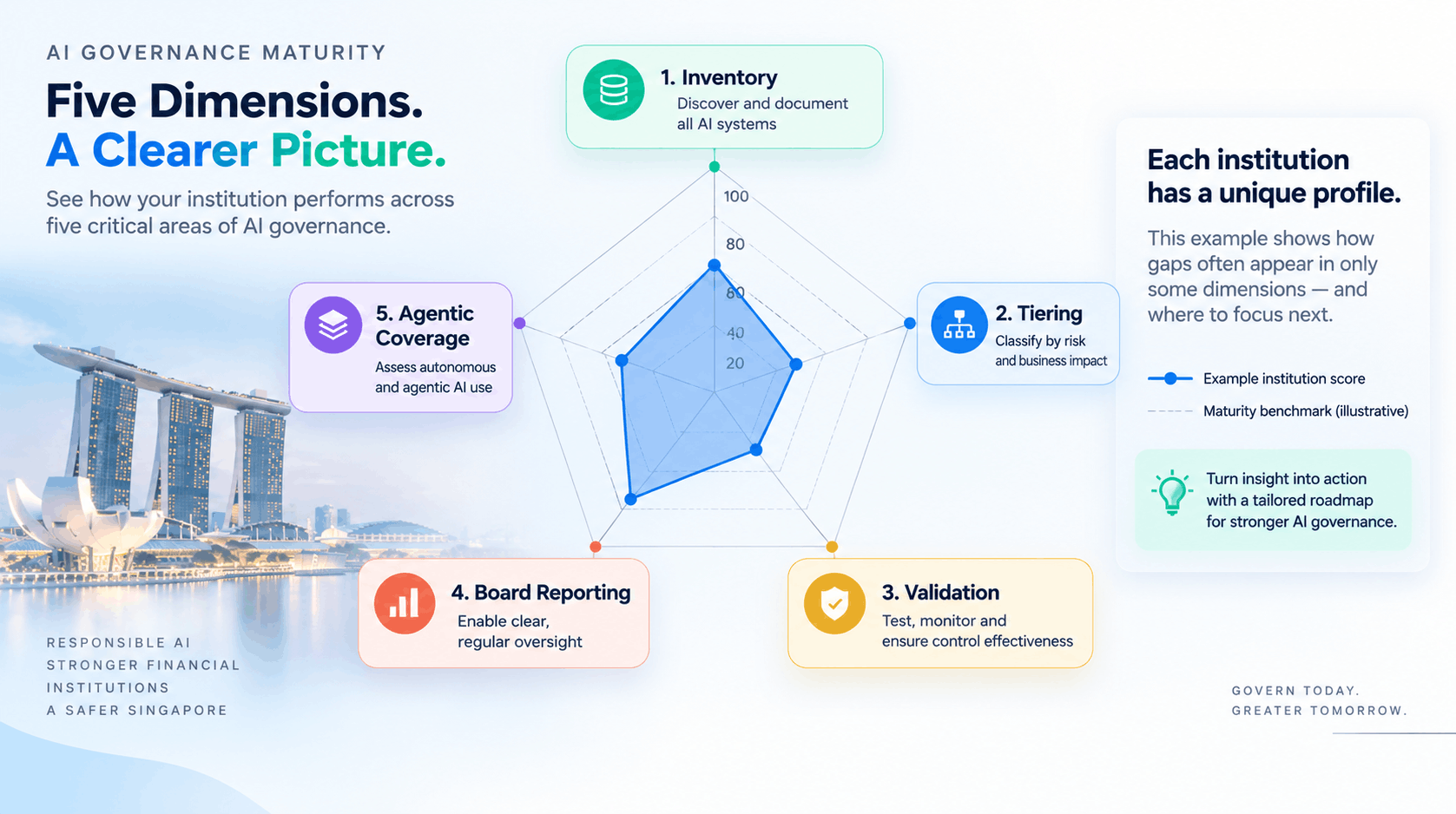
Score your AI inventory completeness. Can every model and agent, including third party and embedded AI, be listed with an owner and a last review date.
Score your risk tiering consistency. Are models classified by impact, complexity, and reliance using shared criteria, or does classification vary by business unit.
Score your validation cadence. Is validation continuous and triggered by material change, or a single pre deployment gate never revisited.
Score your board reporting structure. Does reporting scale with risk tier, giving critical systems more board visibility than low risk ones, or does every model get the same summary treatment.
Score your agentic AI coverage specifically. Do autonomous agents get runtime checkpoints and escalation paths, or are they assessed using criteria built for static models.
Add the five scores together to place your institution on the maturity scale described in the table below.
This is where the engineering execution layer matters. Samta.ai builds the VEDA AI decision analytics platform to score and track all five dimensions continuously, integrating with existing Databricks, Snowflake, or Microsoft data infrastructure through our data integration consulting services so the scorecard reflects current state rather than a snapshot from the last manual review. Institutions evaluating whether a general analytics tool can hold this structure should see how VEDA compares to other data intelligence platforms, since most were not built to score governance maturity alongside operational data. The VEDA platform treats the five scorecard dimensions as living metrics, updated as the inventory changes, not a static assessment repeated annually. For the organizational structure underneath this scorecard, our overview of the six components of a mature AI governance program covers what needs to exist before scoring becomes meaningful.
AI governance maturity levels at a glance
Maturity Level | Governance Characteristics | Risk Management Characteristics | Board Visibility | Typical Institution Profile |
Level 1, Ad Hoc | No formal AI inventory, accountability undefined | Risk assessed informally, if at all | No structured AI reporting | Early adopters with fast deployment, no governance build out yet |
Level 2, Emerging | Partial inventory, inconsistent policy across units | Some models reviewed, criteria vary by team | Occasional, ad hoc updates | Institutions scaling AI faster than governance |
Level 3, Defined | Documented governance charter, named committee exists | Risk materiality assessment applied to some models | Scheduled reporting, not yet tiered | Institutions building formal structure after rapid adoption |
Level 4, Managed | Full inventory, consistent tiering criteria across the institution | Continuous validation triggered by material change | Reporting cadence scales with risk tier | Institutions aligning with SR 26-2 and MAS AIRG proportionate expectations |
Level 5, Optimized | Governance and risk management fully integrated systems | Agentic AI covered by runtime checkpoints, not just static model criteria | Real time, tier based board dashboards | Institutions treating governance as a continuously operating system |
Assess Your AI Model Risk Exposure
Real world enterprise use cases
BFSI: a bank scoring itself at Level 2 despite strong AI adoption
A bank with genuinely fast AI deployment, consistent with Singapore's strong national adoption figures, scored itself against the five dimensions and landed at Level 2, with a partial inventory and inconsistent tiering criteria across its retail and institutional banking units. Building AI security and compliance services around a shared tiering methodology moved the bank toward Level 4 within two quarters, without slowing its deployment pace.
General enterprise: a proptech firm using the scorecard before a client audit
A proptech firm anticipated a BFSI client's procurement audit would ask governance maturity questions modeled on this same five dimension structure. Reviewing enterprise AI engineering in Singapore helped the firm self score honestly at Level 3 and prioritize board reporting structure as the fastest path to Level 4 before the audit occurred.
Key risks and failure modes
Assuming fast AI adoption implies mature governance. Deployment speed and governance maturity are measured differently, and Singapore's strong adoption figures do not by themselves indicate strong governance scores.
Scoring governance maturity inconsistently across business units. A shared scorecard methodology only works if every unit applies the same criteria, not its own interpretation of what counts as a complete inventory.
Treating a maturity score as a one time exercise. A score measured once and never repeated cannot show whether governance capability is closing the gap with deployment speed or falling further behind.
Scoring agentic AI using the same criteria as static models. Institutions that do not score dimension five separately tend to overstate their overall maturity, since agentic systems require materially different governance.
Confusing national level adoption statistics with institution specific maturity. Sector wide figures describe an industry trend, not any single institution's actual governance readiness.
When to run a full maturity assessment versus a lighter self score
Run a full assessment when:
Your institution has not scored governance maturity against a consistent methodology before
AI deployment has scaled faster than governance headcount or tooling
A regulatory examination or client audit is expected within the next two quarters
A lighter self score is enough when:
A formal assessment was completed recently and only needs a refresh
Governance maturity is already tracked consistently across business units
The institution's AI footprint has not changed materially since the last assessment
Reviewing Samta.ai's case studies alongside your own self score gives a useful benchmark for how other institutions have closed specific dimension gaps.
Get Expert Guidance on Your AI Governance Strategy

Conclusion
An ai governance readiness benchmark singapore institutions run should separate two questions that get conflated constantly, how much AI is deployed and how well it is governed. Singapore's institutions lead on the first measurement by most independent accounts. The five level scorecard here gives CROs a consistent way to answer the second question honestly, rather than assuming deployment speed already implies governance maturity.
About Samta
Samta.ai is a Singapore-headquartered AI Product Engineering & Data Intelligence partner helping enterprises build production-grade AI systems for regulated and data-intensive environments.We help organizations move beyond experimentation by engineering scalable, explainable, and enterprise-ready AI solutions from data foundations and model development to workflow automation and deployment.
Our capabilities combine deep AI expertise, data engineering, and product engineering to deliver measurable business impact across FinTech, BFSI, cybersecurity, regulatory technology, and enterprise operations.
Our enterprise AI products power real-world intelligence systems:
• TATVA : AI-driven data intelligence platform for governed analytics, monitoring, and operational insights
• VEDA : Explainable and audit-ready AI decisioning engine built for compliance-sensitive enterprise workflows
• CORA-Property Management Solutions: : Predictive intelligence platform for real-estate pricing, portfolio optimization, and investment analytics
Backed by ecosystem partnerships with Microsoft, Databricks, Snowflake, and AWS, Samta.ai delivers agile, cost-efficient AI engineering with faster turnaround and enterprise-grade scalability. Trusted by enterprises across FinTech, BFSI, and digital transformation initiatives, Samta.ai embeds AI governance, data privacy, and compliance-by-design principles directly into the AI lifecycle , enabling organizations to scale AI with transparency, accountability, and operational control.
Enterprises leveraging Samta.ai automate 65%+ of repetitive data, analytics, and decision workflows while maintaining governance, explainability, and measurable business outcomes. Samta.ai provides the strategic consulting, AI engineering, and data modernization expertise needed to align enterprise operations with next-generation AI transformation goals.
Frequently asked questions
What is an AI governance readiness benchmark?
An AI governance readiness benchmark is a scoring framework that measures how consistently an institution governs its AI systems, covering inventory completeness, risk tiering, validation cadence, board reporting, and agentic AI coverage, rather than measuring how much AI the institution has deployed.
Does fast AI adoption in Singapore mean governance is also mature?
Not necessarily. Independent research shows Singapore leading on AI deployment metrics, but deployment speed and governance maturity are different measurements. An institution can score highly on adoption while still sitting at an early governance maturity level.
How many levels does the AI governance maturity scorecard have?
The framework described here uses five levels, from ad hoc governance with no formal inventory through to a fully integrated system where risk tiering, validation, and board reporting scale automatically with each model's risk profile.
What is the most common governance gap Singapore BFSI institutions have?
Inconsistent tiering criteria across business units is a common gap, where different teams apply their own interpretation of risk classification rather than a shared methodology, making board level comparability across the institution's full AI portfolio difficult.
Why does agentic AI get scored as a separate dimension?
Agentic systems require materially different governance than static models, since they can act autonomously. Scoring agentic coverage separately prevents institutions from overstating overall maturity based on strong static model governance alone.