
Summarize this post with AI
Singapore's AI governance in banking Singapore landscape has changed more in the past 12 months than in the previous five years combined. MAS finalized its AI Risk Management Guidelines, IMDA launched the world's first governance framework for agentic AI on 22 January 2026, and then updated it again on 20 May 2026 with multi-agent system guidance and automation bias controls. For Singapore BFSI institutions, an ai governance framework singapore bfsi is no longer a voluntary best practice document; it is the architecture that determines examination outcomes and board-level risk accountability. This guide covers the complete 2026 governance architecture every Singapore bank, insurer, and capital market firm needs, across IMDA, MAS, and FEAT obligations simultaneously.
AI Governance Framework Singapore BFSI:
An ai governance framework singapore bfsi in 2026 must cover three layered obligations simultaneously: Singapore's Model AI Governance Framework, while technically voluntary, is effectively mandatory for MAS-licensed financial institutions through the Technology Risk Management Guidelines, which incorporate its principles as binding AI risk control requirements. IMDA's Model AI Governance Framework for Agentic AI, launched January 2026 and updated May 2026, provides the world's first governance framework specifically designed for AI agents capable of autonomous planning, reasoning, and action, structured around four core dimensions: assessing and bounding risks upfront, making humans meaningfully accountable, implementing technical controls, and enabling end-user responsibility. For BFSI institutions, these two frameworks plus MAS FEAT principles operate as a single, converging governance architecture that examiners now evaluate during routine supervisory reviews.
What AI Governance Means for Singapore BFSI in 2026
The singapore model ai governance framework is not a single document. It is a layered architecture of three interconnected frameworks that have evolved progressively since 2019. IMDA has progressively extended its Model AI Governance Framework to address new AI types. In 2024, it released the Model AI Governance Framework for Generative AI addressing risks associated with large language models including hallucinations, bias, intellectual property, content provenance, cybersecurity, and systemic risk. Most recently, in January 2026, IMDA introduced the Model AI Governance Framework for Agentic AI, addressing governance challenges posed by autonomous or semi-autonomous AI agents capable of independent decision-making. These developments place Singapore among the first jurisdictions to articulate structured governance guidance for advanced AI systems.
AI governance in banking Singapore adds the MAS layer on top of these IMDA frameworks. MAS's Technology Risk Management Guidelines, which are legally binding for all licensed financial institutions, incorporate the framework's principles directly into their AI and machine learning risk control requirements. For Singapore's BFSI sector, the Singapore AI governance framework is effectively mandatory through this regulatory bridge, even when described as guidance. For the six components that underpin any complete Singapore AI governance program, see the 6 components of AI governance guide. For the FEAT compliance layer that sits within this broader architecture, see the MAS FEAT compliance checklist.
Identify AI Risks and Opportunities in Minutes
Why 2026 Is the Inflection Point for BFSI AI Governance
Three developments make 2026 a structurally different regulatory environment from any prior year.
1. The May 2026 MGF update introduced multi-agent system governance: On 20 May 2026, IMDA updated the Model AI Governance Framework for Agentic AI, incorporating industry feedback and introducing new best practices and real-world case studies demonstrating how organisations have operationalised the framework to address multi-agent systems, third-party agents, and automation bias. The update differentiated the roles and responsibilities of platform providers versus system providers or app developers across the agentic AI value chain and lifecycle, encouraging adaptive governance and providing further guidance on guarding against automation bias.
2. The agentic AI risk tier system is now the operational standard: A tiered risk classification applies: Tier 1 covers reversible actions only, non-sensitive data, and no external APIs, requiring standard logging and quarterly review. Tier 2 covers some irreversible actions or access to personal data, requiring a pre-deployment evaluation gate, named owner, and human checkpoint on high-value actions. Tier 3 covers irreversible actions on regulated or sensitive data, external integrations, or customer-facing decisions, requiring full technical control stack, CISO sign-off, and explicit MAS-aligned risk acceptance.
3. AI governance is now examined alongside technology risk: For any organisation licensed by MAS banks, insurers, fund managers, and payment service providers the Model AI Governance Framework is not merely guidance; it is the compliance baseline that supervisory examinations increasingly reference. For BFSI enterprises navigating the tension between AI innovation and governance, the Singapore BFSI governance balancing guide covers how institutions manage this in practice. The BFSI AI solutions governance guide documents the solution architecture that peer institutions are using to operationalize these requirements.
The BFSI AI Governance Framework: Step by Step
Use this sequence to build or audit an ai governance framework singapore bfsi program aligned to all 2026 regulatory expectations.
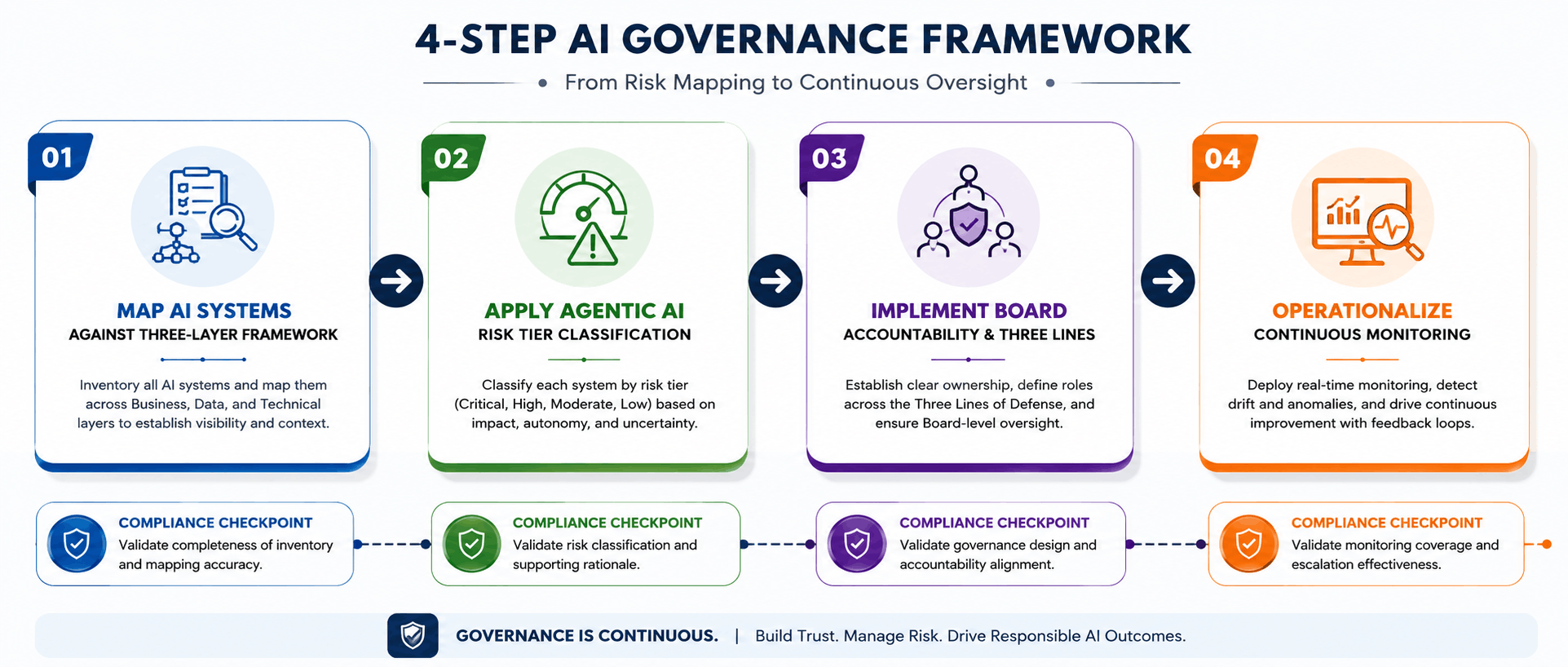
Step 1: Map Your AI Systems Against the Three-Layer Framework
IMDA Model AI Governance Framework (traditional AI): four pillars: internal governance structures, human oversight decisions, operations management, and stakeholder communication. Apply to all AI systems.
IMDA Model AI Governance Framework for Generative AI (2024): apply additionally to any LLM or generative AI system, addressing hallucination risk, bias, IP controls, content provenance, and cybersecurity.
IMDA Model AI Governance Framework for Agentic AI (January 2026, updated May 2026): apply to any AI agent capable of autonomous planning, reasoning, and action, requiring use-case-specific assessments that consider autonomy level, access to sensitive data, and breadth of impact.
Step 2: Apply the Agentic AI Risk Tier Classification
For any agentic AI system in your BFSI portfolio, classify it before deploying any governance control:
Tier 1 (low risk): reversible actions only, non-sensitive data, no external APIs. Standard logging and quarterly review sufficient.
Tier 2 (moderate risk): some irreversible actions or personal data access. Pre-deployment gate, named owner, and human checkpoint on high-value actions required.
Tier 3 (high risk): irreversible actions on regulated or sensitive data, external integrations, or customer-facing decisions. Requires full technical control stack, CISO sign-off, and explicit MAS or IMDA-aligned risk acceptance. A BFSI example: an agent that reads transaction history to draft a dispute summary is Tier 1. An agent that sends payment instructions is Tier 3 even if it looks simple. The risk is in the action, not the interface.
Step 3: Implement Board-Level Accountability and Three Lines of Defense
Assign board-level AI risk owner: MAS's AI Risk Management Guidelines require board and senior management to assume primary and ultimate responsibility for AI risk oversight.
Build AI-specific responsibilities into each line: business units (first line), risk and compliance (second line), and internal audit (third line) each need documented AI-specific roles rather than generic technology risk ownership.
Integrate AI risk into existing enterprise risk frameworks: do not create a parallel governance silo; connect AI risk reporting to existing board-level technology and operational risk reporting cycles.
Step 4: Operationalize Continuous Monitoring and Audit Trails
This is where most institutions have the largest gap between policy and practice. Access controls, guardrails, human approvals, logging and monitoring are now explicitly listed as core components of an AI agent under the updated May 2026 MGF. These are not post-deployment additions; they are architecture requirements that must be embedded from the first deployment. Samta.ai's Veda AI data analytics platform supports this step by connecting model inventory, bias monitoring, audit trail generation, and agentic AI action logging into a single governance layer on Databricks and Snowflake. The Veda AI data analytics platform turns the MGF's operational recommendations from a documentation exercise into a live, continuously monitored governance capability. The Veda vs data intelligence platform comparison documents how this compares against general-purpose analytics platforms for governance-intensive BFSI deployments. For the enterprise AI engineering in Singapore context, Samta.ai's AI security compliance services and data integration consulting services provide the end-to-end delivery layer connecting data infrastructure to governance documentation.
AI Governance Framework Comparison: Singapore BFSI in 2026
Dimension | IMDA MGF (Traditional AI, 2020) | IMDA MGF for Generative AI (2024) | IMDA MGF for Agentic AI (Jan 2026, updated May 2026) | MAS AI Risk Management Toolkit (March 2026) | Samta.ai Integration Point |
Nature | Technically voluntary; effectively mandatory for MAS-licensed FIs through TRM Guidelines | Voluntary companion guide to MGF | World's first framework for autonomous AI agents; voluntary but rapidly becoming de facto supervisory baseline | Non-binding but treated as supervisory expectation during MAS examinations | Continuous compliance monitoring across all three layers |
Primary Coverage | Internal governance, human oversight, operations, stakeholder communication | Hallucinations, bias, IP, content provenance, cybersecurity, systemic risk for LLMs | Autonomous planning, reasoning, and action: risk bounding, human accountability, technical controls, end-user responsibility | Board oversight, AI inventory, lifecycle controls, proportionate risk tiering | Unified model inventory and audit trail across all AI types |
Agentic AI Coverage | Not addressed | Not addressed | Multi-agent systems, third-party agents, automation bias, access controls, guardrails, human approvals, logging and monitoring | Emerging agentic AI technologies explicitly covered | Agentic AI action logging and governance layer |
Update Cadence | Second edition 2020; Companion Guide 2024 | Published 2024 | Launched January 2026; updated May 2026 with industry feedback, new case studies, and multi-agent guidance | Published March 2026 under Project MindForge | Real-time update without governance lag |
BFSI Enforcement Status | Mandatory via MAS TRM Guidelines for all licensed FIs | De facto expected alongside MGF | De facto compliance baseline as agentic AI enters regulated workflows | Examined during MAS supervisory inspections | Reduces examination exposure across all four frameworks |
Measure Your AI Model Risk Exposure Before It Becomes a Business Risk
Enterprise Use Cases: How Singapore BFSI Applies This Framework
Use Case 1: Singapore Bank Governing a Tier 3 Agentic Payment Agent
A Singapore bank deployed an AI agent that could autonomously initiate payment instructions within defined parameters. Under the agentic AI risk tier system, this was an immediate Tier 3 classification: irreversible actions on regulated data with external system integration. The bank applied the full technical control stack required by the May 2026 updated MGF: explicit permission boundaries restricting the agent to pre-approved payment corridors, human approval checkpoints for any single transaction above S$10,000, continuous monitoring for prompt injection and unauthorized action attempts, and an exportable audit trail covering every agent decision. The AI transformation for banks guide documents how peer institutions are structuring similar agentic AI deployments for credit and payment workflows, and the governance documentation structure this bank produced became a reference for its next MAS supervisory preparation exercise.
Use Case 2: Insurer Building a Generative AI Governance Layer
A Singapore insurer deployed a generative AI system for claims document summarization and needed governance aligned to the 2024 IMDA MGF for Generative AI. The insurer implemented hallucination detection logging at every summary output, IP control documentation confirming no proprietary training data was used without consent, and bias testing across claim type categories before production launch. The governance documentation was structured using the ai governance framework singapore bfsi principles, with audit trails exportable for MAS review. The insurer's compliance team referenced the 6 components of AI governance guide to structure the documentation across all six required areas, ensuring nothing was missed before the system went live.
Key Risks and Failure Modes
Treating the MGF as voluntary because it is technically non-binding: For Singapore's BFSI sector, the Singapore AI governance framework is effectively mandatory through the MAS TRM regulatory bridge, even when described as guidance. Institutions that treat it as optional documentation will find themselves facing examination gaps when MAS inspectors reference the framework during technology risk reviews.
Applying traditional AI governance to agentic systems: The jump from generative AI to agentic AI is the governance-critical shift. Traditional AI predicts. Generative AI produces. An agent acts. Governance programs built for predictive or generative systems are architecturally insufficient for agentic AI because they do not cover action boundaries, tool access controls, human approval checkpoints, or cascading failure prevention.
No tier classification before agentic AI deployment: Institutions deploying agentic AI without first classifying each agent against the Tier 1, 2, 3 risk system have no framework for proportionate governance design. A Tier 3 agent deployed with Tier 1 controls creates the exact kind of examination finding that MAS supervisory reviews are designed to surface.
Governance documentation that does not update when AI systems change: Updated MGF May 2026 guidance requires governance to be lifecycle-based, not point-in-time. Governance documentation completed at launch that does not update when agents are retrained, their tool access is modified, or their permissions change fails the lifecycle management standard.
Decision Framework: Is Your BFSI AI Governance Framework 2026-Ready?
Every AI system is classified against all three IMDA frameworks: traditional, generative, or agentic, with appropriate framework version applied
Agentic AI systems are risk-tiered as Tier 1, 2, or 3 before deployment, not after
Board-level AI risk owner is named and AI risk is reported in board materials
Three lines of defense have documented, AI-specific responsibilities
Lifecycle controls update dynamically when AI systems change, not only at annual review cycles
Audit trails for every AI-influenced decision are exportable on demand without manual reconstruction
If fewer than four boxes are checked, your BFSI AI governance framework has gaps that a 2026 MAS examination is likely to surface before an internal audit does.
Discuss Your AI Risk and Compliance Challenges with an Expert

Conclusion
An ai governance framework singapore bfsi in 2026 is not a single compliance document; it is a layered architecture covering three evolving IMDA frameworks, MAS TRM binding requirements, FEAT principles, and the May 2026 updated agentic AI guidance, all operating simultaneously on the same AI portfolio. Institutions that build board accountability, risk-tiered agentic AI controls, and dynamic lifecycle governance now face materially less examination friction than those still treating any of these frameworks as optional guidance.
About Samta
Samta.ai is a Singapore-headquartered AI Product Engineering & Data Intelligence partner helping enterprises build production-grade AI systems for regulated and data-intensive environments.We help organizations move beyond experimentation by engineering scalable, explainable, and enterprise-ready AI solutions from data foundations and model development to workflow automation and deployment.
Our capabilities combine deep AI expertise, data engineering, and product engineering to deliver measurable business impact across FinTech, BFSI, cybersecurity, regulatory technology, and enterprise operations.
Our enterprise AI products power real-world intelligence systems:
• TATVA : AI-driven data intelligence platform for governed analytics, monitoring, and operational insights
• VEDA : Explainable and audit-ready AI decisioning engine built for compliance-sensitive enterprise workflows
• CORA-Property Management Solutions: : Predictive intelligence platform for real-estate pricing, portfolio optimization, and investment analytics
Backed by ecosystem partnerships with Microsoft, Databricks, Snowflake, and AWS, Samta.ai delivers agile, cost-efficient AI engineering with faster turnaround and enterprise-grade scalability. Trusted by enterprises across FinTech, BFSI, and digital transformation initiatives, Samta.ai embeds AI governance, data privacy, and compliance-by-design principles directly into the AI lifecycle , enabling organizations to scale AI with transparency, accountability, and operational control.
Enterprises leveraging Samta.ai automate 65%+ of repetitive data, analytics, and decision workflows while maintaining governance, explainability, and measurable business outcomes. Samta.ai provides the strategic consulting, AI engineering, and data modernization expertise needed to align enterprise operations with next-generation AI transformation goals.
Frequently Asked Questions
What is the AI governance framework for BFSI Singapore and what does it cover in 2026?
An ai governance framework singapore bfsi in 2026 covers three layered IMDA frameworks (traditional AI MGF, Generative AI MGF, and the Agentic AI MGF launched January 2026 and updated May 2026) plus MAS AI Risk Management Toolkit obligations. For MAS-licensed financial institutions, the Singapore Model AI Governance Framework is effectively mandatory through the Technology Risk Management Guidelines even when described as voluntary guidance.
What is the Model AI Governance Framework for Agentic AI Singapore BFSI and how does it differ from the generative AI framework?
The Model AI Governance Framework for Agentic AI, launched at the World Economic Forum on 22 January 2026, is the world's first governance framework for AI agents capable of autonomous planning, reasoning, and action, structured around four dimensions: assessing and bounding risks, meaningful human accountability, technical controls, and end-user responsibility. The Generative AI framework (2024) addresses hallucinations, bias, IP, and content provenance for LLMs. Agentic AI requires additional action boundary, tool access, and human approval checkpoint governance that the generative AI framework does not cover.
What is the ai security governance framework required for Singapore BFSI institutions?
Ai security governance framework for Singapore BFSI institutions combines access controls and whitelisted tool permissions per the IMDA MGF, encryption and data protection per PDPA, model security controls per MAS TRM Guidelines, and for agentic AI specifically, prompt injection monitoring and unauthorized action detection per the May 2026 updated MGF. These are not separate compliance exercises; they share the same underlying data lineage and audit trail infrastructure.
Does the IMDA Model AI Governance Framework for Generative AI apply to all Singapore BFSI institutions?
IMDA released the Model AI Governance Framework for Generative AI in 2024, addressing risks associated with large language models including hallucinations, bias, intellectual property, content provenance, cybersecurity, and systemic risk. For Singapore BFSI institutions deploying any LLM, copilot, or generative AI feature, this framework applies alongside the original MGF and, for agentic deployments, the January 2026 Agentic AI framework.
What does the May 2026 update to the IMDA Agentic AI MGF add for BFSI institutions?
The May 2026 update incorporated industry feedback and introduced new best practices and real-world case studies addressing multi-agent systems, third-party agents, and automation bias. It explicitly added access controls, guardrails, human approvals, logging and monitoring as core components of an AI agent, and differentiated responsibilities between platform providers and system providers across the agentic AI value chain. For BFSI institutions, this means governance documentation must now address the full multi-agent pipeline, not only individual agents in isolation.