
Summarize this post with AI
Most property management platform decisions in Singapore get made on feature checklists, not on how the system actually behaves once tenant data, maintenance workflows, and financial reporting all hit it at once. Cora vs yardi is really a question about two different starting points: Yardi is a mature, modular enterprise real estate system built over four decades, while CORA was engineered as an AI native platform from the start. This piece compares them directly on architecture, AI capability, implementation time, and cost, so you can match the platform to your portfolio rather than to a sales deck.
Cora Vs Yardi:
Yardi Voyager and Yardi Breeze are established, modular property management systems covering leasing, accounting, and maintenance, well suited to large, complex portfolios that need deep configurability and a long track record. CORA is an AI driven platform built by Samta.ai, designed for predictive maintenance, automated tenant workflows, and faster implementation, and tends to fit portfolios that want AI capability built in rather than bolted on. JLL's research on AI in real estate notes that a robust data foundation is now the deciding factor separating firms that get real value from AI investment, which is the core architectural difference between these two platforms.
What Is CORA?
CORA is Samta.ai's AI driven property management platform, built to run leasing, maintenance, tenant communication, and reporting workflows through predictive automation rather than manual configuration. Unlike systems that added AI as a feature on top of an existing accounting core, CORA was engineered with AI at the center of its architecture. This means predictive maintenance, tenant risk scoring, and automated workflow triggers are native functions rather than add on modules purchased separately.
Core capabilities of CORA include:
Predictive maintenance: Flags equipment and facility issues before failure, based on usage patterns and historical maintenance data, rather than relying on fixed inspection schedules alone.
Automated tenant workflows: Handles routine tenant requests, renewal reminders, and communication triggers without manual intervention from property staff.
Real time reporting: Surfaces occupancy, maintenance cost, and portfolio performance data live, rather than through scheduled batch reports.
Fast implementation: Designed to onboard a portfolio in weeks rather than months, since the system does not require the same depth of manual configuration as older modular platforms.
CORA is built on enterprise grade cloud infrastructure and integrates with Microsoft and Snowflake environments where clients already run their broader data stack, which keeps the platform consistent with how the rest of an enterprise's technology already operates.
Take the First Step Toward Smarter AI Adoption
What Cora Vs Yardi Actually Means For Your Portfolio
Yardi Systems was founded in 1984 and has grown into one of the most widely used real estate software providers globally, offering Yardi Voyager for large and complex portfolios and Yardi Breeze for smaller operators. Its architecture is modular: leasing, accounting, maintenance, and investment reporting each sit as connected modules within one database.
AI in property management looks different depending on which platform you start from. Yardi has added AI capable modules over time on top of an accounting first foundation built decades before AI was part of the product roadmap. CORA was designed the opposite way, with predictive models and automation as the starting architecture rather than an added layer. This distinction matters most when you ask property management software comparison questions that go beyond features into how the system behaves under real operating conditions: how fast it flags a maintenance issue before it becomes a bigger repair, how much manual configuration a workflow needs, and how quickly a new building can be onboarded. A closer breakdown of CORA against another AI native competitor is available in our CORA vs AppFolio AI comparison, which covers similar architectural questions from a different competitive angle.
Why It Matters Now: PropTech Singapore In 2026
Singapore's built environment sector is under active pressure to digitalise, with the Building and Construction Authority's Integrated Digital Delivery programme pushing firms across the property value chain toward connected digital platforms rather than siloed tools. This shift is reshaping expectations for what a property management system should deliver out of the box.
PropTech Singapore adoption has accelerated for three reasons specific to this market:
Land scarcity means every building needs tighter operational efficiency to protect margins.
Institutional investors increasingly expect real time reporting rather than monthly exports.
Tenant expectations have shifted toward faster response times on maintenance and service requests.
Enterprises evaluating whether SaaS delivery models fit their operating model should also review our explainer on why SaaS property management makes sense for portfolios that want to avoid the infrastructure overhead of an on premises deployment.
The Core Framework: How To Actually Compare The Two Platforms
Comparing cora vs yardi properly means evaluating five dimensions rather than a single feature list.
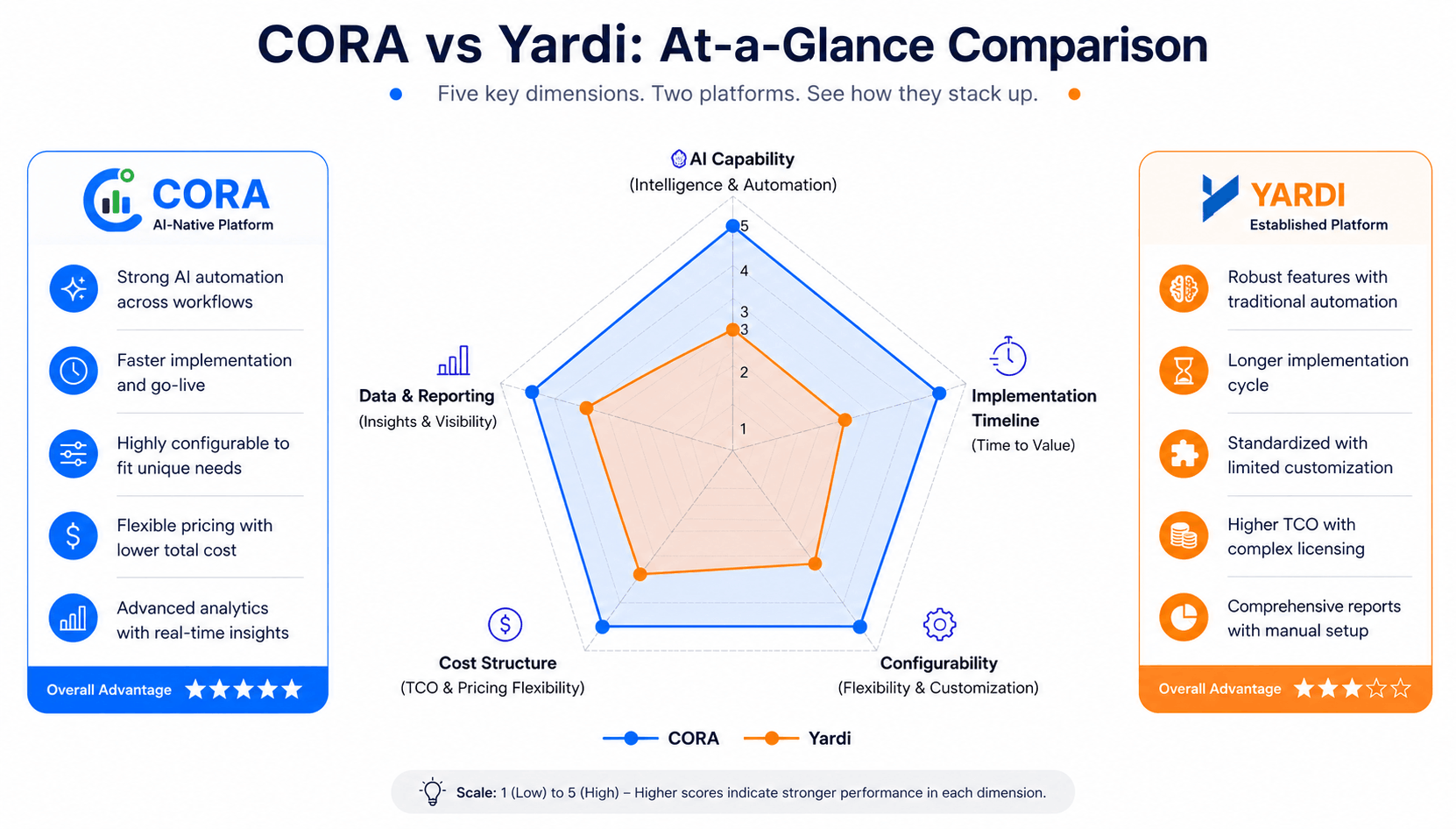
AI capability depth: Is AI a core part of the architecture, or an add on module purchased separately?
Implementation timeline: How long from contract signing to a fully operational system across your portfolio?
Configurability versus simplicity: Highly configurable systems take longer to set up but can match very specific workflows.
Cost structure: Licensing, implementation, and ongoing support costs, and how they scale with portfolio size.
Data and reporting model: Real time dashboards versus scheduled report generation.
Enterprise asset management teams evaluating platforms for large, multi building portfolios typically weight configurability and reporting depth most heavily, while smaller and mid sized operators tend to weight implementation speed and total cost of ownership more heavily.
Dimension | CORA | Yardi (Voyager/Breeze) | Best Fit For | Typical Consideration |
AI Capability | Native, predictive maintenance and automation built in | Available via add on AI modules | CORA fits teams wanting AI first workflows | Depth of AI depends on module tier selected in Yardi |
Implementation Timeline | Weeks for most portfolios | Months for Voyager, faster for Breeze | Smaller and mid size portfolios often prefer CORA speed | Voyager depth requires longer configuration |
Configurability | Streamlined, opinionated workflows | Highly configurable, extensive module options | Large complex portfolios may prefer Yardi flexibility | More configuration means more setup time |
Cost Structure | Predictable, bundled AI capability | Modular pricing, AI features often priced separately | Budget conscious teams should model total module cost for Yardi | CORA reduces the risk of surprise add on costs |
Data and Reporting | Real time dashboards | Scheduled and on demand reporting via Voyager modules | Portfolios needing live operational visibility lean CORA | Yardi's reporting depth suits complex institutional needs |
Samta.ai's engineering team builds CORA deployments on top of the same enterprise grade cloud infrastructure used across our broader AI work, including Microsoft and Snowflake integrations where clients already have that stack in place. You can review CORA's full capability set on the CORA AI driven property management software product page, and our proptech AI consulting services page covers how we scope a migration or new deployment before implementation begins.
Is Your AI Model Exposed to Hidden Risks?
Real World Enterprise Use Cases
Regulated and institutional: A REIT evaluating reporting requirements. A Singapore listed REIT needed real time occupancy and maintenance visibility across its portfolio for investor reporting purposes, alongside audit ready documentation for its asset managers. The deciding factor was not feature count but how quickly discrepancies between projected and actual maintenance costs could be surfaced to the finance team. Full platform detail sits on our CORA property management platform page.
General enterprise: A mid sized commercial landlord consolidating multiple buildings. A landlord operating a dozen mixed use buildings needed to replace a patchwork of spreadsheets and a legacy system with a single platform. The priority was fast implementation over deep configurability, since the team lacked the internal resources to manage a months long rollout. Comparable deployment timelines and outcomes are detailed in our case studies. Both cases illustrate that the right platform choice depends on what your team actually optimizes for: audit depth and configurability, or speed and predictive automation.
Key Risks And Failure Modes In Platform Selection
Underestimating implementation time: Enterprise grade Yardi Voyager deployments can take several months to configure fully, and teams that plan for a shorter timeline often face delays that ripple into budget and staffing plans.
Treating AI as a checkbox feature: Gartner's research on enterprise technology adoption consistently finds that AI works best embedded in workflows, not bolted on as a separate module.
Underbudgeting for module costs: Modular systems can look cost effective at the base tier, but AI, reporting, and integration modules often carry separate licensing costs that are easy to miss during initial evaluation.
Choosing configurability you will never use: Highly configurable systems carry setup and maintenance overhead. Portfolios that do not need deep customization pay a time and cost penalty for flexibility they never exercise.
Decision Framework: When To Choose CORA, When To Choose Yardi
Use this checklist to match the platform to your portfolio.
Is your portfolio large and highly complex with specialized reporting needs across many stakeholders? Yardi Voyager's depth may justify the longer implementation.
Do you need AI capability, such as predictive maintenance, live from day one rather than as a future add on? CORA is built for this from the ground up.
Is speed to operational value more important than maximum configurability? Faster implementation timelines generally favor CORA.
Do you already operate on Microsoft or Snowflake infrastructure? Both platforms can integrate, but confirm the specific data plumbing before committing.
For teams needing broader operational automation beyond property management specifically, our workflow automation consulting services page and digital transformation managed services page outline how a wider automation layer can sit around either platform choice.
Ready to Turn AI Strategy into Business Results?
Conclusion
Choosing between CORA and Yardi comes down to whether your portfolio needs deep, decades tested configurability or fast, AI native automation from day one. Neither platform is universally better. The right choice depends on portfolio size, reporting complexity, and how much implementation time you can realistically absorb.
About Samta
Samta.ai is a Singapore-headquartered AI Product Engineering & Data Intelligence partner helping enterprises build production-grade AI systems for regulated and data-intensive environments.We help organizations move beyond experimentation by engineering scalable, explainable, and enterprise-ready AI solutions from data foundations and model development to workflow automation and deployment.
Our capabilities combine deep AI expertise, data engineering, and product engineering to deliver measurable business impact across FinTech, BFSI, cybersecurity, regulatory technology, and enterprise operations.
Our enterprise AI products power real-world intelligence systems:
• TATVA : AI-driven data intelligence platform for governed analytics, monitoring, and operational insights
• VEDA : Explainable and audit-ready AI decisioning engine built for compliance-sensitive enterprise workflows
• CORA-Property Management Solutions: : Predictive intelligence platform for real-estate pricing, portfolio optimization, and investment analytics
Backed by ecosystem partnerships with Microsoft, Databricks, Snowflake, and AWS, Samta.ai delivers agile, cost-efficient AI engineering with faster turnaround and enterprise-grade scalability. Trusted by enterprises across FinTech, BFSI, and digital transformation initiatives, Samta.ai embeds AI governance, data privacy, and compliance-by-design principles directly into the AI lifecycle , enabling organizations to scale AI with transparency, accountability, and operational control.
Enterprises leveraging Samta.ai automate 65%+ of repetitive data, analytics, and decision workflows while maintaining governance, explainability, and measurable business outcomes. Samta.ai provides the strategic consulting, AI engineering, and data modernization expertise needed to align enterprise operations with next-generation AI transformation goals.
FAQ
What is the main difference between CORA and Yardi?
CORA was built with AI as a core part of its architecture, while Yardi's AI capability sits on top of a modular system originally designed around accounting and leasing workflows built over four decades.
Is CORA a good yardi alternative singapore teams should consider?
Yes, particularly for portfolios that want predictive maintenance and automated tenant workflows without a lengthy configuration process. Larger institutional portfolios with highly specific reporting needs may still find Yardi's configurability a better fit. Our list of leading proptech consultants covers how to evaluate implementation partners for either platform.
How does ai property management vs yardi implementation time compare?
CORA deployments typically complete in weeks for most portfolios, while Yardi Voyager implementations for large, complex portfolios can take several months due to the depth of configuration available.
What does property management ai software actually predict?
Predictive capability typically covers maintenance needs before equipment failure, tenant churn risk, and occupancy trends. Our guide on seven ways AI predicts property outcomes breaks down these use cases in detail.
How do I evaluate total cost between the two platforms?
Model licensing, implementation, and module costs together rather than comparing base tier prices alone, since AI and reporting modules are often priced separately in modular systems like Yardi. Singapore specific engineering and integration considerations are covered in our page on enterprise AI engineering in Singapore.