
Summarize this post with AI
A credit scorecard that performs well in development validation but fails MAS examination is not a model risk problem. It is a governance documentation problem, and it costs Singapore banks more to remediate than the original validation would have cost to do correctly. MAS model risk expectations for credit scoring models have become materially more specific since 2023, requiring validation evidence that most internal model risk teams were not producing as standard practice. This guide gives model risk officers, Chief Risk Officers, and AI governance leads at Singapore banks the complete 2026 framework for credit scorecard validation that satisfies MAS TRM, FEAT, and model risk management expectations before examination, not during remediation.
Credit Scorecard:
A credit scorecard in Singapore BFSI is a statistical or machine learning model that assigns a numerical score to a loan applicant based on financial, behavioural, and alternative data signals, which the institution then maps to a credit decision, pricing tier, or risk classification. Under MAS Technology Risk Management guidelines and the model risk management framework applicable to Singapore financial institutions in 2026, every production credit scorecard must have: an independent validation report, a model card documenting purpose and limitations, documented data lineage from source to training and inference, explainability output at the individual decision level, and continuous drift monitoring with defined alerting thresholds. AI model governance banking expectations have shifted from policy alignment to engineering evidence, meaning institutions must demonstrate these controls exist in the technical infrastructure, not just in policy documents.
What Is a Credit Scorecard and Why MAS Governance Applies
A credit scorecard is a quantitative model used by banks and financial institutions to evaluate the creditworthiness of loan applicants. Traditional scorecards use logistic regression with Weight of Evidence encoded variables. Modern scorecards increasingly use gradient boosting, random forest, or neural network architectures that improve predictive accuracy but introduce explainability and governance challenges that simpler models did not have. AI in BFSI for credit decisioning covers the full spectrum from rules based scorecards through traditional statistical models to ML based credit risk models. MAS model risk expectations apply to all categories, but the governance requirements for ML based scorecards are substantially more demanding than for traditional statistical models because:
ML models are less inherently interpretable, requiring engineered explainability infrastructure rather than coefficient based explanation. ML models are more prone to feature drift when the economic environment changes, requiring more rigorous drift monitoring. ML models trained on historical data can embed and amplify biases in ways that statistical models expose more visibly through their coefficient structure. AI model risk management for credit scorecards therefore requires a governance layer that was not standard practice for traditional scorecard development, and this is precisely the gap MAS examinations are now identifying at Singapore financial institutions. Review model validation in BFSI for the specific validation evidence MAS examiners are requesting at the model level, not just the policy level.
Start Your AI Transformation with a Free Assessment
Why Credit Scorecard Governance Is More Consequential in 2026
Three regulatory and market developments have changed the stakes:
1. MAS TRM examinations now inspect at the individual model level
MAS Technology Risk Management examinations in 2025 and 2026 have moved from enterprise level AI governance policy review to individual model level documentation inspection. Examiners are requesting model cards, independent validation reports, and drift monitoring records for specific named production models, not for the AI program overall (Source Required: MAS Technology Risk Management Guidelines).
2. FEAT explainability requirements apply to every credit decision
The FEAT principles require that every consumer facing credit decision made by an AI model can be explained at the individual applicant level using the specific factors that contributed to the score. Aggregate model explainability (SHAP feature importance at the population level) does not satisfy FEAT. Individual applicant level explanation is required and must be producible on demand.
3. Agentic AI in BFSI is introducing new credit model risk categories
Agentic AI in BFSI for credit decisioning, where AI agents autonomously gather additional applicant data, request clarifications, and update credit scores in real time, introduces new model risk categories that traditional credit scorecard governance frameworks do not address: action audit trails for every agent step, human in the loop escalation path documentation, and tool call logging for every external data source the agent queries.
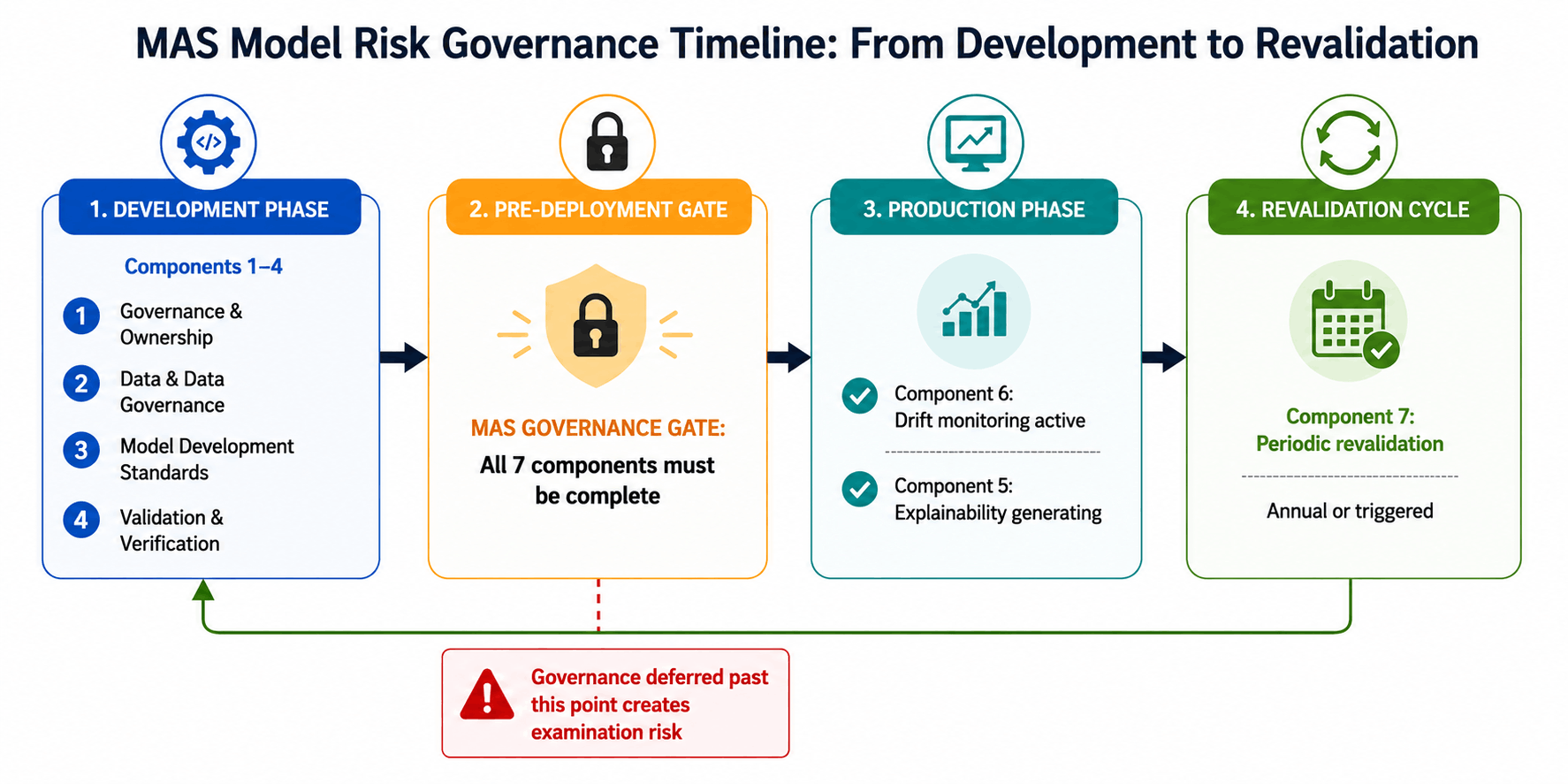
The 7 Component Credit Scorecard Validation Framework for MAS Compliance
Component 1: Model Inventory Registration
Every production credit scorecard must be registered in a formal model inventory with: model name and version, purpose and intended use, risk classification (high, medium, or low based on decision impact and data sensitivity), development team, and validation status. MAS examiners ask for the model inventory as the first documentation request in a model risk examination. Institutions without a complete, current inventory cannot demonstrate that their governance framework covers all production models, which is itself a finding.
Component 2: Development Documentation
The development documentation for a credit scorecard must cover: business objective and intended decision use, data sources and preparation methodology, variable selection rationale, model architecture and hyperparameter selection, training and validation dataset construction, and performance metrics across the full development lifecycle. AI model governance banking requires this documentation to be produced during development, not reconstructed after deployment. Reconstructed documentation is consistently less complete and less credible than contemporaneous records.
Component 3: Independent Validation
Independent validation must be conducted by a team or individual with no involvement in model development. The validation report must cover: replication of development results on holdout data, out of time validation on data post the training period, stress testing under adverse economic scenarios, sensitivity analysis on key variables, and assessment of model limitations and appropriate use conditions. Principles of AI governance and model risk management consistently require this independence: self validation by the development team does not satisfy MAS model risk management standards regardless of the quality of the validation methodology applied.
Component 4: Data Lineage Documentation
Every data source feeding the credit scorecard at training time and inference time must be documented with: source system name, data extraction date and methodology, preprocessing and transformation steps applied, consent basis under PDPA for personal data, and quality checks performed. Samta.ai's data integration consulting services implement data lineage tracking on Databricks and Snowflake that produces examination ready lineage documentation automatically rather than requiring manual reconstruction from development notebooks.
Component 5: FEAT Explainability Infrastructure
Every individual credit decision made by the scorecard must be accompanied by an applicant level explanation identifying the top factors contributing to the score and the direction of their influence. This explanation must be: Accurate at the individual level, not just at the population level. Producible on demand for any historical decision within the retention period. Expressed in terms that are meaningful to a non technical reader, not in raw SHAP values. The VEDA AI Decision Analytics Platform generates FEAT compliant individual decision explanations automatically for every credit scoring inference, storing them with the decision record for on demand retrieval during examination or customer dispute processes.
Component 6: Drift Monitoring and Alerting
Production credit scorecards must have automated monitoring for: Input drift: changes in the distribution of applicant features relative to the training data distribution. Score drift: changes in the distribution of model outputs, including population stability index tracking. Performance drift: degradation in model discrimination measured through Gini coefficient or KS statistic tracking on labelled outcome data. Alert thresholds must be defined and documented before production deployment, and escalation procedures must specify who receives alerts, what investigation is required, and under what conditions the model is suspended or retrained. Samta.ai's AI security and compliance services configure all three drift monitoring types on production credit scorecards as standard engagement components, not optional add ons.
Component 7: Periodic Revalidation
Production credit scorecards must be revalidated on a defined schedule, typically annually for standard risk models and more frequently when economic conditions change significantly. Revalidation reports must cover the same scope as initial validation and document any material changes to model performance since the prior validation. Review the complete guide to AI model risk for the full revalidation scope requirements that MAS model risk management framework expectations are increasingly applying to AI based credit models.
Credit Scorecard Governance:
Governance Component | No Governance | Policy Only | Partial Engineering | Full MAS Compliance | Samta.ai Implementation |
Model Inventory | None | List in spreadsheet | Partial, not current | Complete, risk tiered, current | Automated model registry with risk classification |
Independent Validation | None | Internal self review | External but incomplete | Independent, full scope, documented | Structured validation engagement with full report |
Data Lineage | None | Data dictionary only | Table level lineage | Column level automated lineage | Databricks or Snowflake with examination ready lineage |
FEAT Explainability | None | Population SHAP only | Score level summary | Individual applicant level, on demand | VEDA embedded individual explainability, stored per decision |
Drift Monitoring | None | Manual quarterly review | Single metric tracked | Input, score, performance drift automated | Three layer drift with threshold alerting and escalation |
Identify AI Governance Gaps with Confidence
Real World Use Cases
Use Case 1: Credit Scorecard Remediation, Singapore Retail Bank (BFSI)
A Singapore retail bank had four production credit scorecards with no independent validation reports, no individual level explainability output, and drift monitoring limited to a manual quarterly population stability index review. During a MAS technology risk examination, examiners requested independent validation reports for all four models and individual applicant level FEAT explanation records for a sample of recent decisions. None of the four models could produce individual applicant explanations on demand. The institution received formal remediation findings requiring resolution within 90 days. The retroactive remediation cost across all four models exceeded SGD 640,000, approximately 4.5 times the cost of building correct governance infrastructure during original model development. Explore AI governance for MAS compliance to understand the specific documentation standards MAS applies to credit models that would have prevented this finding.
Use Case 2: ML Credit Scorecard Deployment, Singapore Digital Bank (BFSI)
A Singapore digital bank building its first ML based credit scorecard embedded all seven governance components during the development phase rather than treating them as post deployment additions. Data lineage was tracked in Databricks from source to training dataset. Independent validation was scoped and budgeted as part of the development program. VEDA was deployed as the serving layer to generate individual FEAT compliant explanations for every decision. Drift monitoring was configured with defined thresholds before the first production loan decision. The scorecard passed MAS examination without remediation findings 8 months after production deployment. The total governance investment during development: SGD 185,000. The estimated cost of equivalent retroactive remediation had governance been deferred: SGD 550,000 to SGD 800,000 based on peer institution remediation benchmarks. Review AI model risk management for the governance investment sequencing that produced this outcome in practice and compare how VEDA performs against other data intelligence platforms for credit scorecard governance use cases.
Key Risks in Credit Scorecard Governance
Independent validation conducted by the development team: does not satisfy MAS model risk management framework independence requirements. Examiners ask specifically whether the validation team had any involvement in model development. Any involvement, including data preparation or variable selection input, disqualifies the validation from satisfying the independence requirement.
Population level FEAT explainability treated as individual level: is the most common FEAT compliance gap identified in MAS examinations. An institution that can explain why the average score for a demographic segment is lower cannot satisfy a customer who requests the specific factors that affected their individual application score.
Drift monitoring configured after an incident: rather than before deployment creates audit evidence that the institution was aware of the monitoring gap and chose not to address it proactively. Examiners treat post incident monitoring configuration less favourably than pre deployment monitoring configuration.
Model card documentation reconstructed post deployment: lacks the contemporaneous development evidence that makes it credible. Examiners distinguish between model cards produced during development and model cards reconstructed from notebooks and emails after an examination request. Both may contain the same information but carry different evidentiary weight.
Understand why AI governance for banking matters at the engineering layer, not just the policy layer, to avoid these failure modes in your current credit scorecard program.
Decision Checklist: Is Your Credit Scorecard MAS Examination Ready
Your credit scorecard is examination ready when:
A complete model inventory entry exists with current risk classification and validation status
An independent validation report exists covering out of time validation and stress testing
Data lineage is documented at the column level from source to training and inference
Individual applicant level FEAT explanations are generated and stored for every production decision
Three layer drift monitoring (input, score, performance) is active with defined alert thresholds
A periodic revalidation schedule is documented and the most recent revalidation report is current
Your credit scorecard has examination risk when:
Any production scorecard lacks an independent validation report
FEAT explainability is available only at the population or segment level, not the individual decision level
Drift monitoring is manual, periodic, or limited to a single metric
Data lineage exists only as a high level data flow diagram rather than column level automated tracking
Model cards were produced after deployment rather than during development
Consider enterprise AI engineering in Singapore to understand how the engineering infrastructure behind examination ready credit scorecards is built and maintained as an ongoing operational discipline rather than a one time compliance exercise.
Accelerate Your AI Journey with a Free Consultation

Conclusion
Credit scorecard governance in Singapore is no longer a documentation exercise. It is an engineering discipline that requires automated lineage tracking, individual level FEAT explainability infrastructure, three layer drift monitoring, and contemporaneous model card production as technical deliverables, not policy commitments. Institutions that embed these seven components during scorecard development consistently pass MAS examination without remediation findings. Those that defer governance to after deployment consistently fund expensive retroactive remediation programs under regulatory deadline pressure. The sequencing decision is made once per model. The cost of getting it wrong compounds across every examination cycle.
About Samta
Samta.ai is a Singapore-headquartered AI Product Engineering & Data Intelligence partner helping enterprises build production-grade AI systems for regulated and data-intensive environments.We help organizations move beyond experimentation by engineering scalable, explainable, and enterprise-ready AI solutions from data foundations and model development to workflow automation and deployment.
Our capabilities combine deep AI expertise, data engineering, and product engineering to deliver measurable business impact across FinTech, BFSI, cybersecurity, regulatory technology, and enterprise operations.
Our enterprise AI products power real-world intelligence systems:
• TATVA : AI-driven data intelligence platform for governed analytics, monitoring, and operational insights
• VEDA : Explainable and audit-ready AI decisioning engine built for compliance-sensitive enterprise workflows
• CORA-Property Management Solutions: : Predictive intelligence platform for real-estate pricing, portfolio optimization, and investment analytics
Backed by ecosystem partnerships with Microsoft, Databricks, Snowflake, and AWS, Samta.ai delivers agile, cost-efficient AI engineering with faster turnaround and enterprise-grade scalability. Trusted by enterprises across FinTech, BFSI, and digital transformation initiatives, Samta.ai embeds AI governance, data privacy, and compliance-by-design principles directly into the AI lifecycle , enabling organizations to scale AI with transparency, accountability, and operational control.
Enterprises leveraging Samta.ai automate 65%+ of repetitive data, analytics, and decision workflows while maintaining governance, explainability, and measurable business outcomes. Samta.ai provides the strategic consulting, AI engineering, and data modernization expertise needed to align enterprise operations with next-generation AI transformation goals.
Frequently Asked Questions
What is a credit scorecard and how does it differ from a general AI model in BFSI?
A credit scorecard is a model specifically designed to rank loan applicants by creditworthiness and map that ranking to a credit decision or pricing tier. It differs from general AI in BFSI models in its direct regulatory impact: every output drives a consumer credit decision that carries MAS fair dealing, PDPA, and FEAT explainability obligations. This makes credit scorecards the highest governance obligation category within the AI model risk management market for Singapore financial institutions.
What does MAS require for credit scorecard validation in 2026?
MAS AI risk management requirements for credit scorecard validation in 2026 include: independent validation by a team with no development involvement, out of time validation on data after the training period, stress testing under adverse economic scenarios, individual applicant level FEAT explainability producible on demand, automated drift monitoring for input, score, and performance dimensions, and data lineage documented at the column level from source to inference. These requirements apply to both traditional statistical scorecards and ML based credit models.
What is the model risk management framework for Singapore banks?
The model risk management framework for Singapore banks is defined by MAS Technology Risk Management guidelines, which require: a complete and current model inventory with risk classification, independent model validation, model cards documenting purpose and limitations, ongoing performance monitoring, and periodic revalidation on a defined schedule. For AI based models including credit scorecards, the framework extends to FEAT principle compliance and PDPA data lineage obligations that traditional statistical model governance frameworks did not address.
What are the principles of AI governance and model risk management for credit scoring?
Principles of AI governance and model risk management for credit scoring cover five core requirements: accountability (named model owner accountable to the CRO), transparency (individual applicant level explainability for every decision), fairness (FEAT assessment documenting disparate impact analysis across protected characteristics), accuracy (independent validation and ongoing drift monitoring), and auditability (tamper evident audit trails for every inference stored for the MAS required retention period).
What is the governance model for AI credit scorecards in Singapore BFSI?
The governance model for AI credit scorecards in Singapore BFSI assigns responsibility across three lines of defense: the model development team (first line) owns development documentation, model cards, and monitoring configuration; model risk management (second line) owns independent validation, risk classification, and revalidation scheduling; and internal audit (third line) assesses whether governance controls are operating effectively and whether documentation is current and accurate.