
Summarize this post with AI
The Databricks State of Data and AI 2026 Report found that 71 percent of data engineering teams are now explicitly tasked with building AI-ready infrastructure, up from 31 percent in 2023. Organizations that built this capability proactively are deploying AI at three times the rate of those still working from analytics-era stacks. The data engineering consulting vs in-house team decision is therefore not just a headcount question in 2026; it is a strategic infrastructure decision that determines whether your AI program deploys in months or stalls for years. Getting it wrong costs more than the hiring or engagement itself. This guide gives CIOs the real cost numbers, an honest comparison of tradeoffs, and the three-question framework that correctly answers the data engineering consulting vs in-house team question for your specific program.
Data Engineering Consulting vs In-House Team:
According to Clutch's July 2026 IT Services Pricing Guide, US-based IT consulting firms typically charge $100 to $149 per hour, with average project engagements costing $120,776 more expensive on an hourly basis than a salaried employee, but often substantially less on a total-engagement basis. The decision is not which model costs less per hour; it is which model produces a production-grade, AI-ready data infrastructure faster given your specific constraints of timeline, data maturity, governance requirements, and available internal capability. Build in-house when the organization has a multi-year commitment, stable budget, executive sponsorship, and the time to recruit and onboard. Engage a consultancy when speed matters, when internal teams are missing senior expertise, or when an objective outside assessment of the current state is needed before any direction is set.
What Data Engineering Consulting Actually Delivers vs What In-House Teams Build
Build vs buy data engineering is not a binary choice between hiring and outsourcing. A comprehensive data engineering consulting engagement in 2026 spans six capability areas: architecture decisions, data governance and observability, AI-ready infrastructure including RAG pipelines and vector databases, MLOps, pipeline engineering, and analytics engineering. An in-house team delivers depth within your specific system landscape, institutional knowledge that consultants cannot replicate, and long-term ownership of the codebase. If data engineering is a core, ongoing, mission-critical function and you need someone embedded in team culture and systems for years, hiring makes sense. A full-time engineer builds institutional knowledge that a consultant cannot.
Outsourced data engineering team engagements deliver speed, senior expertise that is scarce to recruit, and a defined end-state rather than an open-ended headcount commitment. The enterprise data integration engineering guide covers what production grade integration infrastructure requires before either engagement model can deliver reliable outputs.
Discover Where Your Business Stands on AI Readiness
Why the CIO Decision Is More Consequential in 2026
Three forces make data engineering consulting vs in-house team a more impactful decision than in prior years.
1. AI program timelines are now the primary driver: MuleSoft's 2026 Connectivity Benchmark Report found 82 percent of IT leaders now cite data integration as one of the biggest barriers to using AI effectively. Every month of delay in building AI-ready data infrastructure is a month of delay in your AI program. Consulting can compress a 12-month hiring and onboarding cycle to an 8-week engagement start.
2. The Data Engineering as a Service market confirms the shift: According to Technavio (2025), the data engineering as a service market will reach $13.2 billion by 2026. That growth reflects a clear trend: organizations increasingly prefer to partner for data platform work rather than build the full capability internally, especially when the work is project-based rather than ongoing.
3. 75 percent of organizations still fail to move from proof of concept to enterprise scale: Deloitte's AI Infrastructure Survey found 75 percent of organizations still fail to move from proof of concept to enterprise scale regardless of the path, with governance frameworks embedded from day one delivering better compliance and adoption outcomes than those added after deployment. The right engagement model is the one that gets governance built in from the start, not the one with the lowest hourly rate. For CIOs specifically assessing the AI program enablement dimension of this decision, the data engineering ROI guide covers how to connect data infrastructure investment to board-level business case metrics, and the AI engineering team structure guide documents the team composition required to sustain AI-ready infrastructure after the initial build.
The Decision Framework: Step by Step
Use this three-question framework to correctly answer the build vs buy data engineering question for your program.
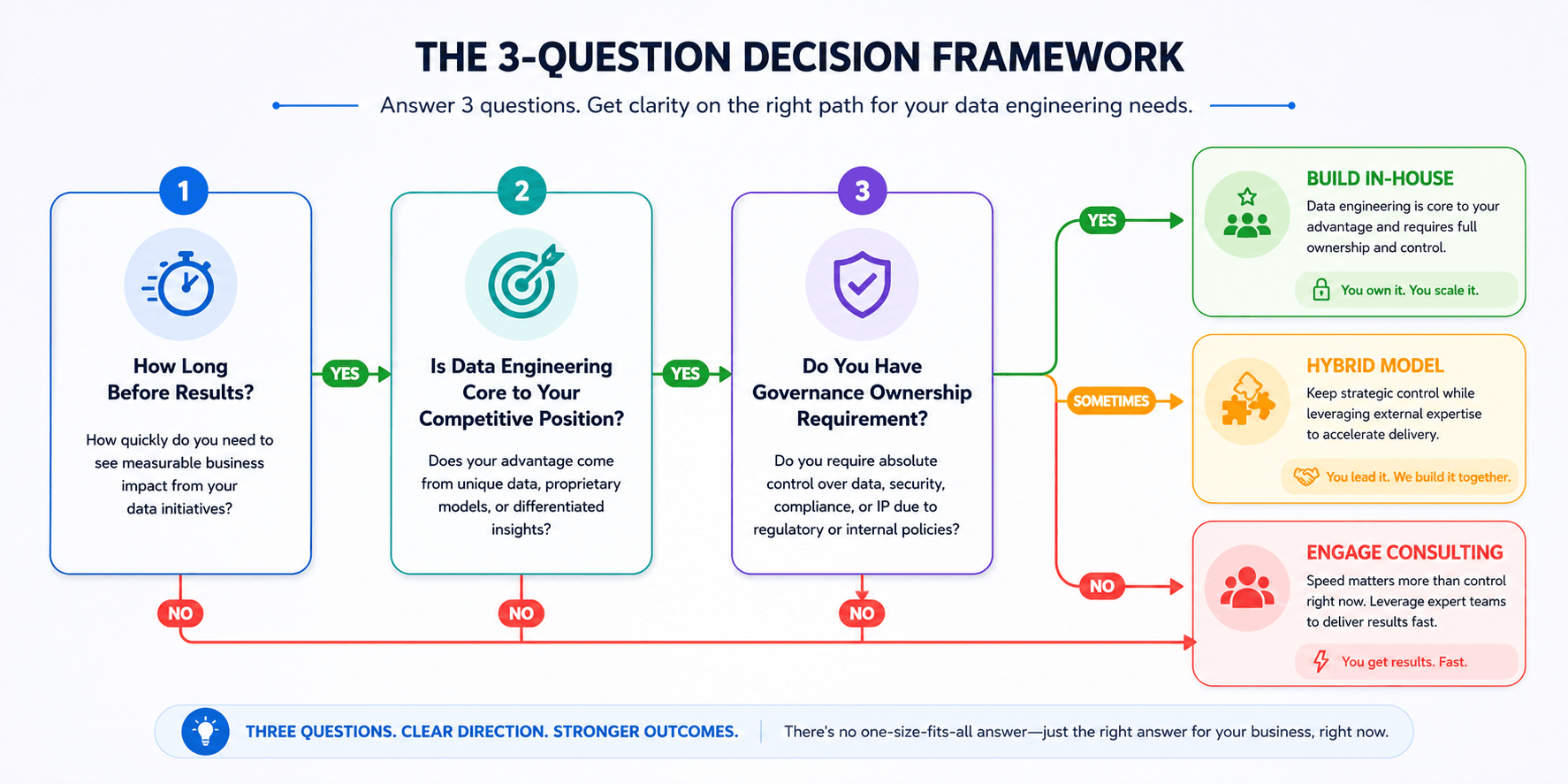
Question 1: How Long Before You Need Results?
Data engineering consulting services exist for a specific situation: when the problem is scoped, when you need results in weeks rather than months, or when you do not have the internal capacity to recruit and manage a new hire. In contrast, in-house hiring requires 4 to 6 weeks to recruit, 3 to 6 months to onboard before the hire produces reliable output, and management infrastructure to sustain the team during slower periods. You need at least four to six months before you need results, and you need to be prepared to carry that headcount permanently, including during slower periods, for in-house hiring to make sense.
Question 2: Is Data Engineering Core to Your Competitive Position?
CIOs should ask: are we buying intelligence, or are we buying standardization where our business actually needs specialization? For commodity workflows, the SaaS or consulting market wins decisively. For workflows that distinguish the business from competitors, buying has always been a compromise. For BFSI enterprises where data lineage, CDE governance, and AI model input traceability are regulatory requirements rather than competitive differentiators, consulting delivers the capability faster without requiring the institution to build specialist regulatory data engineering expertise permanently in-house. The how to hire data engineers guide covers the talent market constraints that make specialist BFSI data engineering capability particularly difficult to recruit internally.
Question 3: Do You Have the Governance Requirement to Own the Architecture?
For regulated enterprises, governance architecture must be owned internally even when the build is outsourced. External specialists help organizations build infrastructure and governance frameworks required to eventually manage AI development independently. Building internal AI capabilities requires hiring AI talent for sustainment, establishing a disciplined development lifecycle, and creating governance frameworks before deployment. This is precisely where the governed hybrid model emerges as the correct answer for most BFSI and regulated Singapore enterprises. Samta.ai's data integration consulting services are structured on this principle: every engagement includes formal knowledge transfer gates so internal teams own the governance documentation and production system, with Samta.ai providing the engineering acceleration layer on Databricks and Snowflake. The digital transformation managed services model extends this with post-delivery pipeline monitoring and drift management. The AI vs traditional dev companies comparison documents where AI-native consulting partners outperform traditional development firms for this type of engagement.
Data Engineering Consulting vs In-House: Full Comparison
Dimension | Full In-House Build | Data Engineering Consulting | Governed Hybrid | Best Fit | Key Risk |
Time to First Output | 4 to 6 months minimum (hiring plus onboarding ramp) | 4 to 8 weeks from engagement start | 6 to 10 weeks with knowledge transfer built in | Speed critical or regulated timeline: consulting or hybrid | In-house: AI program delays compound; consulting: knowledge concentration risk without transfer gates |
Cost Model | Average US data engineer salary $133,484; total compensation $171,131 at senior levels; add 20 to 30 percent for employer-side costs | $100 to $149 per hour; average project engagement $120,776 | Lower than full in-house Year 1; higher than project-only consulting | Budget under $500K with defined scope: consulting or hybrid | Both models have hidden costs; in-house misses attrition; consulting misses integration overruns |
Governance and IP Ownership | Full internal control of codebase and documentation | Risk of knowledge concentration without transfer gates; governance requires explicit contractual clauses | Strongest overall; internal team owns governance, consulting team owns build acceleration | Regulated industries (BFSI, healthcare): hybrid or in-house for governance layer | Outsourcing governance to a consultant creates audit exposure in MAS-regulated contexts |
Specialist Expertise Access | Limited by talent market; 77 percent of companies report lacking critical data skills | Immediate access to MLOps, vector store, streaming architecture expertise that is scarce to recruit | Senior expertise available during build; knowledge transferred to internal team post-delivery | MLOps, AI-ready infrastructure, RAG pipelines: consulting or hybrid | In-house teams frequently lack the specialist profile needed for AI-ready infrastructure builds |
Three-Year Total Cost | Gap versus consulting narrows in Year 2 to 3 as consulting fees accumulate; in-house wins at sustained, high-velocity data work | Gap closes in Years 2 to 3; most pipeline architectures need re-design within 2 to 3 years anyway | Most cost-predictable at three-year horizon for regulated enterprise programs | Long-term, core competency: in-house; scoped modernization: consulting; regulated governance: hybrid | Vendor lock-in at the architecture layer is the primary three-year risk for pure consulting |
Understand Your AI Risk Exposure Before It Becomes a Business Risk
Enterprise Use Cases: How CIOs Apply This Framework
Use Case 1: Singapore Bank Choosing Governed Hybrid for Data Lakehouse Migration
A Singapore bank's CIO needed a Databricks lakehouse migration completed within 10 months to satisfy MAS AI governance requirements for an upcoming credit decisioning AI deployment. A full in-house build was ruled out by the hiring timeline. Pure consulting was ruled out by the governance ownership requirement the bank needed its internal data team to own the production system, not be dependent on a vendor for every change request. The governed hybrid model was selected: Samta.ai built the data pipeline architecture and migration on Databricks, while the bank's internal risk and compliance team owned the CDE governance documentation, lineage standards, and audit trail structure throughout the engagement. The in-house AI engineering guide was used to benchmark the internal team's capability requirements for post-delivery ownership. The engagement completed in 11 months at approximately 40 percent lower Year 1 cost than an equivalent full in-house build. The Veda AI decision analytics platform was deployed as the decision analytics layer on top of the completed lakehouse.
Use Case 2: Technology Enterprise Using Pure Consulting for AI-Ready Pipeline Build
A Singapore technology company had no existing data engineering team and needed an AI-ready data infrastructure built within one quarter for a customer analytics initiative. The use case qualified for pure consulting: no regulatory governance requirement, defined scope, clean data sources, and speed as the primary constraint. The engagement followed a phased approach: 2 to 4 weeks strategy phase producing a technical design document and cost model, followed by implementation with explicit checkpoints at each gate to validate whether the direction still made sense given what the team had learned. The pipeline was delivered on Snowflake within 12 weeks with full knowledge transfer documentation. The company hired one internal data engineer post-delivery to own pipeline monitoring and extension, consistent with the enterprise data integration engineering guide recommendation to internalize operations after the initial build is complete.
Key Risks and Failure Modes
No knowledge transfer gates in the consulting contract: Consulting engagements without explicit knowledge transfer milestones leave the enterprise dependent on the vendor for every change request post-delivery. Knowledge transfer must be a contractual deliverable, not a verbal commitment at project kickoff.
Hiring without governance infrastructure in place: You already have a technical team that can onboard, manage, and develop a new engineer before hiring makes sense. An internal hire dropped into an environment without data governance infrastructure, clear architecture standards, or a defined data roadmap produces undirected work, not a governed data foundation.
Treating hourly rate as the total cost comparison: On an hourly basis, consulting is more expensive than a salaried employee. On a total-engagement basis, it is often substantially less, because it avoids the employer-side costs, onboarding ramp, and permanent headcount that a hire requires. Model the full three-year comparison, not the headline price.
Missing the AI-readiness requirement in the architecture brief: Most enterprise data stacks were built to answer yesterday's questions in a BI dashboard. They were not built to feed real-time AI inference, RAG pipelines, or agent-orchestrated workflows. Consulting engagements that build a traditional data warehouse rather than an AI-ready lakehouse will require a re-architecture within 18 to 24 months.
Decision Framework: Which Model Is Right for Your Program?
You need results within 4 to 8 weeks and cannot afford a 6-month hiring ramp → consulting or hybrid
Data engineering is a core, ongoing, mission-critical function you will sustain permanently → in-house
You are a regulated enterprise (BFSI, healthcare) requiring governance documentation owned internally → governed hybrid
You lack the senior MLOps, streaming, or AI-ready infrastructure expertise to hire immediately → consulting or hybrid
You have a multi-year commitment, stable budget, and executive sponsorship to sustain a team → in-house
Knowledge transfer milestones are contractually committed before any consulting engagement is signed → any model is defensible
If fewer than four boxes are clearly resolved, the build versus consult decision is not yet ready to take to the board.
Explore the Right Strategy for Your Business
Conclusion
data engineering consulting vs in-house team in 2026 resolves to a governed hybrid for most regulated enterprises: consulting provides the speed and specialist expertise that the talent market cannot supply in time; internal governance ownership provides the audit trail and regulatory documentation that cannot be delegated. The data engineering market is set to double to $187 billion by 2030, yet 40 percent of pipelines still fail weekly. The organizations that get the build versus consult decision right are the ones that define governance ownership before signing any engagement, not after the pipeline is already running.
About Samta
Samta.ai is a Singapore-headquartered AI Product Engineering & Data Intelligence partner helping enterprises build production-grade AI systems for regulated and data-intensive environments.We help organizations move beyond experimentation by engineering scalable, explainable, and enterprise-ready AI solutions from data foundations and model development to workflow automation and deployment.
Our capabilities combine deep AI expertise, data engineering, and product engineering to deliver measurable business impact across FinTech, BFSI, cybersecurity, regulatory technology, and enterprise operations.
Our enterprise AI products power real-world intelligence systems:
• TATVA : AI-driven data intelligence platform for governed analytics, monitoring, and operational insights
• VEDA : Explainable and audit-ready AI decisioning engine built for compliance-sensitive enterprise workflows
• CORA-Property Management Solutions: : Predictive intelligence platform for real-estate pricing, portfolio optimization, and investment analytics
Backed by ecosystem partnerships with Microsoft, Databricks, Snowflake, and AWS, Samta.ai delivers agile, cost-efficient AI engineering with faster turnaround and enterprise-grade scalability. Trusted by enterprises across FinTech, BFSI, and digital transformation initiatives, Samta.ai embeds AI governance, data privacy, and compliance-by-design principles directly into the AI lifecycle , enabling organizations to scale AI with transparency, accountability, and operational control.
Enterprises leveraging Samta.ai automate 65%+ of repetitive data, analytics, and decision workflows while maintaining governance, explainability, and measurable business outcomes. Samta.ai provides the strategic consulting, AI engineering, and data modernization expertise needed to align enterprise operations with next-generation AI transformation goals.
Frequently Asked Questions
What is the real cost difference between data engineering consulting and hiring in-house?
The average US data engineer salary is $133,484 per year, with total compensation reaching $171,131 at senior levels, plus 20 to 30 percent for employer-side costs. Consulting engagements average $120,776 per project at $100 to $149 per hour. In-house wins at sustained, high-velocity, multi-year data work. Consulting wins for scoped modernization projects where speed to output matters more than long-term headcount economics.
When does an outsourced data engineering team make more sense than hiring?
Consulting is the faster and often more cost-effective path when the problem is scoped, when you need results in weeks rather than months, or when you do not have the internal capacity to recruit and manage a new hire. For regulated enterprises that need an AI-ready data foundation to unlock an already-approved AI program, the 4 to 6 month hiring ramp represents an unacceptable delay.
What are software engineering outsource models for data engineering specifically?
Software engineering outsource models for data engineering include project-based fixed-scope engagements (defined deliverable, defined timeline), ongoing retainer models (monthly access to a consultant team for strategy and architecture), staff augmentation (individual contractor embedded in your team), and managed services (the consulting firm operates the production data infrastructure post-delivery). The right model depends on whether the data engineering need is periodic and project-based, or continuous and operational.
What is the governed hybrid model and why do most Singapore BFSI CIOs choose it?
The governed hybrid model is a structured engagement where the consulting partner builds the data infrastructure acceleration layer pipelines, platform migration, AI-ready architecture while the enterprise's internal team owns governance documentation, audit trail architecture, and operational standards from day one. For Singapore BFSI enterprises, MAS audit requirements mean governance documentation cannot be delegated to a vendor, making pure consulting an incomplete answer for regulatory contexts.
What are outsource product data management risks specific to data engineering?
Outsource product data management risks in data engineering include: knowledge concentration in the vendor team without formal transfer gates; architecture decisions optimized for the vendor's preferred stack rather than the enterprise's long-term roadmap; governance documentation that exists only in the vendor's systems rather than the enterprise's internal records; and vendor lock-in at the pipeline layer that creates negotiating exposure at contract renewal.