
Summarize this post with AI
Many procurement teams assume that does buying ai vendor transfer compliance obligation is a question with a comforting answer, that a vendor's own compliance certifications somehow become the institution's compliance posture once the contract is signed. It does not work that way, and MAS has said so directly across both its outsourcing guidelines and its proposed AI Risk Management Guidelines. Buying an agentic AI product, whether it handles onboarding, KYC checks, or another autonomous workflow, does not shift accountability away from the financial institution using it. The vendor builds the technology. The institution still owns the risk.
Does Buying AI Vendor Transfer Compliance Obligation:
Does buying ai vendor transfer compliance obligation? No. MAS's existing Guidelines on Outsourcing state plainly that a board and senior management cannot delegate responsibility to a service provider, and the institution remains ultimately responsible and accountable for managing the risks of any outsourcing arrangement. The proposed AI Risk Management Guidelines extend this same principle to agentic AI specifically, requiring institutions to conduct due diligence, maintain oversight, and hold documentation covering a vendor's AI product, regardless of who built the underlying technology.
What agentic AI vendor accountability actually means under MAS
Agentic ai vendor accountability mas expects is not a new concept invented for AI, it is the same principle MAS has applied to outsourcing for years, extended to cover autonomous systems specifically.
The institution retains ultimate accountability. Whether the AI is built internally or licensed from a vendor, the institution using it to make or support a regulated decision remains responsible for the outcome.
Due diligence is the institution's job, not the vendor's marketing claim. A vendor stating its product is compliant is not the same as the institution having assessed and documented that compliance for its own specific use case.
Agentic systems raise the stakes further. An agent that can act autonomously, initiating a KYC decision or flagging a transaction, needs oversight and escalation controls the institution defines, not ones the vendor assumes are sufficient by default.
Our guide on what an AI model actually is and how that differs from an autonomous agent, and our companion piece on when AI acts alone, both cover the technical distinction that makes agentic accountability harder to delegate than a simple static model.
Turn AI Readiness Into a Clear Action Plan
Why this misconception is common, and costly, in 2026
Ai vendor compliance obligation singapore institutions face has become more visible for three reasons.
MAS is replacing its outsourcing guidelines with broader third party risk guidelines. A March 2026 consultation proposes Third Party Risk Management Guidelines that will supersede the existing Outsourcing Guidelines for banks and other financial institutions, widening scope from just outsourcing to any third party arrangement.
The AIRG consultation names third party AI explicitly. Institutions procuring AI, not only building it, fall inside scope, and our guide on whether MAS AIRG applies to AI you buy covers this in more depth.
Agentic AI vendor products are proliferating faster than institutions can assess them. Agentic AI for business processes like onboarding, KYC, and fraud triage is being adopted quickly, often before a formal vendor risk assessment framework catches up.
Our third party AI risk guide covers the broader vendor discovery exercise most institutions still need to run before they can even answer this question accurately for their own AI footprint.
The vendor AI accountability framework
Retaining accountability for a vendor's agentic AI product is a repeatable process, not a one time contract review.
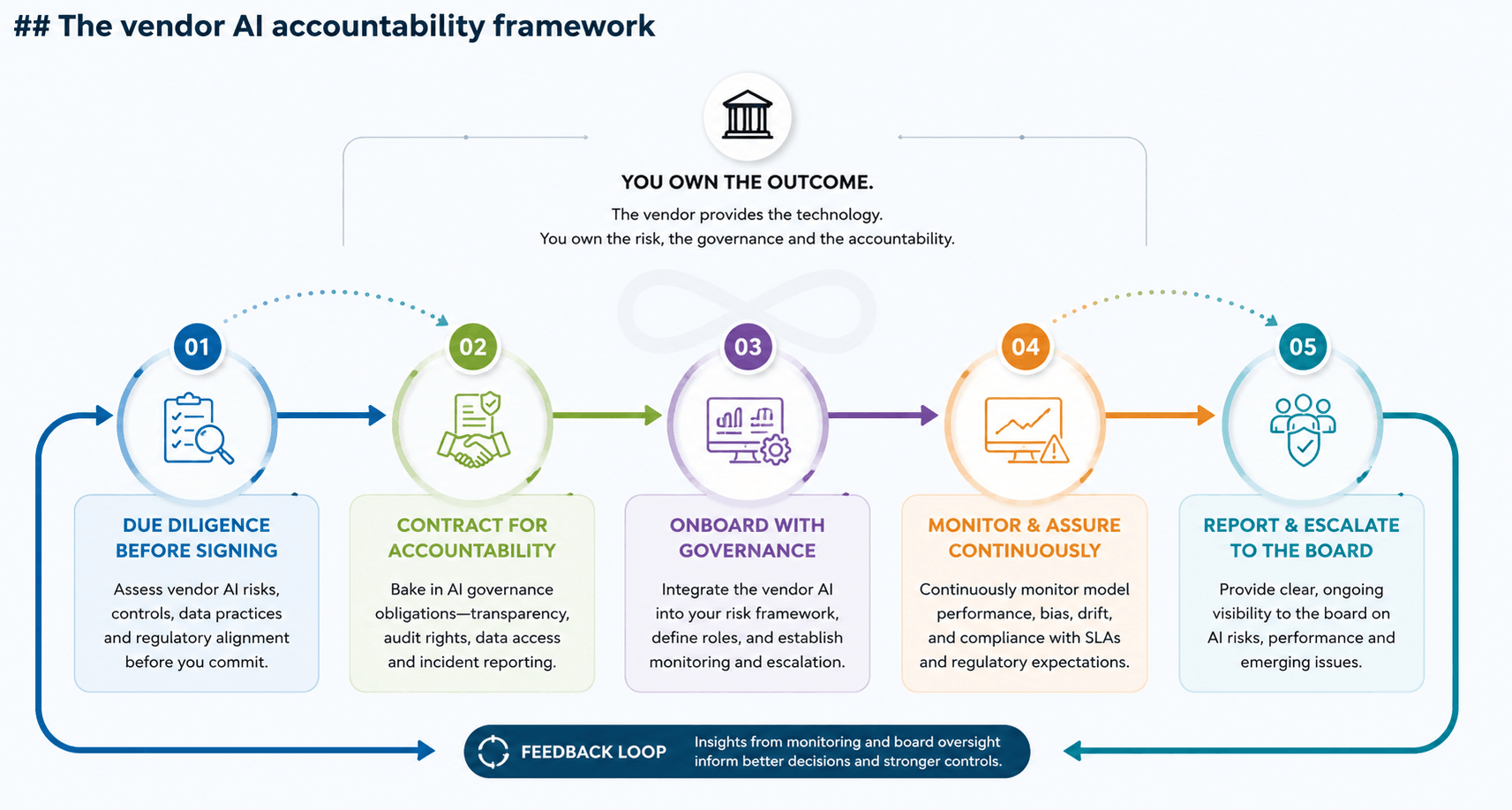
Run due diligence before signing, not after. Assess the vendor's transparency around data handling, model behavior, and fairness practices as part of procurement, not as a follow up task after go live.
Document why the vendor's AI is appropriate for your specific use case. A vendor's general compliance claims do not substitute for the institution's own assessment of fit for its regulated activity.
Define escalation and human oversight for autonomous actions. An agentic product that can act without a human in the loop needs an institution defined escalation path, not the vendor's default configuration left unreviewed.
Monitor vendor AI performance on an ongoing cycle. A vendor model updated or retrained after onboarding needs a fresh review, since the original due diligence no longer reflects the current system.
Maintain board level visibility into vendor AI risk. Senior management needs reporting on vendor AI performance the same way it would for an internally built model, not a lighter touch simply because the technology was purchased.
This is where the engineering execution layer matters. Samta.ai builds the VEDA AI decision analytics platform to track vendor AI accountability alongside internally built systems in one inventory, using ai model risk assessment methodology consistently across both sourcing types rather than treating vendor products as a lighter weight category by default. Institutions weighing whether a general analytics tool can hold this evidence should see how VEDA compares to other data intelligence platforms, and the VEDA platform itself is built around retaining this kind of vendor and internal evidence side by side.
Vendor arrangements and what the institution retains
Vendor Arrangement | What the Institution Retains | What the Vendor Provides | Documentation Needed | Common Misconception |
Fully outsourced agentic AI product | Full compliance accountability, oversight, and audit evidence | The technology, hosting, and day to day operation | Vendor due diligence file, service agreement, ongoing performance review | The vendor is regulated too, so the institution is covered |
Licensed AI software configured internally | Full compliance accountability plus configuration and monitoring evidence | The underlying model or platform | Configuration change log, internal testing records | A compliant product means compliant use by default |
Cloud hosted large language model API used to build an agent | Full compliance accountability for the agent's behavior | Underlying model access and infrastructure | Model version tracking, prompt and output monitoring logs | The cloud provider's security posture covers the institution's obligations |
White labeled AI embedded in a core system | Full compliance accountability, even if not marketed as AI | Whatever AI feature is bundled into the broader system | Discovery documentation identifying the embedded feature | It came with the system, so it is the vendor's responsibility |
Managed service where the vendor also operates the agent | Oversight, escalation authority, and final accountability | Operational execution and technical support | Board reporting on vendor performance, escalation procedures | Paying someone to run it means they own the compliance risk |
Benchmark Your AI Model Risk Readiness
Real world enterprise use cases
BFSI: a bank buying an agentic KYC onboarding product
A bank licensed an agentic AI product to automate customer onboarding and KYC checks, assuming the vendor's own compliance marketing meant the institution's due diligence obligation was satisfied. During an internal review, the bank found no documentation showing why the specific configuration was appropriate for its customer risk profile. Standing up a proper onboarding and KYC governance layer, supported by AI security and compliance services, closed that gap without requiring the bank to switch vendors. The underlying onboarding KYC platform now holds the due diligence and configuration evidence directly, rather than leaving it scattered across the vendor's own documentation and the bank's internal notes.
General enterprise: a proptech firm evaluating an AI powered lead qualification agent
A proptech firm evaluating a vendor's AI agent for lead qualification realized during procurement that its BFSI customers would eventually ask for evidence of oversight over any AI acting on their data, even indirectly. Reviewing enterprise AI engineering in Singapore helped the firm build a lightweight due diligence process ahead of that requirement appearing in a client audit.
Key risks and failure modes
Treating vendor certifications as institutional compliance. A vendor's own audit or certification speaks to the vendor's practices, not to whether the institution has assessed fit for its specific regulated use case.
No documented rationale for why a specific vendor product is appropriate. MAS examiners look for the institution's own due diligence record, not a copy of the vendor's marketing material.
Assuming agentic products need less oversight than static models. An agent that acts autonomously arguably needs more oversight, not less, since a static model's output at least waits for a human decision before anything happens.
No re assessment cadence for vendor AI after onboarding. A vendor updating its model without notifying the institution is common, and the institution's due diligence goes stale the moment that happens unmonitored.
No board visibility into vendor AI specifically. General vendor risk reporting rarely surfaces AI specific concerns like fairness testing or explainability unless it is asked for directly.
When to escalate a vendor AI accountability gap
Escalate immediately when:
An agentic AI vendor product can take autonomous action affecting a customer without a documented human escalation path
No due diligence record exists explaining why the vendor's product fits the institution's specific regulated use case
The vendor has updated or retrained its model since onboarding with no institutional re assessment
A standard review cycle is enough when:
Due diligence and fit for use documentation already exists and only needs a periodic refresh
The vendor AI tool is assistive rather than decision making, and oversight controls are already proportionate
Board reporting already includes vendor AI specific detail, not just general vendor performance metrics
Comparing an agentic KYC vendor product against traditional KYC processes is a useful exercise for institutions trying to work out where their own accountability gaps are likely to sit, since the oversight expectations differ meaningfully between the two approaches.
Find the Right AI Strategy for Your Business
Conclusion
Does buying ai vendor transfer compliance obligation? No, and institutions that treat a vendor contract as a compliance shortcut discover that gap during an examination, not before one. The accountability for an agentic AI product's behavior sits with the institution using it, the same way it always has for any outsourced arrangement, whether the technology is new or not.
About Samta
Samta.ai is a Singapore headquartered AI product engineering and data intelligence partner helping enterprises build production grade AI systems for regulated and data intensive environments. We help organizations move beyond experimentation by engineering scalable, explainable, and enterprise ready AI solutions, from data foundations and model development to workflow automation and deployment.
Our capabilities combine deep AI expertise, data engineering, and product engineering to deliver measurable business impact across FinTech, BFSI, cybersecurity, regulatory technology, and enterprise operations.
Our enterprise AI products power real world intelligence systems:
TATVA: AI driven data intelligence platform for governed analytics, monitoring, and operational insights
VEDA: Explainable and audit ready AI decisioning engine built for compliance sensitive enterprise workflows
CORA Property Management Solutions: Predictive intelligence platform for real estate pricing, portfolio optimization, and investment analytics
Backed by ecosystem partnerships with Microsoft, Databricks, and Snowflake, Samta.ai delivers agile, cost efficient AI engineering with faster turnaround and enterprise grade scalability. Samta.ai embeds AI governance, data privacy, and compliance by design principles directly into the AI lifecycle, enabling organizations to scale AI with transparency, accountability, and operational control.
Frequently asked questions
Does buying an agentic AI vendor product transfer compliance obligation to the vendor?
No. MAS's outsourcing guidelines and proposed AI Risk Management Guidelines both state that the institution retains ultimate accountability for any outsourced or vendor procured AI, regardless of who built the underlying technology.
What is agentic AI vendor accountability under MAS?
It refers to the institution's ongoing responsibility for due diligence, oversight, and documentation covering a vendor supplied AI agent, extending the same accountability principle MAS applies to traditional outsourcing arrangements to autonomous AI systems specifically.
Does a vendor's compliance certification satisfy the institution's own due diligence requirement?
No. A vendor's certification reflects the vendor's own practices. MAS expects the institution to separately document why that specific product is appropriate for its own regulated use case, customer base, and risk profile.
How is agentic AI vendor risk different from a licensed software product?
Agentic AI can act autonomously, initiating decisions or actions without waiting for human review, which raises the oversight bar compared to a static software tool that simply presents information for a human to act on.
What happens if a vendor updates its AI model after onboarding?
The institution's original due diligence no longer reflects the current system once a vendor updates or retrains its model, which is why ongoing monitoring, not a one time onboarding review, is the standard MAS expects institutions to meet.