
Summarize this post with AI
Most buyers pick assessment tools on features and price, then find the real costs later: weak evidence that the tests predict performance, candidate data stored somewhere nobody checked, and results that never reach the ATS. Hiring assessment software should be chosen on validity, integrity, data privacy, integrations, candidate experience, and total cost. This guide gives you a seven criteria checklist, the questions to ask every vendor, and a two week pilot plan.
Hiring Assessment Software:
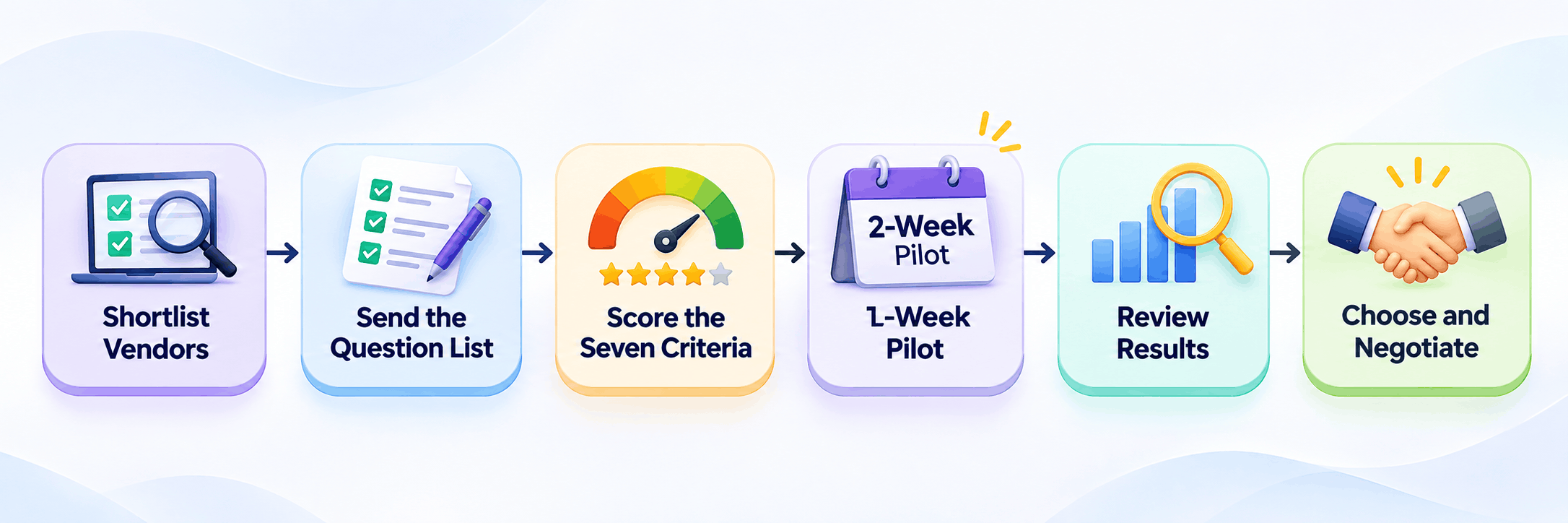
To choose assessment tools for hiring, score each vendor on seven criteria: validity, integrity, data privacy, integrations, candidate experience, reporting, and pricing. Ask for evidence on each one rather than accepting claims, and weight the criteria by the roles you hire for. In Singapore, confirm how candidate data is collected, retained, and shared under the PDPA, then run a short pilot on a real role before signing a contract.
What is assessment software for hiring?
Assessment software for hiring is a product that tests candidates against job related criteria before a hiring decision. It delivers tests, scores them, and reports results to recruiters and hiring managers. The market uses many names. Hiring assessment tools and recruitment assessment software describe overlapping products with different strengths.
Most products fall into a few test types.
Cognitive ability tests: reasoning, numeracy, and problem solving
Skills and job knowledge tests: role specific questions in a library
Coding and work samples: realistic tasks that mirror the job
Situational judgment tests: choices in realistic workplace scenarios
Personality and behavioural tools: work style and preferences
Many vendors bundle several types. For a roundup of options, see our list of the 8 best talent assessment platforms. For engineering roles in particular, our guide to the best technical assessment tools covers the coding focused end of the market.
Why it matters now
Choosing wrongly is expensive because assessments sit in the middle of the hiring funnel. A weak test rejects good candidates, and a leaky one lets weak candidates through. The evidence on methods is moderate but useful. In Sackett and colleagues' revised estimates, structured interviews show validity of 0.42, job knowledge tests 0.40, and work sample tests 0.33. No single method decides a hire, so ask vendors how their scores combine with other evidence.
Data rules matter too. The PDPC's advisory guidelines on selected topics include a chapter on employment, and earlier PDPC guidance states that recruitment agencies are subject to the PDPA's data protection provisions. That means purpose, retention, and access rights apply to candidate data. AI scoring adds another layer. The PDPC has also published advisory guidelines on personal data in AI recommendation and decision systems, which is relevant when a model ranks or scores candidates.
The category is changing quickly as vendors add AI. Our overview of the AI driven assessment platform explains how these products differ from older test libraries. For regulated enterprises, the broader context sits in our guide to enterprise AI transformation in Singapore.
Turn AI Ambition Into an Actionable Roadmap
The seven criteria checklist
Score every vendor on the same seven criteria, and ask for evidence on each.
Criterion | What to check | Evidence to request | Red flag | Why it matters |
Validity | Do scores relate to job performance? | Job analysis, validation studies, technical documentation | Only marketing claims or generic studies | Weak validity means poor hires |
Integrity | Can candidates cheat or share questions? | Proctoring options, plagiarism detection, question rotation | No controls or no explanation of how they work | Cheating undermines every score |
Data privacy and PDPA | How is candidate data handled? | Data processing terms, retention settings, hosting location, sub processor list | Vague answers on storage, retention, or deletion | Candidate data is personal data |
Integrations | Does it connect to your ATS and reporting? | Connector list, API documentation, export formats | Manual exports only | Manual copying erases time savings |
Candidate experience | Is it short, clear, and accessible? | Sample test, completion rates, accessibility statement | Long tests, poor mobile support | Strong candidates drop out |
Reporting | Can recruiters read the results? | Sample reports, benchmarks, score explanations | Opaque scores with no reasoning | Recruiters need to explain decisions |
Pricing | What is the total cost at your volume? | Written quote with limits, overage, and term | Per attempt fees that spike at volume | Surprise costs at scale |
Validity: does it predict the job?
Ask which job analysis the tests are based on, and how the vendor shows that scores relate to performance. A test built for your role family beats a generic one.
Be cautious of single numbers. A vendor that claims a very high accuracy figure should explain the study, the sample, and the outcome it measured.
Integrity: can scores be trusted?
Integrity covers plagiarism detection, question rotation, and options such as browser lockdown or proctoring. More controls can hurt candidate experience, so match them to the stakes of the role.
For technical hiring, our guide to technical screening tools explains how integrity controls fit into an agency workflow.
Data privacy: what happens to candidate data?
Assessment scores, answers, and any recordings are personal data when they identify a candidate. Ask where the data is stored, how long it is kept, who can see it, and how a candidate can request access or deletion.
Security evidence matters as well. Our overview of AI security and compliance services shows what a thorough review of a vendor's controls covers.
Integrations: does data reach your systems?
Check for your ATS, single sign on, and an export or API for results. Scores that sit in a separate dashboard get retyped, which erases the speed gain.
Joining assessment data with hiring outcomes also needs engineering work. Data integration consulting services often handle this, because the value comes from linking scores to later performance.
Candidate experience: will good people finish?
Ask for completion rates by role, average time to finish, mobile support, and accessibility features. A test that feels fair and relevant improves completion and your employer reputation.
Reporting and pricing
Reports should explain scores in plain language so a recruiter can brief a hiring manager. For pricing, ask for a written quote that shows limits, overage rules, contract length, and what happens if volume doubles.
Questions to ask every assessment vendor
What questions should I ask an assessment vendor? Use this list in every demo so answers are comparable.
Validity
Which job analysis are your tests based on?
What evidence shows scores relate to job performance for roles like ours?
How often are questions reviewed and updated?
Integrity
How do you detect plagiarism and shared answers?
Do you rotate questions, and how large is the question pool?
What happens when a candidate is flagged?
Data privacy
Where is candidate data stored, and who are your sub processors?
What is the default retention period, and can we change it?
How do you support access, correction, and deletion requests?
Integrations and reporting
Which ATS connectors are live today, not planned?
Can we export raw results through an API?
Can you show a sample report a recruiter would send to a hiring manager?
Candidate experience and pricing
What are typical completion rates and test durations?
Is the product accessible and usable on mobile?
What is the total cost at our volume, including overage and renewal terms?
Is there a single best tool?
There is no single best hiring assessment software, because the right choice depends on roles, volume, regions, and systems. A tool that suits high volume graduate hiring may fail for niche senior roles.
Use the checklist to build a shortlist of two or three vendors, then compare them on a real role. For a view of how a modern AI platform differs from older systems, read TATVA vs traditional hiring platforms.
Where the engineering sits
Assessment data becomes more valuable when it is kept and analysed. Results can be landed in a governed store such as Snowflake or Databricks and reported through Microsoft Power BI, which lets you test whether scores predict later performance. Samta.ai acts as the engineering execution layer for that work, and the TATVA platform is designed to provide structured results that feed it.
TATVA is Samta.ai's AI hiring assessment platform. Apply the same checklist to it as you would to any vendor, and confirm each answer in a demo.
Understand Your AI Model Risk Exposure
How to run a vendor demo and pilot
A hiring assessment software demo should prove fit on your own role, not on a sample. Run it as a short pilot.
Pick one role. Choose a role you hire for regularly, with a clear job description
Agree success measures. Examples include completion rate, time to shortlist, and recruiter confidence in the reports
Run the test. Have three to five current employees take it, then use it with a small group of candidates
Check the data path. Confirm that results reach your ATS and that retention settings match your policy
Collect feedback. Ask recruiters, hiring managers, and candidates what worked
Score the vendor. Rate each of the seven criteria with evidence, then decide
Real world use cases
These are illustrative scenarios based on common hiring patterns, not client results.
Regulated industry example. A bank hiring analysts and engineers in Singapore needs documented, consistent screening and clear handling of candidate data. The team uses the seven criteria as a procurement scorecard, requires written answers on retention and sub processors, and keeps the evidence for audit. The result is a vendor decision that can be explained to risk and compliance teams.
General enterprise example. A growing company hires several hundred people a year across many roles. It shortlists two tools, runs a two week pilot on its most common role, and chooses the one with better recruiter reports and ATS integration, even though the other had a bigger test library. Completion rates and recruiter time saved settle the decision.
Key risks and failure modes
Buying assessment software goes wrong in predictable ways.
Buying on library size. A huge question library is useless if it does not match your roles
Accepting validity claims. Without documentation, accuracy figures are marketing
Ignoring data handling. Unclear retention and sub processor practices create compliance risk
No ATS integration. Manual copying wastes the time the tool was meant to save
Over proctoring. Heavy controls can drive strong candidates away
Skipping a pilot. Demos hide setup effort and candidate drop off
Contract surprises. Overage fees and long terms inflate cost at scale
When to buy, and when to wait
Buy now when:
You hire often for similar roles and need consistent screening
Recruiters spend hours on manual first round checks
You can name the roles and success measures for a pilot
Your ATS and data policies are clear enough to test integration
Wait or fix foundations first when:
Job descriptions are vague, so fix those first
You hire only a few times a year, where structured interviews may be enough
No one owns the process or will review the results
Ready to Build a Smarter AI Strategy?
Conclusion
The best choice is the vendor that gives evidence, not promises. Score validity, integrity, data privacy, integrations, candidate experience, reporting, and pricing, then prove the result on a real role in a short pilot. Keep the written answers for your records. To see how a connected platform fits this process, explore Samta.ai and its TATVA platform.
About Samta
Samta.ai is a Singapore-headquartered AI Product Engineering & Data Intelligence partner helping enterprises build production-grade AI systems for regulated and data-intensive environments.We help organizations move beyond experimentation by engineering scalable, explainable, and enterprise-ready AI solutions from data foundations and model development to workflow automation and deployment.
Our capabilities combine deep AI expertise, data engineering, and product engineering to deliver measurable business impact across FinTech, BFSI, cybersecurity, regulatory technology, and enterprise operations.
Our enterprise AI products power real-world intelligence systems:
• TATVA : AI-driven data intelligence platform for governed analytics, monitoring, and operational insights
• VEDA : Explainable and audit-ready AI decisioning engine built for compliance-sensitive enterprise workflows
• CORA-Property Management Solutions: : Predictive intelligence platform for real-estate pricing, portfolio optimization, and investment analytics
Backed by ecosystem partnerships with Microsoft, Databricks, Snowflake, and AWS, Samta.ai delivers agile, cost-efficient AI engineering with faster turnaround and enterprise-grade scalability. Trusted by enterprises across FinTech, BFSI, and digital transformation initiatives, Samta.ai embeds AI governance, data privacy, and compliance-by-design principles directly into the AI lifecycle , enabling organizations to scale AI with transparency, accountability, and operational control.
Enterprises leveraging Samta.ai automate 65%+ of repetitive data, analytics, and decision workflows while maintaining governance, explainability, and measurable business outcomes. Samta.ai provides the strategic consulting, AI engineering, and data modernization expertise needed to align enterprise operations with next-generation AI transformation goals.
Frequently asked questions
How do I choose hiring assessment software?
Score each vendor on validity, integrity, data privacy, integrations, candidate experience, reporting, and pricing. Ask for evidence on each, weight the criteria by the roles you hire for, and shortlist two or three vendors. Then run a short pilot on a real role before signing a contract.
What questions should I ask an assessment vendor?
Ask which job analysis the tests use, how plagiarism is detected, where candidate data is stored and for how long, which ATS connectors are live, what completion rates look like, and what the total cost is at your volume. Request written answers so vendors can be compared fairly.
Is assessment data covered by PDPA?
Generally yes. Assessment scores, answers, and recordings are personal data when they identify or can identify a candidate, and the PDPC has stated that recruitment agencies are subject to the PDPA's data protection provisions. Confirm purpose, retention, access rights, and vendor processing terms, and take legal advice for your situation.
What is the validity of an assessment?
Validity is the degree to which test scores relate to job performance. A valid assessment predicts who will do well in the role, based on a job analysis and supporting evidence. Ask vendors to explain the study, sample, and outcome behind any validity claim.
How much do assessment tools cost?
Pricing varies widely by vendor, volume, and features, so use written quotes rather than estimates. Compare per candidate, per seat, and flat models against your real monthly volume, and check overage fees, contract length, and renewal terms. Confirm current pricing directly with each vendor.