
Summarize this post with AI
Every unscreened candidate costs an agency twice: once in recruiter hours, and again in client trust when a weak profile reaches the client shortlist. The right technical screening tools let a recruiter who is not an engineer verify skills before the submittal, which lifts placement rate and shortens time to submit. This guide covers what to look for, how the main tool types compare, and how to run a two week agency pilot before you commit budget.
Technical Screening Tools:
A screening tool verifies a candidate's skills through structured tests, coding tasks, and scored interviews before an agency submits them to a client. Agencies should choose tools that a recruiter can run without engineers, score consistently, scale with candidate volume, and support fair hiring rules such as Singapore's Tripartite Guidelines on Fair Employment Practices. Validate any choice with a short pilot that measures time to submit, submittal to interview ratio, and placement rate.
What counts as technical screening?
A technical screening tool is a product that tests whether a candidate can do the technical work before a recruiter sends them to a client. They replace guesswork from CVs with structured evidence.
The category goes by several names. Technical screening software, recruitment screening tools, and assessment platforms all describe overlapping products. The thing that matters is the format of the technical screening test, which usually falls into one of four groups.
Coding challenge platforms: candidates solve programming problems in a browser editor
Skills test libraries: multiple choice and scenario tests across many roles and technologies
AI assisted structured screening: guided assessments with scored, explainable results
Live or take home exercises: engineer reviewed work samples and technical interviews
Agencies often need more than one format, because they place across languages, seniority levels, and clients. For a wider view of the market, see our guide to the best technical assessment tools.
Transform Your Recruitment with Smarter Assessments
Why it matters now
Agencies are judged on the quality of what they submit. A client who receives three weak profiles stops trusting the fourth, so screening quality drives repeat business as much as speed does. Research on hiring methods gives a useful guide to what to trust. A widely cited 1998 meta analysis by Schmidt and Hunter reported high validity for work sample tests, at 0.54, and structured interviews, at 0.51. A 2022 reanalysis summarised in Sackett and colleagues' revised estimates lowered these to 0.33 for work samples and 0.42 for structured interviews, with job knowledge tests at 0.40.
The lesson is practical. Structured, job related methods predict performance better than gut feel, but their value is lower than older figures suggested, so agencies should combine methods rather than lean on one test. Singapore adds a regulatory layer. The Ministry of Manpower has required licensed employment agencies to follow the fair recruitment requirements in the Tripartite Guidelines when recruiting for clients, as set out in its employment agency licence conditions announcement. Consistent, documented screening helps agencies show how decisions were reached.
AI is also changing the market quickly. Our list of AI tools for recruiters shows how many new options have appeared, which makes a clear evaluation method more important than ever.
Seven criteria for choosing screening tools
Score every option on the same seven criteria, including the tool you already use.
Recruiter operable. Can a recruiter without an engineering background create, send, and read an assessment alone? Time a first setup during the trial
Role coverage. Does the library cover the stacks and seniority levels you actually place, not just popular languages?
Scoring clients trust. Look for ranked results and plain language reports you can paste into a client shortlist pack
Integrity controls. Check plagiarism detection, copy paste signals, and question rotation
Candidate experience. Long or confusing tests lose strong candidates, who often have other offers
Pricing against volume. Compare per attempt, per seat, and flat pricing against your real monthly candidate flow
Integration and data. Confirm that results flow into your ATS and reporting without manual copying
Criterion seven is where agencies lose the most time. Scores that sit in a separate dashboard get retyped into the ATS, which erases the speed gain.
Engineering teams usually solve this by landing assessment data in a governed store such as Snowflake or Databricks and reporting through Microsoft Power BI. Samta.ai acts as the engineering execution layer for that work, and the TATVA platform provides the structured results that feed it.
Automating the handoffs between sourcing, testing, and submission is a workflow problem as much as a tooling one. Many agencies handle it through workflow automation consulting so that invites, reminders, and score uploads run without manual steps.
A screening workflow that protects your submittal ratio
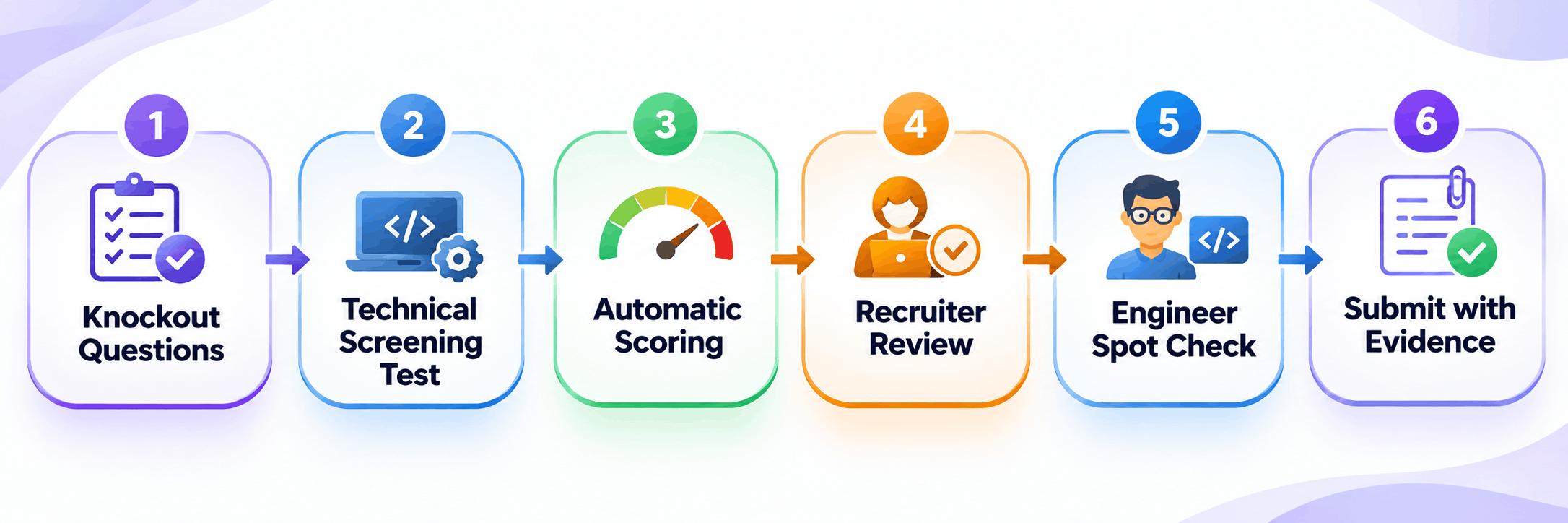
The tool matters less than the process around it. A workable agency workflow has six stages.
Knockout questions. Confirm location, notice period, and core skills before any test is sent
Technical screening test. Send a role specific assessment matched to the job requirements
Automatic scoring. Let the tool rank candidates against a benchmark for that role
Recruiter review. Read the report, check anomalies, and decide who deserves a conversation
Engineer or client spot check. Have a technical lead review borderline or senior profiles
Submit with evidence. Attach the score report to the profile so the client sees why it was sent
This is how an agency answers the question every client eventually asks: how do you verify skills before submitting? Stage six turns screening into a selling point rather than a hidden cost.
For the wider stack that surrounds screening, our guide to recruiting software for tech explains how ATS, assessment, and reporting tools fit together.
Turn AI Ambition Into an Actionable Roadmap
Comparison table: four types of screening tools
Tool type | What it tests | Recruiter effort | Candidate experience | Best for agencies |
AI assisted structured screening (for example TATVA) | Role based skills with scored, explainable results | Low, designed for non engineers | Short, guided, mobile friendly where supported | High volume placement across several roles |
Coding challenge platforms | Programming ability in a browser editor | Medium to high, needs technical judgment | Familiar to developers, can feel long | Pure software engineering placements |
Skills test libraries | Knowledge across many roles and tools | Low | Quick, but can feel generic | Early stage filtering and mixed role mandates |
Live or take home exercises | Real work samples and reasoning | High, needs engineer reviewers | Realistic, but time heavy for candidates | Senior and niche roles |
Pricing models and features change often, so confirm current details with each vendor before you decide. If you are comparing a specific coding platform with TATVA, read TATVA vs HackerRank for a head to head view.
For a look at how an AI first platform differs from older hiring systems, see TATVA vs traditional hiring platforms. A broader scan beyond coding is available in our list of the 8 best talent assessment platforms.
Where TATVA fits
TATVA is Samta.ai's AI hiring assessment platform. It is designed so recruiters can run technical screening and read structured results without writing code.
It supports TAFEP aligned practice by helping teams apply the same criteria to every candidate, though fair hiring still depends on how your team uses it. Confirm current plans, role coverage, and trial options with Samta.ai during a demo.
How to run an agency pilot in two weeks
A technical screening tool trial should answer one question: does it improve what we submit, and how fast? Run it as a controlled agency pilot rather than an open ended demo.
Pick two roles. Choose one high volume role and one harder niche role
Record the baseline. Capture current time to submit, submittal to interview ratio, and recruiter hours per candidate
Run both processes. Screen half of the candidates with the new tool and half with your usual method
Track candidate drop off. Note how many start the test and how many finish it
Ask clients. Share the score reports and ask whether they help with decisions
Compare results. Decide on evidence, not on the sales demo
Set the success threshold before the pilot begins. For example, you might require a clear improvement in interview conversion without a rise in drop off.
Get a Clear View of Your AI Model Risk Exposure
Real world use cases
These are illustrative scenarios based on common agency patterns, not client results.
Regulated industry example. An IT agency places engineers into a bank in Singapore. The client requires consistent, documented screening and wants to see that every candidate faced the same criteria. The agency uses structured assessments, attaches score reports to each submittal, and keeps a record of the process. Data pipelines of the kind described under enterprise AI engineering in Singapore let the bank's teams audit results centrally.
General enterprise example. A regional staffing agency fills dozens of developer roles each month and loses margin on recruiter time. It adopts a screening tool for staffing agencies that recruiters can run alone, automates invites and score uploads, and reserves engineer time for senior profiles only. Time to submit falls because fewer unqualified candidates reach the client.
In both cases, the tool worked because it matched recruiter skill and client expectations, not because it had the largest question library.
Key risks and failure modes
Agencies commonly stumble on the same issues.
Buying for engineers, not recruiters. A tool that needs technical judgment to operate stalls in recruiter hands
Over trusting a single score. Combine test results with a short structured conversation
Ignoring candidate experience. Strong candidates abandon long or unclear tests, which hurts placement rate
No client buy in. If clients do not read the reports, the evidence has no selling value
Pricing surprises. Per attempt fees compound quickly in a busy quarter
Skipping the pilot. Choosing on a demo alone hides setup effort and integration gaps
When to buy a screening tool, and when to wait
Buy now when:
Recruiters spend hours chasing technical validation from engineers
Clients reject submittals for weak technical fit
You place across several stacks and need consistent criteria
You want screening evidence to support your pitch to clients
Wait or keep it simple when:
You place a handful of senior specialists each year, where live interviews work better
Your ATS cannot receive assessment results and you have no plan to integrate
No one owns the screening process or will review the reports
Let’s Find the Right AI Approach for Your Business
Conclusion
The best screening setup is the one your recruiters can run alone and your clients actually read. Score tools on seven criteria, test two on live roles in a short pilot, and attach evidence to every submittal. Then connect the results to your ATS and reporting so speed gains are not lost to manual work. To see how this fits together, explore Samta.ai and its TATVA platform.
About Samta
Samta.ai is a Singapore-headquartered AI Product Engineering & Data Intelligence partner helping enterprises build production-grade AI systems for regulated and data-intensive environments.We help organizations move beyond experimentation by engineering scalable, explainable, and enterprise-ready AI solutions from data foundations and model development to workflow automation and deployment.
Our capabilities combine deep AI expertise, data engineering, and product engineering to deliver measurable business impact across FinTech, BFSI, cybersecurity, regulatory technology, and enterprise operations.
Our enterprise AI products power real-world intelligence systems:
• TATVA : AI-driven data intelligence platform for governed analytics, monitoring, and operational insights
• VEDA : Explainable and audit-ready AI decisioning engine built for compliance-sensitive enterprise workflows
• CORA-Property Management Solutions: : Predictive intelligence platform for real-estate pricing, portfolio optimization, and investment analytics
Backed by ecosystem partnerships with Microsoft, Databricks, Snowflake, and AWS, Samta.ai delivers agile, cost-efficient AI engineering with faster turnaround and enterprise-grade scalability. Trusted by enterprises across FinTech, BFSI, and digital transformation initiatives, Samta.ai embeds AI governance, data privacy, and compliance-by-design principles directly into the AI lifecycle , enabling organizations to scale AI with transparency, accountability, and operational control.
Enterprises leveraging Samta.ai automate 65%+ of repetitive data, analytics, and decision workflows while maintaining governance, explainability, and measurable business outcomes. Samta.ai provides the strategic consulting, AI engineering, and data modernization expertise needed to align enterprise operations with next-generation AI transformation goals.
Frequently asked questions
What is a technical screening tool?
A technical screening tool is software that tests whether a candidate has the skills a role requires before they are shortlisted or submitted. It uses coding tasks, skills tests, or structured assessments, then scores the results. Agencies use it to verify skills quickly and to give clients evidence behind each submittal.
How do recruitment agencies screen technical candidates?
Agencies typically combine knockout questions, a technical screening test, automatic scoring, and a short recruiter or engineer review. Senior or niche profiles often add a live technical conversation. The strongest agencies attach the score report to the submittal so clients can see why the candidate was recommended.
What should an agency look for in a screening tool?
Look for recruiter friendly setup, coverage of the roles you place, scoring clients can trust, integrity controls, a good candidate experience, pricing that fits your volume, and ATS integration. Test these in a pilot using real roles, because demos rarely reveal setup effort or candidate drop off.
How can my IT recruitment agency verify candidates' technical skills before submitting them to clients?
Send a role specific assessment after basic knockout questions, review the scored report, and add a short structured conversation for borderline cases. Use a technical screening tool for recruiters that does not need engineering help to operate, and keep the score report with each submittal as evidence for the client.
How does a technical screening test differ from an interview?
A technical screening test is a standardised, scored assessment that every candidate takes under the same conditions, which makes results comparable. An interview is conversational and depends more on the interviewer. Agencies get the best signal by using a test first and a structured interview second.