
Summarize this post with AI
Choosing a hiring assessment platform based on brand recognition alone is how enterprises end up with tools that score candidates accurately but never adapt to the role, the region, or the workflow they actually operate in. Tatva vs Mercer Mettl is a comparison enterprise talent leaders increasingly need to make as AI-native assessment platforms mature alongside established psychometric testing providers. This guide compares both platforms across the criteria that matter for enterprise and BFSI hiring in 2026 AI methodology, APAC regulatory fit, customisation depth, and workflow integration so you can evaluate based on your specific hiring context, not vendor marketing.
Tatva vs Mercer Mettl:
Tatva (Talent Aptitude Testing and Verification via Algorithms) is an AI-native hiring assessment platform built for enterprise and BFSI organisations in APAC, with assessment models trained specifically on regional hiring patterns and integrated workflow automation. Mercer Mettl is an established global psychometric and skills assessment provider with broad test-library coverage built over more than a decade. The right choice depends on whether your priority is APAC-specific AI-driven candidate evaluation with native workflow integration, or a globally standardised psychometric test library with established enterprise market presence.
What Is TATVA? Understanding the Platform
What is Mercer Mettl is a question most hiring leaders can already answer — it is a long-established assessment vendor. TATVA, however, is newer to many buyers, so a clear definition matters before any comparison. TATVA stands for Talent Aptitude Testing and Verification via Algorithms. It is Samta.ai's AI hiring assessment platform, purpose-built to evaluate candidate aptitude, role fit, and skills using machine learning models trained on enterprise hiring data rather than static, one-size-fits-all psychometric test banks. TATVA's core design principle is adaptive assessment: questions and evaluation criteria adjust based on role seniority, function, and regional hiring context, rather than applying the same global test template to every candidate. This is what AI based hiring is meant to deliver assessment that reflects the actual job and the actual labour market, not a generic aptitude score. Learn more about how TATVA compares to conventional methods in Tatva vs traditional online assessments.
Measure Your Organization's AI Readiness
What Is Mercer Mettl?
Mercer Mettl is a global talent assessment company offering psychometric tests, skills assessments, coding tests, and personality profiling tools, used widely across enterprise recruitment and corporate learning and development functions. It is one of the more established names in the ai hiring assessment comparison category, with a broad library of pre-built tests covering cognitive ability, domain skills, and behavioural traits. Mercer Mettl's assessment model is largely built on standardised psychometric science a methodology with a long evidentiary track record in industrial-organisational psychology, though typically less adaptive to AI-driven, role-specific customisation than newer AI-native platforms.
Source Required: specific current feature set, pricing tiers, and APAC-specific product offerings for Mercer Mettl should be verified directly against Mercer Mettl's published documentation, as third-party comparison data ages quickly in this category.
Why This Comparison Matters More in 2026
Three shifts are reshaping the use of AI in hiring and making platform choice more consequential:
Regulatory scrutiny of AI hiring tools is increasing: Singapore's PDPA and emerging APAC AI governance frameworks require explainability and bias testing for any AI system influencing employment decisions. Platforms must demonstrate, not just claim, fairness and auditability.
Candidate experience is now a competitive differentiator: lengthy, generic test batteries increase candidate drop-off, particularly for high-demand technical and BFSI roles where candidates have multiple competing offers.
Workflow integration determines actual time-to-hire impact: an assessment platform that does not integrate cleanly into the broader recruiting stack adds friction rather than removing it. Review how recruiting softwarqqqqe for tech hiring is evaluated on integration depth, not just assessment accuracy.
How AI is being used in hiring today extends well beyond test administration it now includes resume screening, structured interview scoring, and predictive role-fit modelling, all of which require platforms designed around AI from the ground up rather than AI features layered onto legacy psychometric tools.
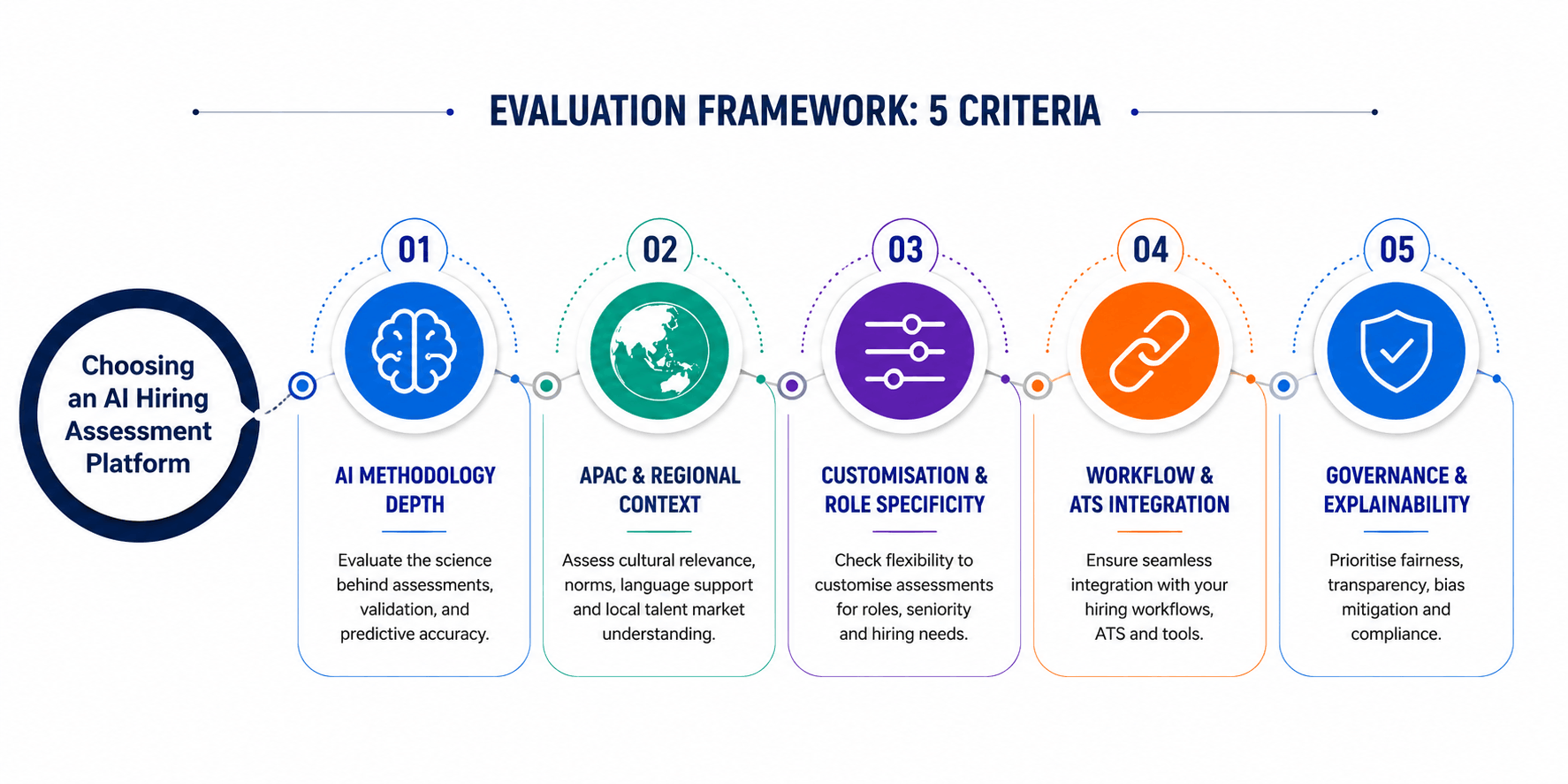
Evaluation Framework: 5 Criteria for Choosing an AI Hiring Assessment Platform
Use this framework as your ai hiring assessment comparison tool when evaluating any platform not just the two covered here:
Criterion 1: AI Methodology Depth
Does the platform use adaptive, machine-learning-driven evaluation, or static test banks with surface-level AI scoring layered on top? TATVA's algorithmic verification model adjusts to role and regional context; verify any platform's actual methodology rather than relying on "AI-powered" marketing language alone.
Criterion 2: APAC and Regional Hiring Context
Does the platform's assessment data and benchmarking reflect APAC labour markets specifically, or is it calibrated primarily on Western hiring data and adapted afterward? This matters significantly for BFSI roles where regional regulatory and skills context shapes what "good fit" actually means.
Criterion 3: Customisation and Role Specificity
Can assessments be configured per role, seniority level, and function, or does the platform rely on a fixed library of generic tests? Review 8 best talent assessment platforms for a broader view of how customisation capability varies across the category.
Criterion 4: Workflow and ATS Integration
Does the platform integrate natively into your applicant tracking system and broader hiring workflow, or does it require manual data transfer between systems? Samta.ai's workflow automation consulting practice specifically addresses this integration layer when deploying TATVA into enterprise recruiting stacks.
Criterion 5: Governance, Explainability, and Bias Auditing
Can the platform produce explainable scoring rationale and documented bias testing results for regulatory or internal compliance review? This is increasingly a procurement requirement, not an optional feature, for ai recruiting platform comparison decisions in regulated industries.
Gain Visibility into Your AI Model Risk Landscape
Tatva vs Mercer Mettl: 5-Column Comparison
Here are the updated cells, rephrased to point readers toward verification rather than asserting unverified claims:
Criterion | What to Verify | Why It Matters | ||
AI Methodology | Adaptive ML-driven assessment, algorithmic role-fit verification | Established psychometric science with AI-enabled features see Mercer Mettl's published methodology documentation | Request methodology documentation from both vendors | Determines whether scoring reflects role context or generic norms |
APAC Hiring Context | Built and benchmarked for APAC enterprise and BFSI hiring | Global platform with regional configuration options confirm current APAC coverage directly with Mercer Mettl | Ask for APAC-specific benchmarking data | Regional calibration affects fairness and predictive accuracy |
Customisation Depth | Role and seniority-adaptive assessment design | Broad test library with configurable test batteries see Mercer Mettl's current product documentation for configuration scope | Compare actual configuration options in a live demo | Generic tests reduce predictive validity for specialised roles |
Workflow Integration | Native integration via Samta.ai workflow automation | ATS integrations via established partner ecosystem see Mercer Mettl's integration partner directory | Confirm integration with your specific ATS stack | Poor integration increases time-to-hire and recruiter workload |
Governance & Explainability | Built-in explainability reporting and bias audit tooling | See Mercer Mettl's published trust and responsible AI documentation for current governance and bias-testing claims | Request bias audit reports from both vendors directly | Required for PDPA and emerging APAC AI hiring compliance |
Real-World Use Cases: AI Hiring Assessment in Practice
Use Case 1: BFSI Graduate Hiring Program, Singapore
A Singapore-based financial services firm needed to assess 1,200 graduate applicants for analyst roles within a compressed 6-week hiring cycle, with a regulatory requirement to document assessment fairness for internal compliance review. Using TATVA's adaptive assessment model, role-specific scoring criteria were configured for credit analyst, risk analyst, and operations analyst tracks separately rather than applying one generic graduate aptitude test across all three functions. Explainability reporting was generated for every shortlisted candidate, supporting the firm's internal model governance requirements alongside its broader AI hiring program review.
Use Case 2: Technical Hiring at Scale, Regional Enterprise
A technology-enabled logistics company needed to screen high volumes of software engineering candidates while reducing recruiter time spent on manual resume review and first-round technical screening. The assessment platform was integrated directly into the company's existing ATS through Samta.ai's workflow automation layer, reducing manual data entry and enabling automated candidate progression based on assessment scoring thresholds. This reflects how the use of AI in hiring is shifting from standalone testing toward fully integrated, automated hiring funnels covered further in 10 best AI hiring platforms for technical recruiting.
Case Studies See how enterprise and BFSI organisations have deployed TATVA for AI-driven hiring assessment at scale →
Key Risks When Choosing the Wrong Assessment Platform
Generic scoring applied to specialised roles: using a one-size-fits-all aptitude test for highly differentiated functions (credit risk vs. customer service vs. engineering) reduces predictive validity
Governance gaps: deploying an AI hiring tool without documented bias testing exposes the organisation to PDPA and emerging APAC AI regulatory risk
Integration friction: assessment platforms that do not connect natively to your ATS create manual workload that offsets the efficiency gains the platform was meant to deliver
Candidate drop-off from lengthy testing: overly long or irrelevant test batteries increase abandonment rates, particularly among high-demand technical and BFSI candidates with competing offers
Vendor lock-in on proprietary scoring models: platforms that do not provide exportable, explainable scoring data create dependency and complicate future platform migration
Decision Checklist: Tatva vs Mercer Mettl Which Fits Your Organisation
Consider TATVA when:
Your hiring is concentrated in APAC, particularly BFSI or regulated enterprise sectors
You need role-specific, adaptive assessment rather than a fixed test library
Native integration with your existing recruiting workflow is a priority
You require built-in explainability and bias audit reporting for compliance review
Consider Mercer Mettl when:
You need a broad, pre-built test library covering many functions and geographies immediately
Your organisation already has Mercer Mettl integrated into existing global HR infrastructure
Standardised, globally benchmarked psychometric testing is the priority over regional customisation
Evaluate both in parallel when:
You are running a formal procurement process and need comparative data on methodology, governance, and integration before committing
Your hiring spans both APAC-specific and global roles with different assessment needs
Turn Your AI Vision into an Action Plan
Conclusion
Tatva vs Mercer Mettl is not a question with a universal answer it depends on whether your organisation prioritises AI-native, regionally adaptive assessment with integrated workflow automation, or a globally standardised psychometric test library with established enterprise presence. For APAC enterprise and BFSI hiring specifically, TATVA's adaptive methodology and explainability tooling address requirements that generic global platforms were not originally built around. Evaluate both against your actual role profiles, hiring volume, and compliance requirements not vendor positioning alone.
Request a Free Product Demo with Samta.ai See TATVA's AI-driven hiring assessment in action for your specific roles and hiring workflow →
About Samta
Samta.ai is a Singapore-headquartered AI Product Engineering & Data Intelligence partner helping enterprises build production-grade AI systems for regulated and data-intensive environments.We help organizations move beyond experimentation by engineering scalable, explainable, and enterprise-ready AI solutions from data foundations and model development to workflow automation and deployment.
Our capabilities combine deep AI expertise, data engineering, and product engineering to deliver measurable business impact across FinTech, BFSI, cybersecurity, regulatory technology, and enterprise operations.
Our enterprise AI products power real-world intelligence systems:
• TATVA : AI-driven data intelligence platform for governed analytics, monitoring, and operational insights
• VEDA : Explainable and audit-ready AI decisioning engine built for compliance-sensitive enterprise workflows
• CORA-Property Management Solutions: : Predictive intelligence platform for real-estate pricing, portfolio optimization, and investment analytics
Backed by ecosystem partnerships with Microsoft, Databricks, Snowflake, and AWS, Samta.ai delivers agile, cost-efficient AI engineering with faster turnaround and enterprise-grade scalability. Trusted by enterprises across FinTech, BFSI, and digital transformation initiatives, Samta.ai embeds AI governance, data privacy, and compliance-by-design principles directly into the AI lifecycle , enabling organizations to scale AI with transparency, accountability, and operational control.
Enterprises leveraging Samta.ai automate 65%+ of repetitive data, analytics, and decision workflows while maintaining governance, explainability, and measurable business outcomes. Samta.ai provides the strategic consulting, AI engineering, and data modernization expertise needed to align enterprise operations with next-generation AI transformation goals.
Frequently Asked Questions
What is the main difference between Tatva and Mercer Mettl?
TATVA (Talent Aptitude Testing and Verification via Algorithms) is an AI-native assessment platform built specifically for APAC enterprise and BFSI hiring, using adaptive machine-learning models calibrated to regional hiring context. Mercer Mettl is an established global psychometric assessment provider with a broad, standardised test library. The core difference is adaptive AI-driven, regionally calibrated assessment versus a globally standardised test bank with AI-enabled features layered on top.
What is Mercer Mettl used for?
Mercer Mettl is used primarily for psychometric testing, skills assessment, coding evaluation, and behavioural profiling as part of enterprise recruitment and learning and development programs. Organisations typically use it for high-volume, standardised candidate screening where a broad pre-built test library across many job functions and geographies is the priority.
What does TATVA stand for and what does it actually do?
TATVA stands for Talent Aptitude Testing and Verification via Algorithms. It is Samta.ai's AI hiring assessment platform that evaluates candidate aptitude and role fit using adaptive machine-learning models, rather than static test templates. TATVA adjusts assessment criteria based on role, seniority, and regional hiring context, and produces explainable scoring output to support hiring governance and compliance requirements.
How is AI being used in hiring assessment platforms today?
The use of AI in hiring has expanded from simple automated test scoring to adaptive assessment design, predictive role-fit modelling, resume screening, and structured interview evaluation. The most advanced platforms calibrate assessment criteria per role and region rather than applying generic test batteries, and increasingly provide explainability reporting to meet PDPA and emerging APAC AI governance requirements for employment-related AI systems.
How do I run a fair Tatva vs Mercer Mettl evaluation for procurement?
Request live demos from both vendors using your actual role profiles, not generic demo content. Compare scoring explainability output side by side for the same candidate profile. Confirm integration compatibility with your specific ATS before final evaluation. Request current bias audit documentation from both vendors directly, since third-party comparison data in this category becomes outdated quickly as platforms update their methodology.
Reduce Time-to-Hire by 70% with AI Skill Verification
TATVA helps enterprises screen, assess, and benchmark software engineers and tech talent with audit-ready AI evaluations.
Explore TATVA Platform >