
Summarize this post with AI
Most enterprises rate their own AI readiness higher than the evidence supports. That gap is exactly where AI budgets disappear. An ai readiness assessment that actually predicts success needs to score more than enthusiasm. This rubric breaks readiness into six measurable dimensions, each scored one to five, so you can see precisely where your organisation stands before committing budget to a pilot.
AI readiness assessment:
An AI readiness assessment evaluates an organisation across six dimensions: data maturity, AI governance maturity, talent readiness, infrastructure readiness, use case prioritisation, and change management, each scored on a one to five scale. Gartner's AI maturity model similarly places organisations into five progressive stages across strategy, data, governance, engineering, operating model, culture and AI product value, confirming that readiness is multidimensional, not a single score. For enterprise and BFSI teams in Singapore and the wider APAC region, a score below three on data maturity or governance maturity is the strongest early predictor of a stalled AI project.
What is an AI readiness assessment?
An ai readiness assessment is a structured evaluation of whether an organisation has the data, governance, talent, infrastructure, prioritised use cases and change management capacity needed to deploy AI successfully. This differs from an ai maturity assessment in scope. A maturity assessment typically benchmarks an organisation against industry stages over time. A readiness assessment is narrower and more immediate: it asks whether you are ready to start a specific initiative now.
Related terms include the ai readiness assessment framework, the structured method used to score each dimension, and the ai readiness checklist, a lighter weight version covering the same ground without formal scoring. For a deeper breakdown of what counts as a strong score, see what a good AI readiness score looks like, and what should happen before you commit to an assessment at all in AI readiness assessment before you start.
See What Your Business Needs to Scale AI Successfully
Why this matters now for enterprises and BFSI teams
Three developments make scored readiness assessment an active priority in 2026, not a nice to have.
Readiness gaps are the leading predictor of AI failure. Gartner's February 2025 research found that 63 percent of organisations lack confidence in their data management practices for AI, and predicts organisations will abandon 60 percent of AI projects unsupported by AI ready data through 2026.
Analysts now treat readiness as multidimensional by design. Gartner's own AI Maturity Model scores organisations across strategy, data, governance, engineering, operating model, culture and AI product value, across five progressive stages, confirming that no single metric captures readiness on its own.
Governance expectations are rising alongside technical readiness. The NIST AI Risk Management Framework, structured around govern, map, measure and manage functions, increasingly shapes what regulators and boards expect an organisation to demonstrate before deploying AI at scale.
Teams building this capability in Singapore specifically can see the supporting engineering work in enterprise AI engineering in Singapore, and how CIOs are approaching this in 2026 in AI readiness for CTOs.
The 6 dimension rubric: score each from 1 to 5
Score your organisation honestly on each dimension before moving forward with any AI initiative.
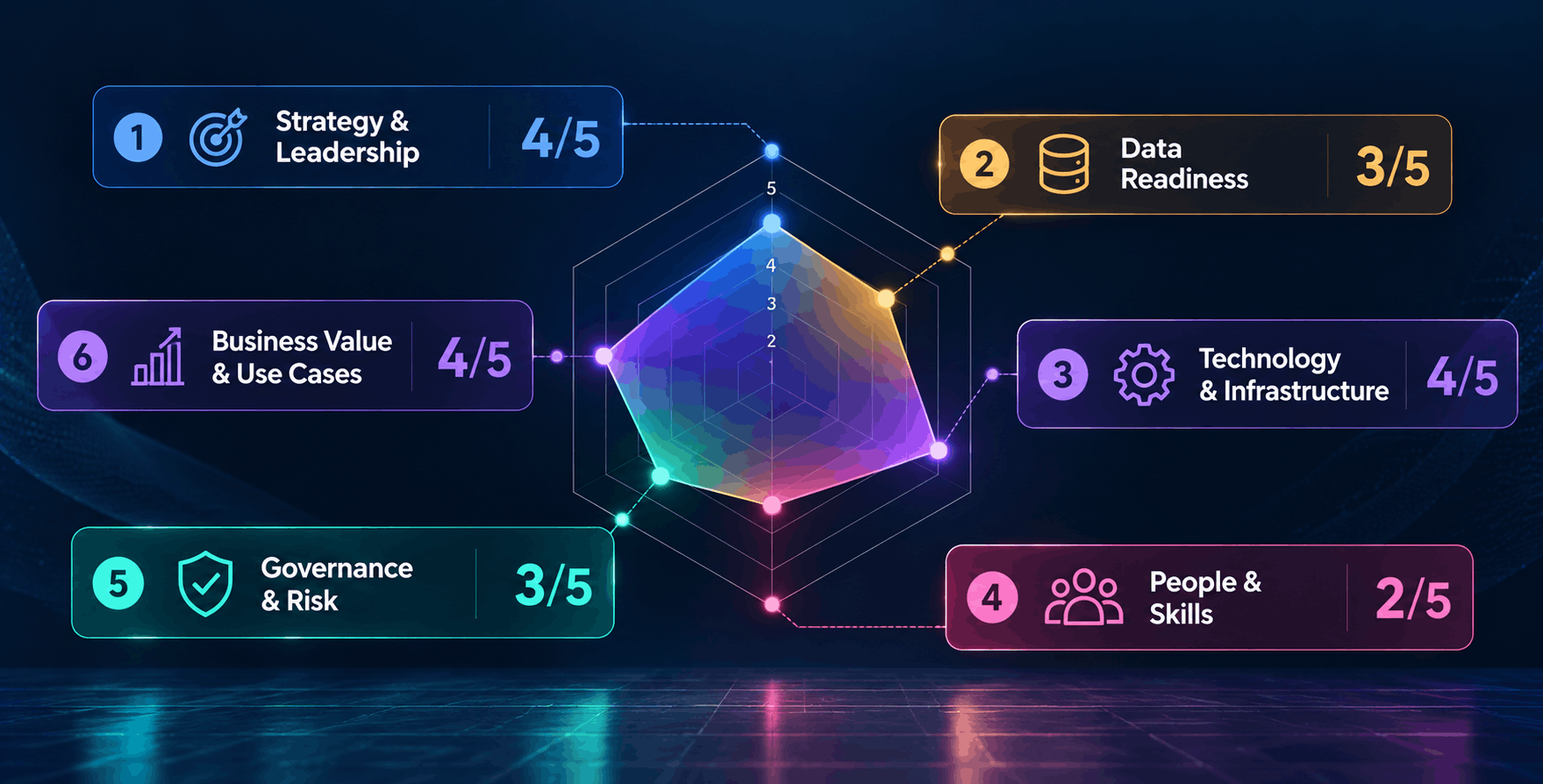
Data maturity. Can your data be trusted, traced and joined across systems. A score of 1 means fragmented, ungoverned data across ERP, CRM and operational systems. A score of 5 means fully integrated, governed data with clear lineage. Data integration consulting services address this gap directly for organisations scoring below 3.
AI governance maturity. Do you have policy, oversight and audit trail capability in place. A score of 1 means no formal AI policy exists. A score of 5 means board level oversight, model inventory and documented lifecycle controls are already operating. AI security and compliance services support organisations moving from a low to a high score here.
Talent readiness. Do you have staff who understand both the models and the business context. A score of 1 means full reliance on outside vendors with no internal capability. A score of 5 means an internal team can build, monitor and explain AI systems independently.
Infrastructure readiness. Can your technical stack actually support production AI workloads. A score of 1 means no cloud data platform or scalable compute exists. A score of 5 means a mature stack on Databricks, Snowflake or Microsoft Fabric already supports production workloads reliably.
Use case prioritisation. Do you know which problems AI should solve first, and why. A score of 1 means AI is being pursued without a clear business case. A score of 5 means use cases are ranked by value and feasibility with measurable success criteria defined upfront.
Change management. Will your organisation's people and processes actually adopt the system once it works. A score of 1 means no plan exists for user adoption or workflow change. A score of 5 means a tested rollout plan with trained users and clear ownership already exists.
Samta.ai's Veda platform and the Veda AI decision analytics product support dimensions one, two and four directly, acting as the engineering execution layer once an organisation knows where its gaps actually are, rather than guessing.
Comparing five approaches to AI readiness assessment
Approach | Coverage across dimensions | Scoring rigor | Actionability | Best fit |
Informal self assessment | Partial, self reported | Low, no defined scale | Low, vague next steps | Early internal discussion |
Free online readiness quiz | Narrow, surface level | Low, generic scoring | Low, generic recommendations | Quick initial orientation only |
Vendor supplied assessment | Narrow, tied to vendor's product | Medium, vendor biased | Medium, points toward their tool | Procurement stage for a specific tool |
Analyst maturity benchmark, for example Gartner | Broad, industry benchmarked | High, structured stages | Medium, strategic not tactical | Board level positioning conversations |
Six dimension scored rubric with named owner per gap | Full, all six dimensions | High, 1 to 5 per dimension | High, maps directly to next engagement | Enterprise and BFSI planning a specific initiative |
The last row is the model used in this piece. For a platform level view of how data and decision layers fit into closing these gaps, see Veda versus a general Data Intelligence Platform.
Assess Your AI Model Risk With Confidence
Real world use cases
Regulated bank: strong infrastructure, weak governance
A bank scored a 4 on infrastructure readiness, having already built a mature cloud data platform, but scored a 2 on governance maturity, with no formal AI policy or model inventory in place. The bank paused its planned credit risk model launch to build governance first, assigning board level ownership and documenting lifecycle controls, rather than deploying on a strong infrastructure foundation with a dangerous governance gap underneath it. See related patterns in Samta.ai's case studies.
General enterprise: strong talent, weak use case prioritisation
A manufacturer had a capable internal data science team, scoring a 4 on talent readiness, but scored a 2 on use case prioritisation, with no clear ranking of which problems to solve first. The team had built three competing pilot projects simultaneously with no shared success criteria. Running the rubric exposed this, and leadership consolidated to one prioritised use case with measurable targets before continuing.
Key risks and failure modes
Scoring yourself higher than the evidence supports. Self assessment without named evidence per dimension consistently overstates real readiness.
Treating one strong dimension as overall readiness. A high infrastructure score does not compensate for weak governance or unclear use cases.
Skipping use case prioritisation entirely. Even strong data and infrastructure cannot save a project with no clear business case behind it.
Underestimating change management. A technically successful AI system that nobody adopts delivers no value, regardless of how well it was built.
Treating the assessment as a one time exercise. Readiness changes as data, governance and talent evolve, so scores need periodic re evaluation, not a single snapshot.
No named owner assigned per dimension. A score without an accountable owner to close the gap rarely leads to actual improvement.
When to run this assessment, and when a lighter check is enough
Run the full six dimension assessment if:
You are about to commit meaningful budget to a specific AI initiative
A previous AI pilot stalled and you need to diagnose exactly where
You are a regulated institution needing documented evidence of readiness before deployment
Multiple business units are competing for the same AI investment and need objective comparison
A lighter checklist is enough if:
You are in early, low stakes internal exploration with no budget commitment yet
The initiative is narrow, low risk and fully contained within one team
You already ran a full assessment recently and nothing material has changed
For the detailed scoring methodology behind each dimension, see the AI readiness assessment framework.
Take the Next Step in Your AI Journey

Conclusion
A single AI readiness number hides more than it reveals. The six dimension rubric above shows exactly which gap is likely to stall your next initiative, before you commit budget to finding out the hard way. Score honestly, assign an owner to each gap below three, and reassess before launch. The next step is running this scoring with someone who can act on what it finds.
About Samta
Samta.ai is a Singapore-headquartered AI Product Engineering & Data Intelligence partner helping enterprises build production-grade AI systems for regulated and data-intensive environments.We help organizations move beyond experimentation by engineering scalable, explainable, and enterprise-ready AI solutions from data foundations and model development to workflow automation and deployment.
Our capabilities combine deep AI expertise, data engineering, and product engineering to deliver measurable business impact across FinTech, BFSI, cybersecurity, regulatory technology, and enterprise operations.
Our enterprise AI products power real-world intelligence systems:
• TATVA : AI-driven data intelligence platform for governed analytics, monitoring, and operational insights
• VEDA : Explainable and audit-ready AI decisioning engine built for compliance-sensitive enterprise workflows
• CORA-Property Management Solutions: : Predictive intelligence platform for real-estate pricing, portfolio optimization, and investment analytics
Backed by ecosystem partnerships with Microsoft, Databricks, Snowflake, and AWS, Samta.ai delivers agile, cost-efficient AI engineering with faster turnaround and enterprise-grade scalability. Trusted by enterprises across FinTech, BFSI, and digital transformation initiatives, Samta.ai embeds AI governance, data privacy, and compliance-by-design principles directly into the AI lifecycle , enabling organizations to scale AI with transparency, accountability, and operational control.
Enterprises leveraging Samta.ai automate 65%+ of repetitive data, analytics, and decision workflows while maintaining governance, explainability, and measurable business outcomes. Samta.ai provides the strategic consulting, AI engineering, and data modernization expertise needed to align enterprise operations with next-generation AI transformation goals.
Frequently asked questions
How do you assess AI readiness?
Score your organisation on each of six dimensions, data maturity, AI governance maturity, talent readiness, infrastructure readiness, use case prioritisation, and change management, using a one to five scale with named evidence for each score. Avoid self reported impressions alone. A credible assessment also assigns an accountable owner to close any gap scoring below three.
What are the dimensions of AI readiness?
The six core dimensions are data maturity, AI governance maturity, talent readiness, infrastructure readiness, use case prioritisation, and change management. Each measures a different failure mode: data and infrastructure determine whether AI can technically run, governance and talent determine whether it can run safely and sustainably, and use case prioritisation and change management determine whether it will actually deliver value once built.
What is a good AI readiness score?
A good score is an average of 4 or higher across all six dimensions, with no single dimension scoring below 3. A high average masking one very low dimension, such as strong infrastructure but weak governance, is not actually a good readiness profile, since any single weak dimension can derail an otherwise well resourced initiative.
Give me a free AI readiness assessment for an Indian enterprise
A scored assessment works the same way regardless of region: evaluate data maturity, governance, talent, infrastructure, use case prioritisation and change management, each from 1 to 5. For an enterprise in India, pay particular attention to data governance maturity given evolving data protection requirements, and infrastructure readiness given the pace of cloud adoption across Indian enterprise IT. A vendor such as Samta.ai can run this scoring directly rather than relying on a generic template.
What framework should a CIO use to score AI readiness?
A CIO should use a framework that scores multiple dimensions independently rather than producing a single blended number, since a blended score hides which specific gap is blocking progress. Gartner's AI Maturity Model offers an industry benchmarked version across seven pillars. A six dimension rubric scored 1 to 5, with a named owner per gap, offers a more immediately actionable version for a specific initiative.