
Summarize this post with AI
Most banks can name their top three AI models. Few can produce a complete inventory of every model actually running in production, including the ones vendors quietly embedded. AI model risk management closes exactly that gap, giving banks a structured way to identify, tier, validate and monitor every model they rely on. This guide walks through the full path from inventory to validation, and where the underlying standards have recently shifted.
AI model risk management:
AI model risk management is the discipline of identifying, classifying, validating and monitoring every model a bank relies on, including third party and vendor supplied AI, to prevent financial loss from model error or misuse. US banking regulators replaced the long standing SR 11-7 framework with SR 26-2 on 17 April 2026, explicitly extending model risk guidance to cover AI, machine learning and agentic systems for the first time. For banks in Singapore and the wider APAC region, this now sits alongside MAS's proposed AI Risk Management Guidelines, meaning a credible framework needs to satisfy global, US referenced and local regulatory expectations at once.
What is AI model risk management?
AI model risk management is the set of practices a bank uses to identify, classify, validate and monitor the AI and statistical models it relies on for decisions such as credit scoring, fraud detection and pricing. This differs from a general model risk management framework in scope. A general framework may cover any quantitative model. AI model risk management specifically addresses the added complexity of machine learning, generative AI and increasingly agentic systems.
Related terms include ai model governance, the policy and oversight layer sitting above day to day model risk practice, and model validation ai, the specific technical process of independently testing whether a model performs as intended. For a broader breakdown of what a complete framework includes, see the 6 components of AI model risk management and AI risk management as a model.
Ready to Scale AI? Start with a Free Assessment
Why this matters now for banks in India and Singapore
Three developments make this an active priority in 2026, not a routine compliance update.
The US reference standard just changed materially: On 17 April 2026, the Federal Reserve, OCC and FDIC jointly issued SR 26-2, which supersedes and replaces the 2011 era SR 11-7 framework that most global model risk practices were originally built around. SR 26-2 explicitly extends coverage to AI, machine learning and emerging agentic systems, and ties validation rigor to a model's materiality rather than a one size fits all approach.
Singapore has its own parallel framework taking shape: MAS's proposed AI Risk Management Guidelines, published for consultation on 13 November 2025, cover board oversight, risk systems and policies, lifecycle controls and organisational capability, building on the same model inventory and validation concepts SR 26-2 reinforces.
Global technical standards reinforce the same lifecycle discipline: The NIST AI Risk Management Framework, structured around govern, map, measure and manage functions, gives banks outside direct US or Singapore supervision a credible reference point covering the same ground. See how this plays out in practice in enterprise AI engineering in Singapore.
A five step framework: from model inventory to validation
Here is the sequence that takes a bank from an incomplete model list to a defensible, audit ready framework.
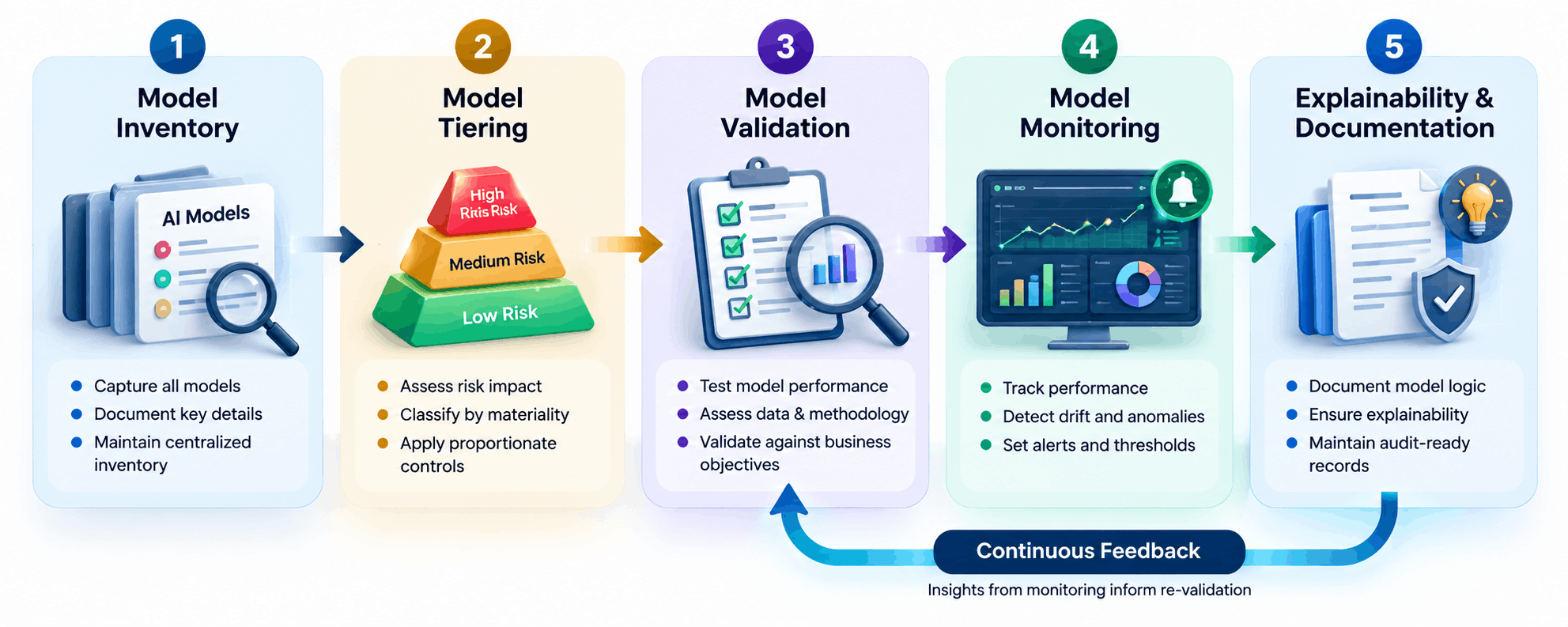
Build a complete model inventory. List every model in production, including internally built, vendor supplied and embedded third party AI. Model inventory gaps, particularly around vendor supplied tools, are the most common finding in model risk reviews.
Apply materiality based model tiering. Classify each model by potential financial and customer impact. Model tiering under SR 26-2 explicitly ties validation depth and monitoring frequency to materiality, so a low impact internal tool does not require the same rigor as a customer facing credit model.
Run independent validation before deployment. Independent validation means a party separate from model development tests whether the model performs as intended, documenting what was compared and what the comparison revealed. AI security and compliance services support banks building this capability directly.
Set up ongoing drift monitoring. Drift monitoring tracks whether a model's performance degrades as real world data shifts away from training conditions, triggering review before accuracy drops materially.
Document explainability for every material model. Explainability evidence, showing why a model reached a given output, is now expected both under SR 26-2's demonstrable evidence standard and MAS's proposed lifecycle controls. Samta.ai's Veda platform and the Veda AI decision analytics product support this step directly, keeping model inventory and monitoring data traceable across connected systems, acting as the engineering execution layer once the framework itself is defined.
Comparing five approaches to AI model risk management
Approach | Model inventory coverage | Validation rigor | AI and agentic AI coverage | Best fit |
No formal framework | None | None | None | Not viable for any regulated bank |
Legacy SR 11-7 era practice, not updated | Partial, often excludes vendor models | Uniform, not risk tiered | Weak, predates AI specific guidance | Banks yet to update post April 2026 |
SR 26-2 aligned framework | Full, including third party | Risk tiered by materiality | Strong, explicitly covers AI and ML | US regulated and US benchmarked banks |
NIST AI RMF aligned framework | Full, structured by function | Strong, govern and measure functions | Strong, general purpose AI coverage | Banks outside direct US or MAS supervision |
Integrated platform supporting inventory, validation and monitoring together | Full, continuously updated | Strong, automated evidence generation | Strong, covers full lifecycle | Enterprise and BFSI scaling multiple models |
The last row removes the manual evidence assembly that slows down every other approach. For a platform level comparison relevant to this, see Veda versus a general Data Intelligence Platform.
Assess Your AI Model Risk with Confidence
Real world use cases
Regulated bank: vendor model missing from inventory
A bank's internal model inventory covered every model built by its own data science team but excluded a vendor supplied fraud detection tool embedded in a third party platform. A validation review flagged this gap directly. Bringing the vendor model into the inventory, applying the same materiality tiering and validation standard used for internal models, closed the gap before an external examiner could raise it independently. See related delivery patterns in Samta.ai's case studies.
General enterprise angle: insurer with strong documentation but no drift monitoring
An insurer had thorough model development documentation for its claims triage model but no ongoing drift monitoring in place. Performance had quietly degraded over eighteen months without anyone noticing, since reviews only happened at initial deployment. Adding scheduled drift monitoring, tied to the model's materiality tier, caught a second, smaller degradation months later before it affected a meaningful number of claims decisions.
Key risks and failure modes
Treating model inventory as a one time exercise. New models, especially vendor embedded ones, enter production continuously, and an inventory not actively maintained goes stale within months.
Applying uniform validation rigor regardless of materiality. SR 26-2 explicitly expects validation depth to scale with risk, so treating every model the same wastes effort on low risk tools while under validating high risk ones.
Assuming legacy SR 11-7 practices already cover AI adequately. SR 11-7 predates generative and agentic AI entirely, and SR 26-2 was issued specifically because the original framework did not address these systems.
No drift monitoring after initial validation. A model validated at launch can degrade silently without ongoing monitoring tied to its materiality tier.
Weak explainability documentation. Both SR 26-2's demonstrable evidence standard and MAS's proposed lifecycle controls expect documented reasoning, not just a performance metric.
Underestimating third party AI risk. Vendor supplied and embedded AI systems carry the same inventory, tiering and validation expectations as internally built models under current guidance.
When to formalise an AI model risk management framework
Formalise it now if:
You operate any AI model with financial, credit or customer facing impact
Your current practices were built around SR 11-7 and have not been reviewed since April 2026
A prior model review flagged inventory gaps, particularly around vendor or embedded AI
You are a Singapore regulated institution preparing for MAS's AIRG finalisation
A lighter approach may work if:
You run very few models, all low materiality and purely internal
You are early in AI adoption with no production deployment yet
A recent, independent review already confirmed your framework meets current standards
Related reading: model risk management consultants for banks in India and Singapore can help scope a gap assessment against both SR 26-2 and MAS's proposed guidelines together.
Talk to an AI Expert About Your Business Needs

Conclusion
A model inventory with gaps is not a model risk management framework, it is a liability waiting to surface during the next review. SR 26-2's arrival in April 2026 makes this the right moment to close those gaps properly. Build the inventory, tier by materiality, validate independently, and monitor continuously. The next step is finding out honestly where your own framework stands against current standards.
About Samta
Samta.ai is a Singapore-headquartered AI Product Engineering & Data Intelligence partner helping enterprises build production-grade AI systems for regulated and data-intensive environments.We help organizations move beyond experimentation by engineering scalable, explainable, and enterprise-ready AI solutions from data foundations and model development to workflow automation and deployment.
Our capabilities combine deep AI expertise, data engineering, and product engineering to deliver measurable business impact across FinTech, BFSI, cybersecurity, regulatory technology, and enterprise operations.
Our enterprise AI products power real-world intelligence systems:
• TATVA : AI-driven data intelligence platform for governed analytics, monitoring, and operational insights
• VEDA : Explainable and audit-ready AI decisioning engine built for compliance-sensitive enterprise workflows
• CORA-Property Management Solutions: : Predictive intelligence platform for real-estate pricing, portfolio optimization, and investment analytics
Backed by ecosystem partnerships with Microsoft, Databricks, Snowflake, and AWS, Samta.ai delivers agile, cost-efficient AI engineering with faster turnaround and enterprise-grade scalability. Trusted by enterprises across FinTech, BFSI, and digital transformation initiatives, Samta.ai embeds AI governance, data privacy, and compliance-by-design principles directly into the AI lifecycle , enabling organizations to scale AI with transparency, accountability, and operational control.
Enterprises leveraging Samta.ai automate 65%+ of repetitive data, analytics, and decision workflows while maintaining governance, explainability, and measurable business outcomes. Samta.ai provides the strategic consulting, AI engineering, and data modernization expertise needed to align enterprise operations with next-generation AI transformation goals.
Frequently asked questions
What is AI model risk management?
AI model risk management is the discipline of identifying, classifying, validating and monitoring every AI model a bank relies on, including third party and vendor supplied systems, to prevent financial loss from model error. It covers the full lifecycle from inventory through ongoing drift monitoring, and is currently shaped in the US by SR 26-2, issued April 2026, and in Singapore by MAS's proposed AI Risk Management Guidelines.
How do banks validate AI models?
Banks validate AI models through independent testing performed by a party separate from model development, documenting what was compared, what the comparison revealed, and how findings were addressed. Under SR 26-2, validation depth scales with a model's materiality tier. Ongoing monitoring after initial validation catches performance drift over time.
What should a model inventory contain?
A complete model inventory lists every model in production, including internally built, vendor supplied and embedded third party AI, along with its materiality tier, validation status and monitoring frequency. The most common gap is excluding vendor supplied or embedded AI tools, which carry the same oversight expectations as internally built models.
How should a bank build an AI model risk management framework?
Start with a complete model inventory covering internal and third party systems, then apply materiality based tiering to determine validation and monitoring rigor for each model. Build independent validation and ongoing drift monitoring into the lifecycle, and document explainability evidence for every material model. Align to SR 26-2 for US benchmarking and MAS's proposed AIRG for Singapore specific institutions.
Model risk management consultants for banks in India and Singapore
Consultants supporting banks in both markets typically scope a framework against SR 26-2 as a global reference standard, MAS's proposed AI Risk Management Guidelines for Singapore specific institutions, and the NIST AI Risk Management Framework as a general baseline. The right consultant should cover the full path from model inventory through validation, not model building or governance policy alone.