
Summarize this post with AI
Every quarter an enterprise delays AI transformation, its competitors are not standing still they are compounding advantages in speed, cost efficiency, and risk management that become structurally harder to close. The cost of delaying AI transformation is not a future risk. It is an accumulating present cost that appears on no single line of the P&L but erodes competitive position, regulatory standing, and operational margin simultaneously. This guide quantifies that cost, names the failure modes, and gives enterprise leaders in BFSI and regulated sectors a 2026 risk model to present to boards that are still treating AI as optional.
Cost of Delaying AI Transformation:
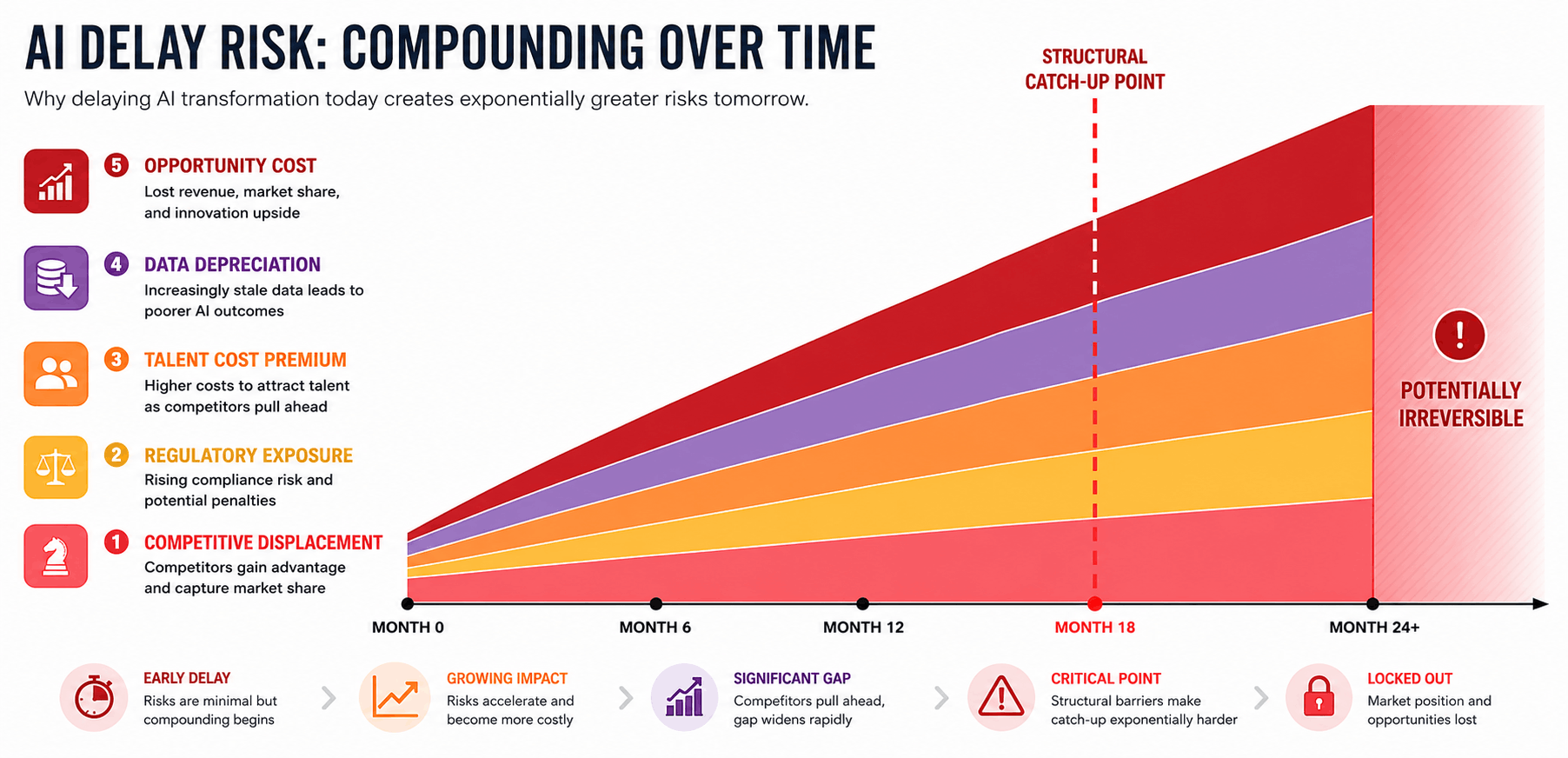
The cost of delaying AI transformation for enterprise organisations in APAC compounds across four dimensions: competitive disadvantage as AI-native competitors widen capability gaps, regulatory exposure as MAS, RBI, and HKMA embed AI governance expectations into standard compliance frameworks, talent cost escalation as AI engineers become scarcer and more expensive each quarter, and opportunity cost measured in the revenue and risk outcomes that AI-enabled peers are already capturing. Organisations that delay beyond 2026 face a structural catch-up problem not just a technology lag.
What "Delaying AI Transformation" Actually Costs: Four Dimensions
The risk of not adopting AI is rarely presented in financial terms because it is distributed across multiple cost centres and time horizons. That invisibility is precisely why boards underestimate it.
The four cost dimensions are:
Competitive displacement cost: revenue lost to AI-enabled competitors who price more accurately, serve faster, and retain customers more effectively
Regulatory remediation cost: the expense of retrofitting AI governance and compliance infrastructure that peer institutions are building now as standard
Talent premium escalation: AI engineering salaries in Singapore and Hong Kong increase 15–20% annually as demand outpaces supply (Source Required: Korn Ferry APAC)
Opportunity cost: quantifiable revenue and risk outcomes that AI-enabled peers are realising today: fraud savings, credit loss reduction, churn prevention, operational cost avoidance
None of these appear as a line item labelled "cost of AI delay." All of them are real, measurable, and compounding.
Know Where Your AI Strategy Stands Today
Why 2026 Is the Inflection Point for AI Transformation Urgency
Three forces converge in 2026 to make delay materially more expensive than it was in 2024:
1. Regulatory frameworks are moving from guidance to obligation
MAS's updated Technology Risk Management guidelines, RBI's AI/ML model risk framework, and the EU AI Act's extraterritorial reach are transitioning from advisory to enforceable. Enterprises without documented AI governance frameworks will face compliance gaps and the cost of AI implementation rises sharply when governance is retrofitted rather than embedded from the start.
2. The AI capability gap is widening faster than expected
Gartner projects that by 2027, enterprises with mature AI programs will operate at 30–40% lower unit cost than peers without AI-enabled operations. The gap is not linear; it compounds as AI systems learn from more data over time.
3. GenAI adoption has reset competitive baselines
In BFSI, insurance, and logistics sectors across APAC, AI-enabled firms are now setting new service and pricing benchmarks. AI transformation urgency is no longer about aspiration it is about whether your organisation can remain competitive at current margins. Understanding how modern enterprises build AI capability makes clear that the firms moving fastest are those that started governance and infrastructure investment 18–24 months ago.
The 2026 AI Delay Risk Model: 5 Dimensions Quantified
Use this framework to calculate and present the compounding cost of delay to your board:
Dimension 1: Competitive Displacement
Map your top three competitors. For each, identify one AI-enabled capability they have deployed in the last 18 months faster credit decisioning, AI-driven pricing, predictive churn models. Estimate the revenue impact of that capability applied to your customer base. That number is your quarterly competitive displacement cost.
Dimension 2: Regulatory Remediation Premium
Retrofitting AI governance after deployment costs 2.5–4x more than embedding it during build. For every production AI model your competitors deploy with governance embedded today, you will pay that remediation premium when regulatory pressure forces your hand. Use your AI readiness assessment score to estimate how many models you are behind.
Dimension 3: Talent Cost Escalation
AI engineering salaries in Singapore increase 15–20% annually. A team that costs SGD 2.4M today will cost SGD 2.9M–3.2M by 2028 for the same headcount, before any productivity value is delivered. Every quarter of delay adds to this compounding salary baseline.
Dimension 4: Data Depreciation
Data that is not being used to train and improve AI models is depreciating in relative value as competitors' models accumulate more training cycles. The longer you delay, the larger the data advantage gap becomes. Samta.ai's digital transformation managed services include data infrastructure activation on Databricks and Snowflake converting dormant data assets into training-ready pipelines before that depreciation compounds further.
Dimension 5: Opportunity Cost of Unrealised Outcomes
Quantify two to three AI use cases your organisation has identified but not deployed. Estimate the annual value of each fraud savings, credit loss reduction, operational cost avoidance. Multiply by the number of quarters of delay. That total is your unrealised opportunity cost. It belongs in your board presentation, not in a technology backlog. Your AI transformation ROI calculation should incorporate all five dimensions not just implementation cost.
The Cost of Delay: 5-Column Risk Comparison
Delay Period | Competitive Gap | Regulatory Exposure | Talent Cost Premium | Cumulative Opportunity Cost |
0–6 Months | Manageable — peers in pilot stage | Low — guidance phase | Baseline salary market | SGD 0.5M–1.5M per use case |
6–12 Months | Widening — peers approaching production | Moderate — frameworks publishing | +15% on baseline | SGD 1.5M–4M per use case |
12–18 Months | Structural — peers in production with data advantage | High — MAS / RBI enforcement active | +25–30% on baseline | SGD 4M–9M per use case |
18–24 Months | Severe — competitors compounding model learning | Very High — audit and remediation required | +35–40% on baseline | SGD 9M–18M per use case |
24+ Months | Potentially irreversible in regulated segments | Critical — board-level compliance risk | Talent scarcity premium | SGD 18M+ per use case |
Explore Samta.ai case studies to see what structured, governed AI transformation delivers in practice.
See Where Your AI Models Need Stronger Controls
Real-World Cases: What AI Delay Cost Enterprise Organisations
Case 1: Regional Insurer, Southeast Asia (BFSI)
A mid-sized insurer delayed deploying an AI-powered claims fraud detection model for 22 months while internal governance debates continued. During that period, three competitors deployed production models. The insurer's fraud loss rate remained flat while peers reduced theirs by 18–24%. When the insurer finally deployed under regulatory pressure the governance retrofit cost 3.1x the original build estimate. The delay did not save money. It multiplied cost while forfeiting competitive ground. See how AI transformation for enterprise organisations is structured to avoid this exact pattern.
Case 2: Manufacturing Conglomerate, APAC (General Enterprise)
A regional manufacturer delayed AI-enabled demand forecasting for 18 months citing data readiness concerns. Competitors using AI forecasting reduced excess inventory by 17% and improved on-time delivery by 9%. By the time the manufacturer deployed, it had accumulated SGD 6.2M in avoidable excess inventory costs and lost two key accounts to faster-fulfilling competitors. AI in digital transformation strategy requires treating delay itself as a risk line not just a scheduling variable.
Key Failure Modes That Extend Delay Unnecessarily
Governance paralysis: waiting for a perfect AI ethics framework before beginning any use case deployment; governance should be built alongside the first use case, not before it
Data perfection trap: requiring 100% data readiness before scoping AI; in practice, 70–75% data readiness is sufficient to begin with structured remediation running in parallel
Vendor evaluation overrun: RFP processes that run 9–12 months for AI consulting engagements that should take 6–8 weeks to scope and award
Budget cycle dependency: deferring AI investment to the next annual budget cycle when board approval for a scoped pilot could be obtained in the current quarter
Risk aversion without risk quantification: boards citing AI risk as a reason to delay without having quantified the cost of delay itself; this guide provides the framework to correct that
A structured AI transformation roadmap template eliminates most of these failure modes by sequencing decisions, not paralysing them.
Decision Framework: When Delay Is Justified vs When It Is Costly
Delay is genuinely justified when:
No data governance foundation exists and data quality is below 60% on completeness and accuracy metrics
A board-level AI risk policy has not been approved and regulatory obligations for the target use case are unclear
A major M&A or restructuring event is underway that will change the data architecture within 12 months
Delay is costly and unjustifiable when:
Data readiness is 65% or above and a scoped first use case has been identified
Competitor AI deployments are already in production in your core market
Your current quarter's board pack does not include a quantified cost-of-delay analysis
AI governance is cited as a blocker but no governance framework development is underway
Use Samta.ai's VEDA AI Decision Analytics Platform to begin monitoring and measuring AI outcomes from the first production model ensuring that time-to-value is visible to the board within 90 days of deployment, not 18 months.
Turn AI Ambitions into a Clear Action Plan

Conclusion
The cost of delaying AI transformation is not theoretical it is a compounding quarterly cost that accumulates across competitive position, regulatory exposure, talent markets, and unrealised opportunity. Every board that treats AI as a future investment is making a present-day financial decision with consequences that are already visible in their competitors' results. Quantify the delay cost. Present it alongside the implementation cost. The comparison consistently favours action and the longer you wait, the less favourable that comparison becomes.
About Samta
Samta.ai is a Singapore-headquartered AI Product Engineering & Data Intelligence partner helping enterprises build production-grade AI systems for regulated and data-intensive environments.We help organizations move beyond experimentation by engineering scalable, explainable, and enterprise-ready AI solutions from data foundations and model development to workflow automation and deployment.
Our capabilities combine deep AI expertise, data engineering, and product engineering to deliver measurable business impact across FinTech, BFSI, cybersecurity, regulatory technology, and enterprise operations.
Our enterprise AI products power real-world intelligence systems:
• TATVA : AI-driven data intelligence platform for governed analytics, monitoring, and operational insights
• VEDA : Explainable and audit-ready AI decisioning engine built for compliance-sensitive enterprise workflows
• CORA-Property Management Solutions: : Predictive intelligence platform for real-estate pricing, portfolio optimization, and investment analytics
Backed by ecosystem partnerships with Microsoft, Databricks, Snowflake, and AWS, Samta.ai delivers agile, cost-efficient AI engineering with faster turnaround and enterprise-grade scalability. Trusted by enterprises across FinTech, BFSI, and digital transformation initiatives, Samta.ai embeds AI governance, data privacy, and compliance-by-design principles directly into the AI lifecycle , enabling organizations to scale AI with transparency, accountability, and operational control.
Enterprises leveraging Samta.ai automate 65%+ of repetitive data, analytics, and decision workflows while maintaining governance, explainability, and measurable business outcomes. Samta.ai provides the strategic consulting, AI engineering, and data modernization expertise needed to align enterprise operations with next-generation AI transformation goals.
Frequently Asked Questions
What is the real cost of delaying AI transformation for an enterprise?
The cost of delaying AI transformation accumulates across four dimensions: competitive displacement as AI-enabled peers widen capability gaps, regulatory remediation premium when governance is retrofitted rather than embedded, talent cost escalation of 15–20% annually in APAC AI engineering roles, and quantifiable opportunity cost from unrealised AI use cases. For most mid-to-large enterprises, the cumulative cost of an 18-month delay exceeds the full cost of a well-scoped AI transformation program.
How do I quantify AI delay risk for a board presentation?
Map your top three competitors' known AI deployments. Estimate the revenue or cost impact of each capability applied to your customer base or operations. Add talent cost escalation projections and regulatory remediation premium estimates. Present the total as a quarterly compounding cost not a one-time investment comparison. AI transformation urgency becomes self-evident when delay is expressed as a cost, not a risk narrative.
What is the risk of not adopting AI in regulated industries like banking?
The risk of not adopting AI in BFSI is two-dimensional: competitive and regulatory. Competitively, AI-enabled banks are deploying faster credit decisioning, more accurate fraud detection, and lower-cost customer service all of which compress margins for non-AI peers. Regulatorily, MAS and RBI are embedding AI governance expectations into standard examination frameworks, meaning non-adoption now carries direct compliance exposure, not just strategic disadvantage.
Is there a minimum data readiness level required before beginning AI transformation?
Practical enterprise AI programs begin with 65–75% data readiness not 100%. Waiting for perfect data is itself a delay cost. The correct approach is to begin AI deployment on your highest-readiness data domain while running data remediation in parallel on lower-readiness domains. A structured AI readiness assessment identifies which domains are deployment-ready now versus which require remediation investment.
How does AI transformation delay compound over time?
Delay compounds because AI systems improve with data and usage. A competitor whose fraud model has been running for 18 months has 18 months more training data, more edge-case learning, and a lower false-positive rate than a model you deploy today. That gap widens every quarter. AI in digital transformation strategy must treat this compounding dynamic as a financial risk similar to compound interest working against you not simply a technology scheduling question.