
Summarize this post with AI
Power BI can generate a dashboard in seconds. It still cannot tell you which customer to call first. VEDA vs Power BI is really a question about starting point. Power BI starts from a dashboard and adds AI features on top. VEDA starts from a business question and builds the answer from connected data underneath. Both are valid, and the right one depends on what your teams actually ask.
VEDA vs Power BI:
Power BI is a dashboard first business intelligence platform where Copilot adds natural language report generation, DAX writing and narrative summaries on top of existing visuals. VEDA is a business question first decision analytics platform, where a user asks a question in plain language and the system resolves it across connected enterprise data without building a dashboard first. For enterprise and BFSI teams in Singapore and the wider APAC region, the choice usually comes down to whether the priority is flexible self service reporting or governed, decision ready answers at scale.
What is the difference between dashboard first and business question first analytics?
Dashboard first analytics, the traditional BI model, starts with a report or dashboard that someone builds in advance. Users then filter, slice or ask questions inside that fixed structure. Power BI, along with Tableau and Qlik, follows this model.
Business question first analytics flips the order. A user asks a question in natural language, and the system resolves the query across connected data sources, without a dashboard needing to exist first. VEDA follows this model.
Related terms buyers use include Copilot vs conversational analytics, comparing Microsoft's AI layer against a natural language first system, and dashboard vs business question analytics, describing the same structural difference at a category level.
This distinction matters because it changes who can use the tool. Dashboard first tools need a report built for every new question. Business question first tools remove that step, at the cost of some visual customisation. For more background on this category shift, see VEDA vs traditional BI and AI decision intelligence.
Benchmark Your Enterprise AI Readiness
Why this comparison matters now
Three developments make this an active decision for enterprise buyers in 2026.
Microsoft has embedded Copilot deeply into Power BI. According to Microsoft's own documentation, Copilot in Power BI can generate report pages from natural language descriptions, write DAX queries, produce narrative summaries and improve the native Q&A visual by suggesting synonyms. Microsoft's documentation also notes real limits: Copilot data questions do not apply existing filters or slicers to their answers, and accuracy depends heavily on how well the underlying semantic model is named and structured.
Analysts expect natural language to become standard, not a differentiator. A 2025 review of the Gartner Magic Quadrant for Analytics and Business Intelligence Platforms noted that the next shift in the category is users wanting to ask questions in plain English and get an answer that did not exist as a predefined dashboard, with Microsoft named among the market leaders.
Automated answers matter more than the query method itself. IBM's overview of the category, citing Gartner's Magic Quadrant survey data, reports that the most sought after capability among analytics buyers is automated insight, not natural language query as a feature on its own. That is the core argument for judging VEDA and Power BI on the answer they produce, not just on how the question is typed. Singapore based teams building this kind of capability internally can see the underlying skill requirements in enterprise AI engineering in Singapore and senior data engineer roles.
A framework for evaluating the two approaches
Use this sequence to compare VEDA and Power BI against your own environment, rather than against marketing claims.
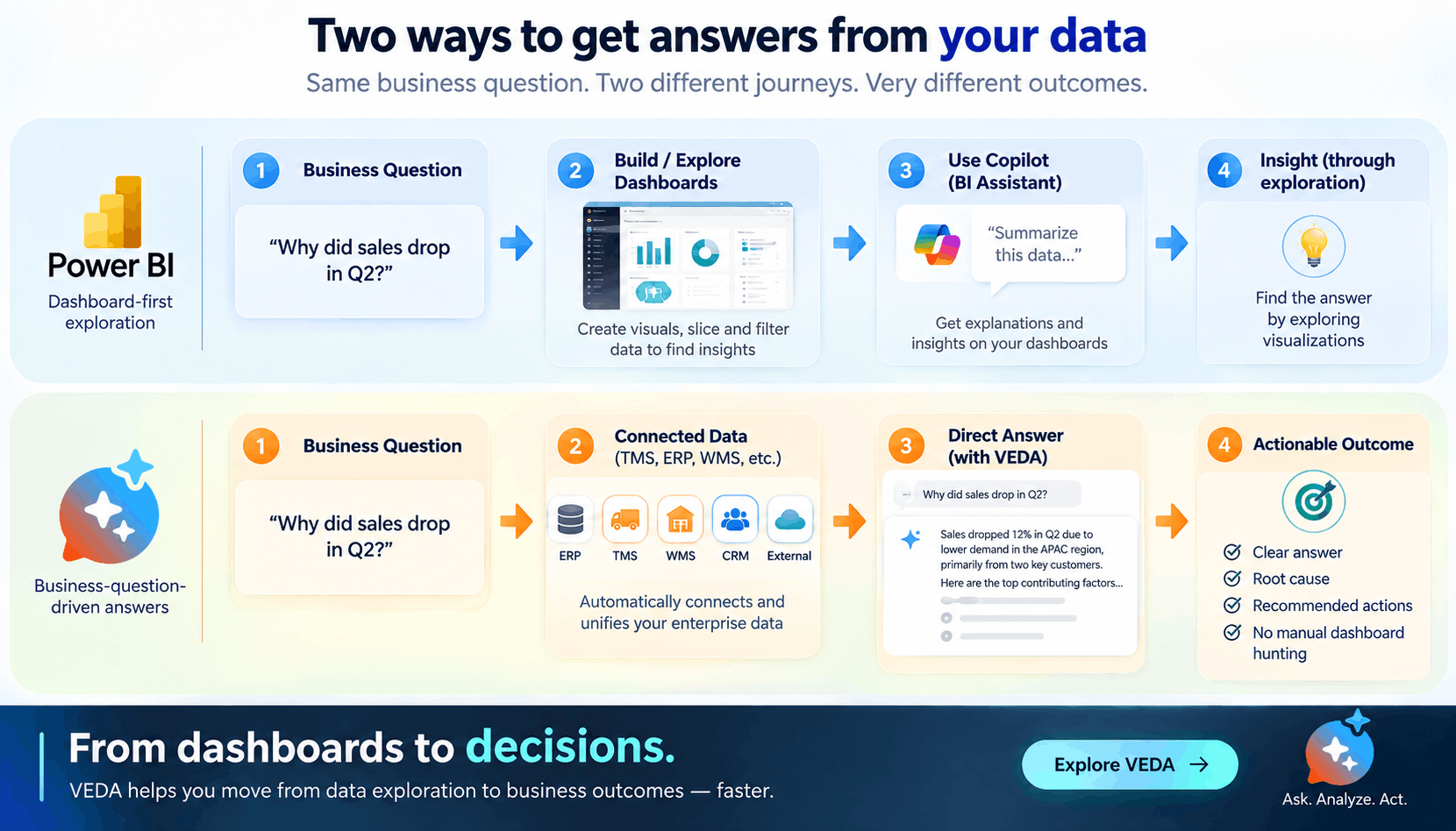
List your top 10 recurring business questions. Write down what leaders actually ask each week, such as "which customer segment is losing margin" or "which region missed target." Do not start with what dashboards you already have.
Test each question against your current Power BI setup. Note which questions need a new report built, which need a data model change, and which Copilot can answer directly using Q&A and existing measures.
Test the same questions against a business question first tool. With VEDA, this means asking the question in plain language and checking whether the answer resolves against your integrated ERP, CRM and operational data without a dashboard build step. Samta.ai's enterprise data integration engineering work is what connects those source systems underneath VEDA so a question can actually resolve correctly.
Score both on governance, not just speed. Check whether each tool shows where a number came from. A fast wrong answer is worse than a slower correct one, especially for regulated reporting.
Samta.ai acts as the engineering layer underneath VEDA in this framework, connecting source systems so the platform has governed data to answer from, rather than being a standalone promotional add on. Where a workflow needs automated follow up actions rather than just an answer, workflow automation consulting covers that layer separately.
Comparing five approaches to business analytics
Approach | Query method | Governance and lineage | Setup effort per new question | Best fit |
Power BI, dashboards only | Predefined filters and slicers | Strong within one semantic model | High, needs new report or visual | Fixed, recurring operational reports |
Power BI with Copilot | Natural language Q&A and report generation | Depends on model naming and synonyms | Medium, some manual model tuning | Teams already standardised on Power BI wanting faster report drafts |
Generic AI chatbot on exported data | Free text prompt | Weak, no source trace | Low, but ungoverned | Quick, low stakes exploration only |
Traditional enterprise BI (Tableau, Qlik) | Dashboard first, some NLQ add ons | Strong within platform | High | Large visualisation heavy reporting teams |
VEDA, business question first | Natural language question, resolved across connected sources | Strong, source traceable by design | Low, no dashboard build needed | Enterprise and BFSI teams needing governed, ad hoc answers |
For a deeper product level breakdown, see VEDA versus a general Data Intelligence Platform and the VEDA AI decision analytics product page.
Assess Your AI Model Risk with Confidence
Real world use cases
Regulated banking: exposure reporting
A bank's risk team uses Power BI dashboards built by a central BI function. When a regulator asks an unplanned question, such as exposure to one sector under a new stress scenario, analysts wait days for a new report to be built and validated. With a business question first layer connected to the same governed data, the same question resolves directly, with a trace back to source ledgers. The dashboard still exists for standard weekly reporting. The business question layer handles the unplanned, high stakes question that cannot wait for a build cycle. See how this pattern plays out in practice in Samta.ai's case studies.
General enterprise: sales and operations alignment
A manufacturer's sales team uses Power BI for pipeline dashboards. Operations uses a separate system for production data. When a sales leader asks whether a large order can be fulfilled on time given current production load, nobody can answer without a manual email chain. A business question first platform connected across both CRM and operations data answers this directly, without a new joint dashboard needing to be designed first. Read more on how this changes decision speed in AI powered insights.
Key risks and failure modes
Overtrusting Copilot generated visuals. Microsoft's own documentation states Copilot cannot reliably modify complex existing visuals or apply precise formatting, so generated reports still need review.
Weak semantic models undermine Copilot accuracy. Without clear field names and synonyms, natural language answers in Power BI can misread intent.
Business question tools without governance become guesswork. A natural language answer with no source trace is not safer than a spreadsheet, just faster.
Assuming one tool replaces the other entirely. Recurring, highly visual reporting often still needs a dashboard. Ad hoc, decision critical questions often do not.
Ignoring the human role in judgment. Neither tool replaces the final decision maker. See AI vs human decision making for where the line sits.
Underinvesting in data integration. Both Copilot and VEDA are only as good as the connected data underneath them. Fragmented ERP, CRM and operational systems limit either tool equally.
When to use Power BI, and when to use a business question first platform
Power BI, with or without Copilot, fits well when:
Reporting needs are recurring and mostly known in advance
Your organisation is already standardised on the Microsoft data stack
Visual customisation and pixel level report design matter
A central BI team can maintain and govern the semantic model over time
A business question first platform such as VEDA fits well when:
Leaders ask unplanned questions that cannot wait for a new dashboard build
Data sits across ERP, CRM and operational systems that are not fully joined today
Regulatory or audit needs require a traceable answer, not just a fast one
Teams outside a central BI function need direct answers without report building skills
Let’s Find the Right AI Approach for Your Business
Conclusion
Power BI and VEDA solve different parts of the same problem. One builds better dashboards faster. The other answers questions a dashboard was never built for. Most enterprise teams need both, applied to the right kind of question. The next step is testing your own questions against each approach directly.
About Samta
Samta.ai is a Singapore-headquartered AI Product Engineering & Data Intelligence partner helping enterprises build production-grade AI systems for regulated and data-intensive environments.We help organizations move beyond experimentation by engineering scalable, explainable, and enterprise-ready AI solutions from data foundations and model development to workflow automation and deployment.
Our capabilities combine deep AI expertise, data engineering, and product engineering to deliver measurable business impact across FinTech, BFSI, cybersecurity, regulatory technology, and enterprise operations.
Our enterprise AI products power real-world intelligence systems:
• TATVA : AI-driven data intelligence platform for governed analytics, monitoring, and operational insights
• VEDA : Explainable and audit-ready AI decisioning engine built for compliance-sensitive enterprise workflows
• CORA-Property Management Solutions: : Predictive intelligence platform for real-estate pricing, portfolio optimization, and investment analytics
Backed by ecosystem partnerships with Microsoft, Databricks, Snowflake, and AWS, Samta.ai delivers agile, cost-efficient AI engineering with faster turnaround and enterprise-grade scalability. Trusted by enterprises across FinTech, BFSI, and digital transformation initiatives, Samta.ai embeds AI governance, data privacy, and compliance-by-design principles directly into the AI lifecycle , enabling organizations to scale AI with transparency, accountability, and operational control.
Enterprises leveraging Samta.ai automate 65%+ of repetitive data, analytics, and decision workflows while maintaining governance, explainability, and measurable business outcomes. Samta.ai provides the strategic consulting, AI engineering, and data modernization expertise needed to align enterprise operations with next-generation AI transformation goals.
Frequently asked questions
How does VEDA differ from Power BI's Copilot features?
Copilot adds natural language generation on top of Power BI's existing dashboard model, helping build reports, write DAX and summarise visuals faster. VEDA starts from the business question itself and resolves it across connected data without a dashboard needing to exist first. Copilot speeds up report building. VEDA removes the report building step for many questions entirely.
What is the difference between dashboard first BI and business question first analytics?
Dashboard first BI builds a fixed report structure that users then filter and explore. Business question first analytics starts from a plain language question and resolves an answer directly from connected data sources. The first requires someone to anticipate what will be asked. The second answers what is actually asked, when it is asked.
Is Power BI enough for natural language business analytics?
For many recurring reporting needs, yes. Microsoft's documentation confirms Copilot supports natural language report generation and Q&A over existing semantic models. It is less suited to unplanned, cross system questions that need data joined across ERP, CRM and operations, which is where a business question first platform adds value.
How does VEDA's approach to AI analytics compare with Power BI's Copilot?
Copilot works within Power BI's existing dashboard and semantic model structure, so its accuracy depends on how well that model is built and named. VEDA is designed around resolving a business question directly across integrated enterprise data, without requiring a dashboard to exist first. Both depend on the quality of the underlying data integration to work well.
What should I evaluate when comparing a business question first analytics platform against a traditional BI tool with AI features?
Evaluate governance and source traceability first, not just speed or natural language fluency. Test both tools against your actual recurring questions, not vendor demos. Check how each handles unplanned, cross system questions, and confirm whether answers can be traced back to source data, which matters most for regulated or audited reporting.
Unlock Verifiable Insights Across All Data Stores
VEDA connects siloed data sources and empowers business leaders with real-time, governed AI decision analytics.
Explore VEDA Platform >