
Summarize this post with AI
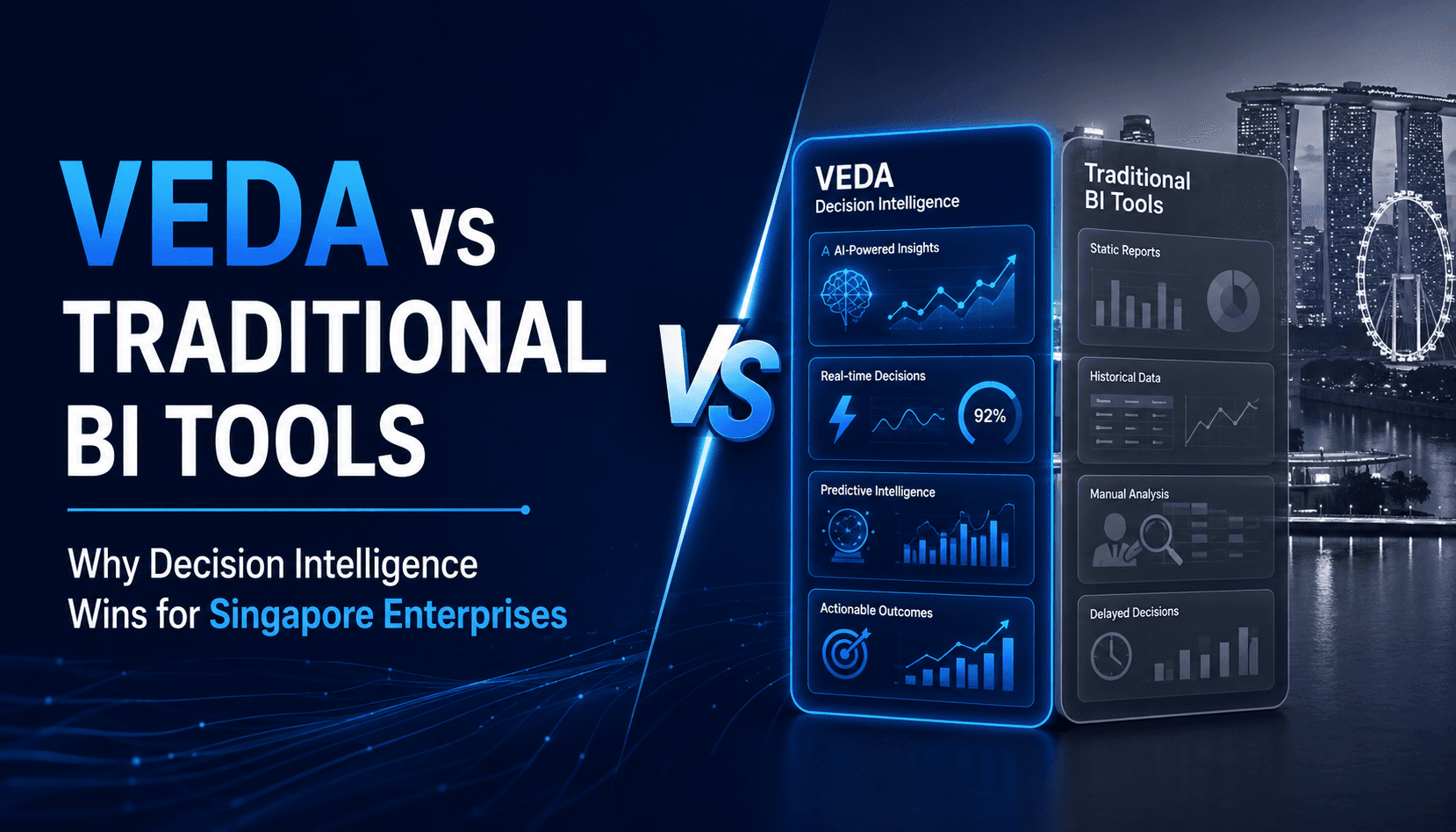
Traditional BI was built to answer "what happened." The problem is that boards no longer pay for that answer they pay for "what should we do next, and what happens if we do it?" The BI category is now splitting into two tiers: platforms that show data and platforms that explain it. veda vs traditional bi tools is precisely this split applied to the Singapore enterprise context, where MAS AI governance expectations, real-time decisioning requirements, and APAC regulatory obligations demand more than a well-formatted dashboard. This guide compares VEDA against traditional BI platforms directly on the five dimensions that determine whether your analytics investment produces decisions or reports.
VEDA vs Traditional BI Tools:
veda vs traditional bi tools resolves to a question of mode: traditional BI platforms including Power BI, Tableau, and Looker surface historical patterns for human interpretation; Veda AI is a decision intelligence platform that models decisions as strategic assets, connects data to recommended actions, and documents every AI-influenced decision with an audit trail built for MAS regulatory review. Gartner predicts 40 percent of enterprise applications will integrate task-specific AI agents by end of 2026, up from less than 5 percent in 2025, making the gap between advisory analytics and autonomous decision execution the primary differentiator in any enterprise analytics platform evaluation this year. For Singapore BFSI and regulated enterprises, veda ai platform governance architecture, explainability, and Databricks and Snowflake native integration make it the stronger operational fit where compliance documentation is a first-order requirement, not a reporting feature.
What Is Decision AI and How Does It Differ from Traditional BI
Business intelligence with ai is not the same as decision intelligence. The distinction determines whether your analytics platform saves your analysts 30 minutes per report or changes the quality of actual business decisions. Traditional BI follows a three-step pattern: connect data, build a dashboard, and hope someone looks at it before the decision is made. What is decision ai in contrast: it is the discipline of connecting data, AI models, and action pathways so that the platform moves from observation to recommendation to execution within a governed, auditable system. AI in BI is only trustworthy when it is grounded in a semantic layer; the best tools reduce metric drift instead of hiding it behind better charts. VEDA operates at the decision intelligence layer, not the reporting layer. It does not replace dashboards; it makes dashboards irrelevant for the decisions where timing, explainability, and governance matter more than visual design. For foundational context on what decision making with ai infrastructure requires before any platform delivers value, see the data discovery for AI guide and the AI decision intelligence platform guide.
Discover Your Organization's AI Readiness Score
Why This Comparison Matters Now for Singapore Enterprises
Three developments make ai decision intelligence vs bi the most consequential technology evaluation for Singapore heads of data and analytics in 2026.
1. Traditional BI platforms have hit a governance ceiling for regulated industries: Data governance is non-negotiable for AI: for AI blocks and predictive models to be accurate, platforms must be fed clean, structured, and first-party data protected by robust internal policies. Most traditional BI platforms treat governance as a data management feature, not a decision audit capability. For Singapore BFSI enterprises, MAS AI governance expectations now require per-decision audit trails, not aggregate dashboard governance.
2. The semantic layer is becoming the primary BI differentiator, but it still stops short of decision automation: Every major BI vendor now claims AI or agentic capabilities, but the depth behind those claims varies enormously and most comparison guides gloss over the differences. Power BI's Copilot, Tableau AI, and Looker's Gemini integration all add conversational querying on top of existing semantic models, but none delivers the governed decision automation that regulated enterprise workflows require.
3. Singapore's Enterprise Development Grant now subsidises qualifying analytics platforms: The Enterprise Development Grant through Enterprise Singapore continues to subsidise approved digital transformation tools, including qualifying BI platforms, covering up to 50 percent of implementation costs for eligible enterprises. This changes the cost comparison between traditional BI and decision intelligence platforms materially for organizations that qualify. For BFSI enterprises specifically, the AI governance framework 2026 guide covers how analytics platform governance connects to MAS supervisory expectations, and the real-time AI inference guide covers the infrastructure requirements for real-time decision systems that traditional BI platforms cannot satisfy.
The Evaluation Framework: Five Dimensions That Separate VEDA from Traditional BI
Use this framework to structure any veda vs traditional bi tools comparison for your specific enterprise context.
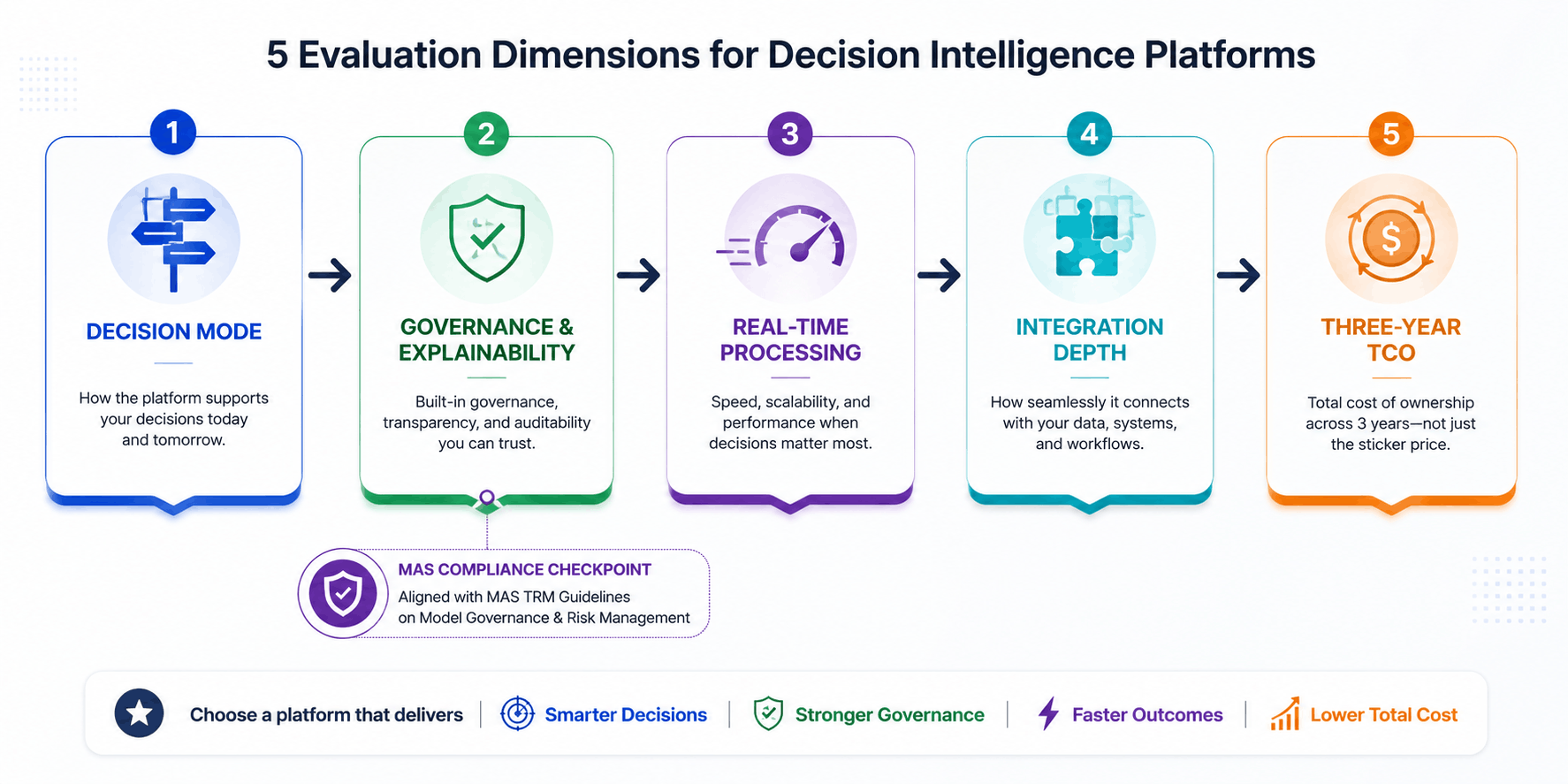
Dimension 1: Decision Mode Advisory vs Autonomous
Traditional BI platforms surface insights for human interpretation. A dashboard shows churn rate increasing; a human analyst investigates and escalates. Decision intelligence platforms close that loop: the platform detects the anomaly, investigates root cause, identifies the highest-confidence action, and either executes it within defined guardrails or escalates with a pre-populated recommendation. The only BI platforms in 2026 that automate the full analytical investigation from detecting that a metric changed, to decomposing why with quantified driver attribution, to delivering a finished explanation before anyone opens a dashboard are those that combine ML-driven root cause analysis with autonomous AI agents monitoring KPIs continuously. VEDA operates in this mode for regulated decision workflows including credit risk triage, fraud escalation, and compliance monitoring. Traditional BI platforms stop at the insight delivery step. For a comparative view of where AI-native platforms outperform traditional approaches across dimensions, see the 5 benefits of AI guide.
Dimension 2: Governance and Explainability Architecture
This is the dimension that separates platforms most sharply for Singapore regulated enterprises. Traditional BI governance means data access controls and row-level security who can see which dashboard. Decision intelligence governance means per-decision audit trails, scoring rationale, and explainability documentation exportable for MAS examiners without engineering involvement. VEDA's governance architecture connects decision outputs to audit trails on Databricks and Snowflake, making every AI-influenced decision in credit, fraud, and compliance workflows traceable through the full execution path. The AI security compliance services layer extends this with the governance documentation structure MAS supervisory reviews require. For enterprises assessing VEDA against general-purpose platforms in detail, the Veda vs data intelligence platform comparison covers this dimension directly.
Dimension 3: Real-Time vs Batch Processing
Traditional BI platforms are architecturally batch-oriented. Dashboards refresh on schedule, not on event. Decision intelligence for fraud detection, credit triage, or operational risk cannot wait for a scheduled refresh. VEDA's real-time streaming architecture on event-driven infrastructure means decisions are influenced by current data, not yesterday's batch. Modern BI has shifted from separate, siloed reporting tools to integrated systems where analytics sit directly alongside the projects they inform to drive immediate action. VEDA takes this further: analytics do not just sit alongside workflows; they trigger them. The real-time AI inference guide covers the infrastructure requirements this decision mode demands. The data integration consulting services team builds the data pipelines connecting source systems to VEDA's real-time decisioning layer.
Dimension 4: Integration Depth and Enterprise Data Architecture
AI features at the BI layer are only as reliable as the semantic modeling and data governance underneath them. Traditional BI platforms connect to data sources through pre-built connectors; VEDA connects through native Databricks and Snowflake integration, meaning property of the data layer lineage, quality scoring, access controls carries through to every decision the platform influences. For enterprises that have already built or are building a cloud data lakehouse architecture, VEDA functions as the decision layer on top of the governed data layer rather than as a separate analytics silo. The best conversational BI platforms guide covers where traditional BI platforms with conversational AI layers sit in this architecture, and the distinction from VEDA's decision intelligence approach.
Dimension 5: Total Cost of Ownership Across Three Years
Traditional BI platforms appear cheaper on a per-user, per-month basis. Enterprise Looker contracts average approximately $150,000 per year, and Tableau's Enterprise Creator tier runs $115 per user per month, with AI features frequently gated behind additional tiers or add-on modules. VEDA is enterprise-quoted based on decision volume and governance scope. The relevant comparison is not the monthly price but the three-year TCO including implementation, governance documentation overhead, compliance review cost, and the cost of decisions made on stale, ungoverned, or unexplainable data. For enterprises currently using or evaluating in-house analytics team structures alongside platform decisions, see the in-house AI team guide.
VEDA vs Traditional BI Tools: Head-to-Head Comparison
Dimension | Power BI + Copilot | Tableau + Tableau AI | Looker + Gemini | What It Means for Singapore BFSI | |
Decision Mode | Decision automation with governed action execution | Advisory: Copilot answers queries within dashboards; no autonomous execution | Advisory: Tableau AI surfaces insights; human executes decisions | Agentic BI in preview since April 2026; production readiness varies | VEDA is the only option where the platform executes regulated decisions with audit trail documentation |
Governance and Explainability | Per-decision audit trail built into platform architecture; exportable for MAS examiners without engineering involvement | Row-level security and workspace governance; no per-decision explainability documentation | Data management governance; no per-decision rationale for regulatory review | LookML semantic governance; no decision-level audit trail for MAS compliance | VEDA is purpose-built for Singapore regulated enterprise governance; others require compliance documentation to be built separately |
Real-Time Decisioning | Native event-driven streaming on Databricks and Snowflake; decisions triggered by live data | Scheduled refresh with real-time streaming on Premium tiers; analytical only | Hyper data engine; analytics focused, not decision automation | Real-time analytics via streaming; advisory not autonomous | VEDA is the only platform in this comparison where real-time data triggers governed automated decisions |
APAC Regulatory Fit | MAS AI governance, PDPA, and Singapore data residency compatibility built in | US and EU compliance tooling; APAC regulatory alignment requires additional configuration | General enterprise compliance; no documented MAS-specific governance | Google Cloud-native; APAC data residency configurable but not Singapore-specific | VEDA requires no additional compliance configuration for Singapore BFSI contexts |
Three-Year TCO | Custom enterprise quote based on decision volume and governance scope | Power BI Pro $14/user/month; Premium from $2,750/month; Copilot add-on priced separately | Enterprise Creator $115/user/month; Tableau+ features require additional contract | Enterprise average $150,000/year; AI features included through September 2026 only | Traditional BI TCO inflates significantly with governance documentation overhead not included in headline pricing |
Identify Hidden Risks Across Your AI Models
Enterprise Use Cases: VEDA vs Traditional BI in Practice
Use Case 1: Singapore Bank Replacing Dashboard-Based Credit Monitoring
A Singapore bank's credit risk team was running a Power BI dashboard refreshed every four hours to monitor portfolio quality indicators. When a metric moved outside tolerance, an analyst was notified, ran a query, escalated the finding, and a credit risk manager made a call. Total cycle time: 6 to 8 hours from signal to decision. After deploying VEDA on the bank's existing Databricks lakehouse, the same workflow became: real-time event detected, root cause isolated, recommended action surfaced with per-decision rationale, and compliance documentation generated automatically. Total cycle time: under 12 minutes. The MAS examination documentation that previously required 2,400 hours of annual analyst time to reconstruct was exportable on demand, consistent with the governance architecture covered in the AI governance framework 2026 guide.
Use Case 2: Logistics Enterprise Moving from BI Reports to Operational Decisions
A Singapore logistics company had invested significantly in Tableau dashboards for supply chain visibility. The dashboards were accurate and well-designed. The problem was that operations managers were looking at them after decisions had already been made, not before. A delayed shipment indicator on a Monday morning dashboard described a problem that should have triggered a routing change the previous Friday afternoon. VEDA was deployed as the decision layer on top of the existing data infrastructure, triggering routing recommendations as events occurred rather than surfacing them in the next dashboard refresh. This is the architectural distinction between ai decision intelligence vs bi in practice: BI reports on the past; decision intelligence acts on the present. Operational decision latency dropped from an average of 6.3 hours to under 18 minutes.
Key Risks and Failure Modes
Treating "AI-powered BI" marketing as equivalent to decision intelligence: Every major BI vendor now claims AI or agentic capabilities, but the depth behind those claims varies enormously. Power BI Copilot, Tableau AI, and Looker Gemini all add conversational querying on top of existing dashboard platforms. None delivers governed decision automation with per-decision audit trails. Verify capability depth before assuming AI-labeled BI platforms are decision intelligence platforms.
Deploying decision intelligence without a governed data foundation: VEDA's decision accuracy is directly proportional to the quality of the data layer underneath it. The data discovery for AI guide covers the data readiness prerequisites that must be in place before any decision intelligence platform delivers reliable outputs at production scale.
Selecting traditional BI for regulated decision workflows: A dashboard that informs a regulated decision but does not document the data inputs, model logic, or scoring rationale creates audit exposure. AI is only trustworthy when it is grounded in a governed layer that auditors can trace, and most traditional BI platforms do not provide this at the per-decision level.
Missing the governance cost in TCO comparisons: Traditional BI platform headline pricing excludes the engineering time required to build compliance documentation separately. A VEDA deployment that includes governance documentation as a platform output eliminates this cost entirely; a Power BI deployment at $14 per user per month that requires a separate compliance documentation process is significantly more expensive in total.
Decision Framework: VEDA or Traditional BI for Your Analytics Program?
Your primary analytics requirement is historical reporting and dashboard distribution → traditional BI is adequate
You need per-decision audit trails for MAS, PDPA, or equivalent regulatory review → VEDA
Your decision workflows require real-time data triggering automated actions → VEDA
Your data architecture is built on Databricks or Snowflake and you need native integration → VEDA
You need conversational querying on top of existing dashboards for business users → traditional BI with AI tier
You operate in BFSI or another regulated Singapore industry where governance documentation must be exportable on demand → VEDA
If the APAC regulatory and real-time decision boxes are checked, VEDA is the defensible choice. If the reporting and conversational querying boxes dominate, traditional BI with an AI tier may be sufficient.
Ready to Move Beyond Traditional BI Limitations?

Conclusion
veda vs traditional bi tools in 2026 is not a feature comparison; it is a mode comparison. Traditional BI platforms have added AI querying, agentic preview features, and semantic governance layers, but they remain architecturally advisory: they surface insights for humans to act on. VEDA operates at the decision intelligence layer where data triggers governed, explainable, real-time decisions with audit trails that Singapore regulated enterprises can present to MAS examiners without manual reconstruction. For the growing share of enterprise decisions that require that level of documentation and automation, the comparison is not close.
About Samta
Samta.ai is a Singapore-headquartered AI Product Engineering & Data Intelligence partner helping enterprises build production-grade AI systems for regulated and data-intensive environments.We help organizations move beyond experimentation by engineering scalable, explainable, and enterprise-ready AI solutions from data foundations and model development to workflow automation and deployment.
Our capabilities combine deep AI expertise, data engineering, and product engineering to deliver measurable business impact across FinTech, BFSI, cybersecurity, regulatory technology, and enterprise operations.
Our enterprise AI products power real-world intelligence systems:
• TATVA : AI-driven data intelligence platform for governed analytics, monitoring, and operational insights
• VEDA : Explainable and audit-ready AI decisioning engine built for compliance-sensitive enterprise workflows
• CORA-Property Management Solutions: : Predictive intelligence platform for real-estate pricing, portfolio optimization, and investment analytics
Backed by ecosystem partnerships with Microsoft, Databricks, Snowflake, and AWS, Samta.ai delivers agile, cost-efficient AI engineering with faster turnaround and enterprise-grade scalability. Trusted by enterprises across FinTech, BFSI, and digital transformation initiatives, Samta.ai embeds AI governance, data privacy, and compliance-by-design principles directly into the AI lifecycle , enabling organizations to scale AI with transparency, accountability, and operational control.
Enterprises leveraging Samta.ai automate 65%+ of repetitive data, analytics, and decision workflows while maintaining governance, explainability, and measurable business outcomes. Samta.ai provides the strategic consulting, AI engineering, and data modernization expertise needed to align enterprise operations with next-generation AI transformation goals.
Frequently Asked Questions
What is the difference between VEDA and traditional BI tools like Power BI or Tableau?
veda vs traditional bi tools is a question of decision mode. Traditional BI platforms including Power BI and Tableau surface historical insights for human interpretation through dashboards and reports. VEDA is a veda ai platform operating at the decision intelligence layer, connecting data to governed, explainable, real-time decision recommendations and actions, with per-decision audit trails built into the platform architecture rather than requiring separate documentation processes.
What is decision AI and how does it differ from traditional analytics?
What is decision ai in enterprise terms: it is the discipline of connecting data, AI models, constraints, and action pathways into a system that moves from observation to recommended action to governed execution. Traditional analytics stops at observation. Decision AI closes the loop from insight to action with documentation of why the action was recommended, which data inputs influenced it, and what the outcome was, creating the audit trail regulated industries require.
How does business intelligence with ai differ from ai decision intelligence?
Business intelligence with ai describes traditional BI platforms that have added conversational querying, anomaly detection, or predictive features on top of existing dashboard architectures. The underlying mode remains advisory: the platform surfaces insights for human decision. AI decision intelligence describes platforms where the AI layer itself models, recommends, and in governed contexts executes decisions, with every step documented for audit. The gap between these two modes is the gap between 6-hour decision cycles and 12-minute decision cycles.
What is the difference between gen ai and gen bi?
Difference between gen ai and gen bi is a distinction between capability and application. Generative AI describes foundation model capability for text, image, code, and data generation. Generative BI describes applying that capability specifically to business analytics: natural language queries, auto-generated visualizations, and AI-written narrative insights on top of existing data. Neither generative AI nor generative BI is the same as decision intelligence, which adds execution, governance, and audit trail documentation to the analytics and AI layers.
Does VEDA replace Power BI or Tableau for Singapore enterprises?
VEDA is not a dashboard replacement for general reporting needs. For regulated decision workflows in BFSI, compliance monitoring, and real-time operational decisions where per-decision audit trails are required, VEDA replaces the analytics layer that feeds those decisions. Enterprises frequently operate VEDA alongside existing BI platforms: VEDA for governed decision workflows, Power BI or Looker for general reporting and self-service analytics. The distinction is the decision mode and governance requirement, not the tool category.