
Summarize this post with AI
A working AI pilot on a laptop convinces nobody. A working AI system in production, tied to real decisions, is what boards actually ask about. AI transformation consulting Singapore firms increasingly get called in after a pilot has already impressed a demo audience and then quietly stalled. This piece covers why that happens and the framework that moves a pilot from proof of concept to something running in production.
AI transformation consulting Singapore:
Most AI pilots fail to reach production because of poor data quality, unclear business value, inadequate risk controls and escalating cost, not because the underlying model is weak. Gartner predicts at least 30 percent of generative AI projects will be abandoned after proof of concept, and a separate 2025 prediction puts agentic AI project cancellations above 40 percent by 2027. For banks and large enterprises in Singapore, closing this gap means treating data integration, governance and change management as part of the AI project itself, not as afterthoughts.
What does pilot to production actually mean?
Pilot to production describes the transition from a small, contained AI test to a system running against live data, in a live workflow, with real users depending on it. This is different from a proof of concept, which only needs to show a concept works once. Production requires the system to keep working reliably, at scale, under governance.
Related terms include AI implementation failure, the general category of projects that stall anywhere along this path, and production ready AI, a system that has cleared data quality, security and monitoring requirements, not just a demo. See a deeper breakdown of what a working implementation actually requires in the AI implementation playbook.
Make Faster, Smarter Decisions With VEDA
Why AI pilots stall now, and why it matters for Singapore banks
Three data points explain why this gap has become a board level concern in 2026.
Most GenAI pilots do not survive past proof of concept: Gartner's 2024 prediction states that at least 30 percent of generative AI projects will be abandoned after proof of concept, driven by poor data quality, inadequate risk controls, escalating costs or unclear business value.
Agentic AI faces an even steeper drop off: Gartner's 2025 prediction goes further, forecasting that over 40 percent of agentic AI projects will be canceled by the end of 2027, citing the same underlying causes at a larger scale.
Scaling value remains the hard part industry wide: BCG's 2024 research on AI adoption found that 74 percent of companies struggle to achieve and scale value from their AI investments, which matches what most enterprise AI teams experience once a pilot leaves the sandbox.
Banks operating in Singapore face this pressure on top of existing model governance expectations. Read how this plays out specifically in AI transformation for banks, and how the broader data foundation gets built in how modern enterprises build that capability.
A five step framework to move AI from pilot to production
Here is the sequence that closes the gap between a working demo and a production system.
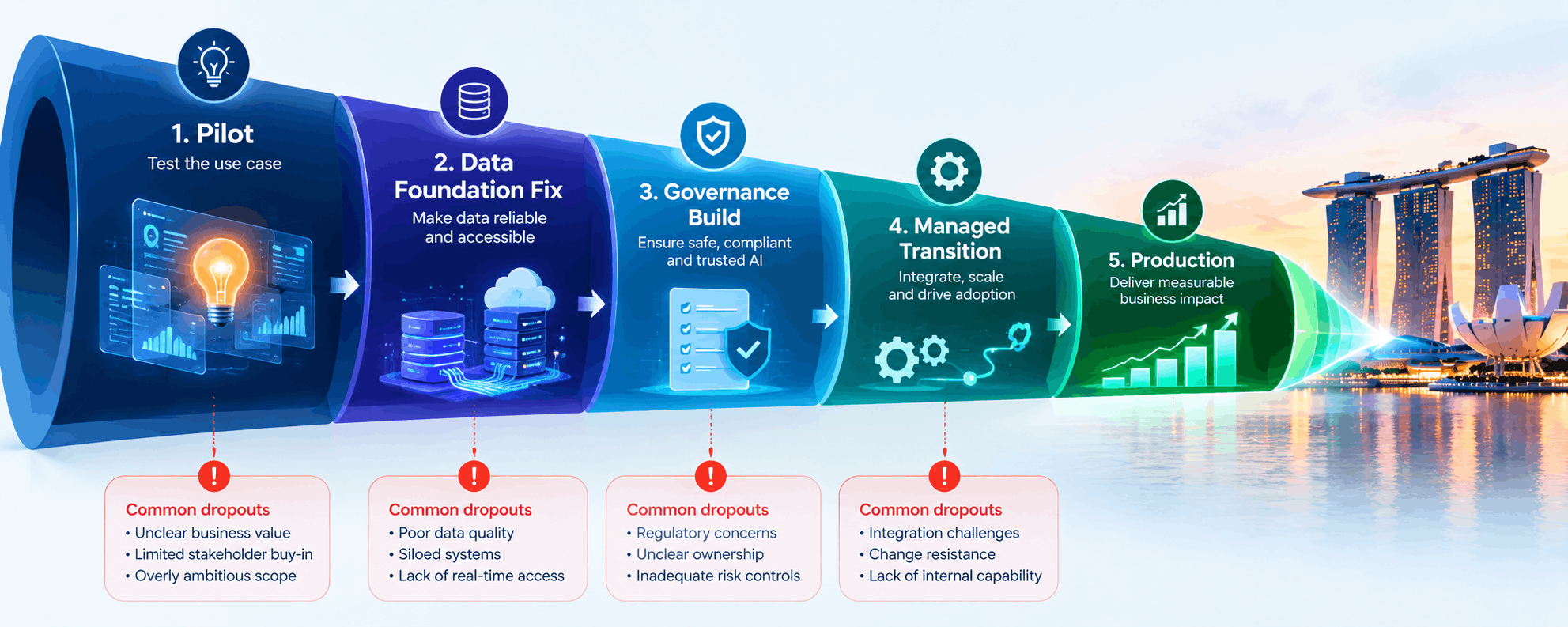
Define the production bar before the pilot starts. Decide upfront what data quality, uptime, security and monitoring requirements the system must meet in production, not after the pilot succeeds. Most stalled pilots never had this bar defined.
Fix the data foundation the pilot quietly skipped. Pilots often run on a clean, hand picked dataset. Production needs the model fed by governed, integrated ERP, CRM and operational data. Data integration consulting services do this connection work, and enterprise AI engineering in Singapore covers the broader engineering discipline behind it.
Build governance and security in from day one. Retrofitting risk controls after a pilot succeeds is slower and harder than designing them in from the start. AI security and compliance services cover this layer directly.
Run the system through a managed transition, not a handoff. Moving from pilot to live operation needs monitoring, rollback plans and a support model, which digital transformation managed services are built to carry.
Connect the system to a decision layer, not just a dashboard. Once in production, the AI system needs to feed real decisions. Samta.ai's Veda platform and the underlying Veda AI decision analytics product serve this role as the engineering execution layer, working with a client's existing Databricks, Snowflake or Microsoft stack rather than replacing it. For how this compares against a general consulting engagement model, see Big 4 versus Samta.ai.
Comparing five approaches to moving AI into production
Approach | Data foundation handled | Governance built in | Speed to production | Best fit |
Pilot left as is, scaled informally | No, runs on sample data | Minimal | Fast at first, stalls later | Early exploration only |
Internal team retrofits governance after pilot | Partial, reactive | Added late, gaps likely | Slow, rework heavy | Teams with in house AI maturity |
General management consulting engagement | Advisory only, not engineered | Strong on policy, weak on implementation | Medium, dependent on internal build | Strategy definition phase |
Point AI vendor tool | Vendor specific, narrow | Limited to vendor scope | Fast for narrow use case | Single, well bounded use cases |
End to end AI transformation consulting | Yes, engineered from source systems | Built in from design | Fastest for sustained production use | Enterprise and BFSI scaling multiple use cases |
Only the last row addresses data, governance and speed together. For a platform level comparison relevant to the decision layer in step 5, see Veda versus a general Data Intelligence Platform.
A five step framework to move AI from pilot to production
Real world use cases
Regulated bank: fraud detection model stuck in pilot
A bank's fraud detection model performed well in testing but could not move to production because transaction data lived across three systems that were never fully integrated. Compliance also flagged that monitoring and explainability had not been designed in. Once the data foundation was rebuilt with proper integration and governance controls added before relaunch, the model reached production with a documented monitoring plan the compliance team could sign off on. See similar patterns in Samta.ai's case studies.
General enterprise: demand forecasting pilot
A retailer's forecasting pilot used two years of clean historical data and looked accurate. In production, real time inventory and supplier data introduced gaps the pilot never accounted for, and the model's accuracy dropped sharply within weeks. Rebuilding the data pipeline to match production conditions, rather than the pilot's curated dataset, closed most of the accuracy gap before relaunch.
Key risks and failure modes
Pilots built on curated data that production will never have. A clean sample dataset hides the real data quality problems that surface later.
No defined production bar from the start. Without agreed thresholds for uptime, accuracy and governance, nobody can say when a pilot is actually ready to scale.
Governance treated as a final step. Retrofitting risk controls after a pilot succeeds takes longer than building them in from the beginning.
Underestimating change management. Users trained on a pilot version often resist or misuse the production version if the transition is not managed.
Cost escalation with no clear owner. Gartner's own findings point to escalating cost as a top reason projects get cancelled, often because nobody tracked total cost from pilot through to scaled production.
Treating AI transformation consulting Singapore engagements as one time projects. Production systems need ongoing monitoring and iteration, not a single delivery milestone.
When to bring in AI transformation consulting, and when not to
Bring in outside support if:
A pilot has stalled for more than a few months with no clear technical reason
Your team can build models but lacks in house data integration or governance capacity
Multiple pilots need to scale at once across different business units
Compliance or risk teams have flagged gaps that need engineering, not just policy
Handle it internally if:
You have a mature in house data engineering and MLOps function already
The use case is narrow, low risk and well bounded
You are still validating whether the use case has business value at all
Read the specifics of what a Singapore focused engagement looks like in AI transformation consulting Singapore.
Get a Clear View of Your AI Model Risk Exposure
Conclusion
A pilot that impresses in a demo says nothing about whether it will survive contact with real, messy production data. The gap between the two is where most AI projects actually die. Closing that gap means treating data integration and governance as part of the build, not as cleanup after the fact. The next step is finding out exactly where your own pilot is stuck.
About Samta
Samta.ai is a Singapore-headquartered AI Product Engineering & Data Intelligence partner helping enterprises build production-grade AI systems for regulated and data-intensive environments.We help organizations move beyond experimentation by engineering scalable, explainable, and enterprise-ready AI solutions from data foundations and model development to workflow automation and deployment.
Our capabilities combine deep AI expertise, data engineering, and product engineering to deliver measurable business impact across FinTech, BFSI, cybersecurity, regulatory technology, and enterprise operations.
Our enterprise AI products power real-world intelligence systems:
• TATVA : AI-driven data intelligence platform for governed analytics, monitoring, and operational insights
• VEDA : Explainable and audit-ready AI decisioning engine built for compliance-sensitive enterprise workflows
• CORA-Property Management Solutions: : Predictive intelligence platform for real-estate pricing, portfolio optimization, and investment analytics
Backed by ecosystem partnerships with Microsoft, Databricks, Snowflake, and AWS, Samta.ai delivers agile, cost-efficient AI engineering with faster turnaround and enterprise-grade scalability. Trusted by enterprises across FinTech, BFSI, and digital transformation initiatives, Samta.ai embeds AI governance, data privacy, and compliance-by-design principles directly into the AI lifecycle , enabling organizations to scale AI with transparency, accountability, and operational control.
Enterprises leveraging Samta.ai automate 65%+ of repetitive data, analytics, and decision workflows while maintaining governance, explainability, and measurable business outcomes. Samta.ai provides the strategic consulting, AI engineering, and data modernization expertise needed to align enterprise operations with next-generation AI transformation goals.
Frequently asked questions
What percentage of AI pilots fail?
Estimates vary by scope and source, but Gartner's own prediction puts at least 30 percent of generative AI projects abandoned after proof of concept, with agentic AI projects facing an even steeper 40 percent plus cancellation rate by 2027. BCG separately found 74 percent of companies struggle to scale value from AI, which is a related but broader measure of difficulty.
Why do AI projects fail in production?
The most common causes are poor data quality, inadequate risk controls, unclear business value and escalating cost, according to Gartner's research. Pilots often run on clean, curated data that does not reflect production conditions, so problems that were invisible in testing surface once the system meets real, messy enterprise data.
How do you move AI from pilot to production?
Define production requirements for data quality, governance and monitoring before the pilot starts, not after it succeeds. Fix the underlying data integration so the model works on real enterprise data, not a curated sample. Build governance and security in from the design stage, then manage the transition with proper monitoring rather than a one time handoff.
What are common AI project failures?
Common failures include pilots built on unrepresentative data, governance added too late to catch real risks, unclear ownership of total project cost, and weak change management once a system reaches real users. Most of these are organisational and data related, not failures of the underlying AI model itself.
What is the failure rate of AI projects specifically in banking?
There is no single verified failure rate specific to banking. Source Required: a bank specific figure would need to come from a banking sector survey such as those published by MAS, McKinsey or a similar named source. What is consistent across studies is that regulated industries face extra governance requirements that increase the risk of stalling if not planned for early.
Unlock Verifiable Insights Across All Data Stores
VEDA connects siloed data sources and empowers business leaders with real-time, governed AI decision analytics.
Explore VEDA Platform >