
Summarize this post with AI
Cybersecurity and RegTech firms in Singapore are simultaneously selling AI-powered products to regulated clients and operating under the same MAS and PDPA obligations as those clients. Most AI engineering consulting cybersecurity Singapore engagements fail because they treat the two problems separately building AI features fast, then retrofitting security and compliance controls when the product reaches a regulated buyer's procurement process. This guide gives CTOs and product engineering leaders at Singapore cybersecurity and RegTech firms a structured framework for AI engineering for security products that satisfies both product velocity requirements and the regulatory obligations that determine whether enterprise clients can actually deploy what you build.
AI Engineering Consulting Cybersecurity Singapore:
AI engineering consulting for cybersecurity and RegTech firms in Singapore covers three distinct problems that generic AI engineering engagements do not address: building AI models that can detect, classify, and respond to adversarial inputs without being fooled by adversarial ML attacks; engineering RegTech AI products that satisfy MAS TRM, PDPA, and FEAT requirements from the product architecture layer; and deploying AI as a tool for security in environments where the data being processed is itself regulated requiring data minimisation, consent tracking, and audit trail infrastructure embedded in the product, not added as a compliance layer later.
What AI Engineering for Cybersecurity and RegTech Actually Covers
What is AI security in the product engineering context is distinct from AI safety in the academic context. For Singapore cybersecurity and RegTech product companies, it means three things:
Adversarial robustness: AI models in security products must be tested against adversarial ML attacks: input perturbation, model evasion, data poisoning, and model inversion. A fraud detection model that can be evaded by a sufficiently sophisticated adversary is not a security product it is a false assurance.
Regulated data handling: security and RegTech products process some of the most sensitive data categories in enterprise environments: transaction records, identity documents, behavioural logs, and financial crime intelligence. Every AI pipeline touching this data carries PDPA and sector-specific data handling obligations.
Client-side deployment constraints: enterprise BFSI clients deploying your RegTech or cybersecurity product will subject it to their own MAS TRM examination. If your product cannot produce model cards, audit trails, and explainability output, it will fail procurement at the largest clients in your target market.
Cyber security AI engineering that ignores any of these three dimensions produces technically functional products that cannot be sold to, deployed by, or retained by Singapore's regulated enterprise market. Review how AI transformation for banks is structured to understand what your BFSI clients require from every AI-embedded product in their technology stack.
Identify Your Biggest AI Opportunities and Risks
Why AI Engineering for Singapore Cybersecurity and RegTech Is Different in 2026
Three market developments have changed what regtech ai engineering requires:
1. MAS has raised the bar for AI-embedded third-party products
MAS Technology Risk Management guidelines now extend to third-party technology vendors including cybersecurity and RegTech product companies. Your BFSI clients are contractually obligated to ensure that third-party AI systems in their environment satisfy MAS TRM standards. If your product cannot be examined alongside your client's own systems, you will be removed from their technology stack during the next examination cycle.
2. Adversarial ML attacks on financial security systems are increasing
Singapore's Cyber Security Agency has reported increasing sophistication in attacks targeting AI-based fraud detection and AML systems specifically — using adversarial inputs designed to evade ML-based detection rather than signature-based rules (Source Required: CSA Singapore Cybersecurity Landscape Report). RegTech and cybersecurity products that have not been tested against adversarial ML attack patterns are operating on an assumption of safety that the threat landscape no longer supports.
3. Generative AI is introducing new attack surfaces in security products
Security products that use LLMs for threat intelligence summarisation, regulatory document analysis, or alert triage now carry prompt injection attack surfaces that did not exist in rule-based or traditional ML systems. AI agents for engineering in security contexts must be designed with prompt injection defence, output validation, and tool call auditing from the architecture layer not patched in after a red team exercise exposes the gap.
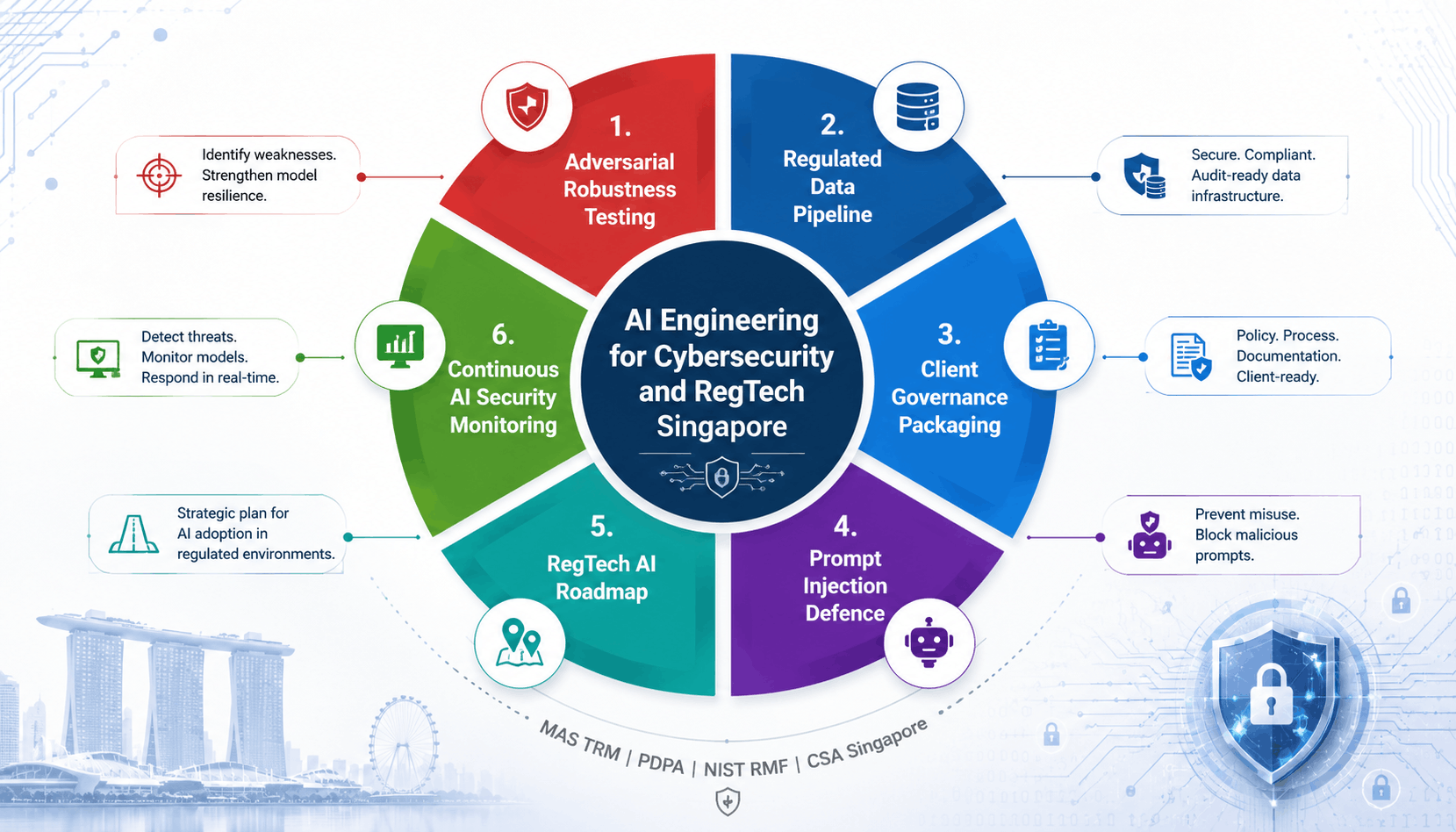
The 6-Component AI Engineering Framework for Cybersecurity and RegTech Products
Component 1: Adversarial Robustness Testing
Before any security AI model reaches production, test it against the four primary adversarial ML attack categories: evasion attacks (input perturbation at inference time), poisoning attacks (malicious training data injection), model inversion (extraction of training data from model outputs), and membership inference (determining whether specific records were in the training set). Document the attack categories tested, the testing methodology, and the model's robustness thresholds for each. This documentation is what your BFSI clients will request during their own model risk assessments of your product.
Component 2: Regulated Data Pipeline Design
For every data category your product processes transaction records, identity data, behavioural logs, financial crime intelligence map the applicable regulatory obligations: PDPA consent basis, MAS data residency requirements, and any sector-specific data handling rules. Build data minimisation, pseudonymisation, and consent tracking into the pipeline architecture before model development begins. Samta.ai's data integration consulting services implement regulated data pipeline design on Databricks and Snowflake as the foundation layer for cybersecurity and RegTech AI product builds ensuring data handling compliance is engineered in, not documented around.
Component 3: Client-Deployable Governance Infrastructure
Every AI model embedded in your product must ship with: a model card covering purpose, training data categories, known limitations, and performance thresholds; explainability API output for individual predictions; audit trail generation for every inference; and drift monitoring infrastructure that your client can integrate with their own monitoring stack. Products that ship AI models without these components will not pass BFSI client procurement processes that include AI governance review which is now standard practice at Singapore's tier-one financial institutions. The 6 components of AI governance provides the complete governance checklist that your product architecture must satisfy.
Component 4: Prompt Injection Defence for GenAI Features
If your product includes LLM-based features threat intelligence summarisation, regulatory document Q&A, alert triage implement prompt injection defence at the architecture layer: input sanitisation, system prompt separation from user input, output validation against defined response schemas, and tool call auditing for every agentic action the LLM takes. Product engineering with AI in security contexts requires treating the LLM as an untrusted component that must be sandboxed and audited not as a trusted reasoning engine. Samta.ai's AI security and compliance services include prompt injection threat modelling and LLM sandboxing architecture as standard components of GenAI security product builds.
Component 5: RegTech AI Engineering Roadmap
A regtech ai engineering roadmap for Singapore product companies must sequence three parallel workstreams: regulatory alignment (mapping your product's AI components to MAS TRM, PDPA, and FEAT requirements); adversarial testing (establishing a continuous red-teaming program for AI model components); and client governance packaging (producing the model cards, audit trail documentation, and explainability outputs that enterprise clients require during procurement and examination). These three workstreams must run in parallel during product development not sequentially, where regulatory alignment is always the last item addressed before a client deal is at risk.
Component 6: Continuous Security Monitoring for AI Components
AI models in production security products degrade in two ways simultaneously: model drift as the threat or regulatory landscape changes, and adversarial adaptation as attackers learn the model's decision boundaries. Implement continuous monitoring for both: standard drift detection on feature and output distributions, and adversarial red-teaming on a defined quarterly cadence. The VEDA AI Data Analytics Platform provides continuous model performance monitoring, drift detection, and audit trail generation that cybersecurity and RegTech product companies can embed in their client-facing reporting dashboards giving enterprise clients real-time visibility into the AI components of your product.
AI Engineering Consulting Cybersecurity Singapore: Capability Comparison
Capability | Generic AI Consulting | Cybersecurity Specialist | RegTech Specialist | |
Adversarial Robustness Testing | Not covered | Penetration testing focus | Limited to regulatory context | Adversarial ML testing: evasion, poisoning, inversion |
Regulated Data Pipeline Design | Generic data engineering | Security-focused, limited PDPA | PDPA and MAS-aligned | Databricks / Snowflake with full consent and lineage |
Client Governance Packaging | Not included | Limited model documentation | Regulatory report focus | Model cards, audit trails, explainability API included |
GenAI Prompt Injection Defence | Not standard | Basic input filtering | Not typically covered | Architecture-layer sandboxing and tool call auditing |
Continuous AI Security Monitoring | Basic drift monitoring | Incident response focus | Compliance reporting | VEDA-embedded drift plus quarterly adversarial red-team |
Discover Hidden AI Risks Across Your Enterprise
Real-World Use Cases: AI Engineering in Cybersecurity and RegTech
Use Case 1: AML Detection Product, Singapore RegTech Firm (BFSI)
A Singapore-based RegTech firm had built an ML-based AML transaction monitoring product that achieved strong detection rates in testing. When the product entered procurement at a tier-one Singapore bank, the bank's model risk team requested: model card, training data lineage documentation, explainability output for individual AML alerts, audit trail specification, and adversarial robustness testing report. None of these existed. The procurement process was paused for 14 weeks while the governance documentation was retroactively produced and the explainability API had to be rebuilt from scratch because the original model architecture did not support feature-level explanation output. The product shipped to the client 17 weeks late and required a SGD 240,000 governance engineering rework. Building client-deployable governance infrastructure from the start as a component of the product, not a procurement deliverable would have cost an estimated SGD 65,000 during the original build. Review the AI transformation consulting Singapore framework to understand how the most examination-ready BFSI AI product engagements are structured.
Use Case 2: Cyber Threat Intelligence Platform, Security Software Firm
A Singapore cybersecurity software company added an LLM-based threat intelligence summarisation feature to its SIEM product using a fine-tuned model to summarise threat feeds and generate analyst briefings. Within 3 months of deployment, a red team exercise identified a prompt injection vulnerability that allowed a malicious threat feed to override the system prompt and instruct the LLM to suppress high-severity alerts from its summaries.The vulnerability was an architecture-layer failure the LLM had been integrated without input sanitisation, system prompt separation, or output validation against a defined response schema. Remediation required a full architecture rebuild of the LLM integration layer, taking 8 weeks and delaying a major product release. AI as a tool for security requires treating the AI component as a potential attack surface not just as a capability layer. The in-house AI team versus consulting partner decision for security product companies often turns on exactly this: external specialists who have seen these attack patterns across multiple product builds identify them during architecture design, before they become production vulnerabilities.
Key Risks and Failure Modes in Cybersecurity and RegTech AI Engineering
Governance as a sales document, not a product component: producing model cards and audit trail documentation as one-off procurement deliverables rather than as automated product outputs; every new client then triggers the same manual documentation exercise
Adversarial testing performed once, not continuously: threat actors adapt their attack patterns; a model that passes a one-time red team exercise at launch may be evadable within 6–12 months as adversaries map its decision boundaries
LLM features without prompt injection defence: treating GenAI components as trusted reasoning engines rather than untrusted, sandboxed components that require input sanitisation and output validation
Data minimisation not enforced at the pipeline layer: collecting more sensitive data than the model requires because it was available, then discovering that client data governance teams reject the data handling model during procurement
Regulatory alignment deferred to pre-sales: treating MAS TRM and PDPA compliance as a sales and legal problem rather than a product engineering requirement; the gap is discovered when the first major client's procurement team asks a technical question that requires a product architecture answer
Compare how AI engineering for security products differs from general enterprise AI in the VEDA vs data intelligence platform comparison where security-specific data handling and audit trail requirements determine platform suitability for regulated client deployments.
Decision Framework: When to Engage AI Engineering Consulting for Cybersecurity and RegTech
Engage specialist AI engineering consulting when:
Your product roadmap includes AI features that will be deployed in BFSI client environments subject to MAS TRM examination
Your engineering team has not previously built AI models against adversarial ML attack categories
Your product processes regulated data categories (transaction records, identity data, financial crime intelligence) and lacks documented data minimisation and consent tracking at the pipeline layer
You have LLM-based features without documented prompt injection defence architecture
Build the capability in-house when:
You have existing senior AI engineers with adversarial ML testing experience on security-specific datasets
Your product has already passed MAS TRM examination at a tier-one Singapore BFSI client with no governance findings
You have a dedicated AI security function with a continuous red-teaming program already in operation
Use a hybrid model when:
You want to build internal AI security capability over 18–24 months while using external consulting for the first two client-ready product builds
You need to reach a major BFSI client deployment within 12 months but do not yet have the internal adversarial testing or governance packaging capability.
Ready to Accelerate Your AI Strategy?

Conclusion
AI engineering consulting for cybersecurity and RegTech firms in Singapore is not a standard AI program delivery; it is a specialist discipline that requires adversarial robustness, regulated data handling, and client-deployable governance to be engineered into the product architecture from the first sprint, not appended before a client deal closes. Products that embed governance and security as engineering requirements not compliance documentation consistently pass BFSI client procurement and MAS examination cycles without the delays and rework costs that define the alternative. Build it right from the start, and your product becomes a competitive differentiator. Build it wrong, and your first major client deal will fund an expensive rebuild.
About Samta
Samta.ai is a Singapore-headquartered AI Product Engineering & Data Intelligence partner helping enterprises build production-grade AI systems for regulated and data-intensive environments.We help organizations move beyond experimentation by engineering scalable, explainable, and enterprise-ready AI solutions from data foundations and model development to workflow automation and deployment.
Our capabilities combine deep AI expertise, data engineering, and product engineering to deliver measurable business impact across FinTech, BFSI, cybersecurity, regulatory technology, and enterprise operations.
Our enterprise AI products power real-world intelligence systems:
• TATVA : AI-driven data intelligence platform for governed analytics, monitoring, and operational insights
• VEDA : Explainable and audit-ready AI decisioning engine built for compliance-sensitive enterprise workflows
• CORA-Property Management Solutions: : Predictive intelligence platform for real-estate pricing, portfolio optimization, and investment analytics
Backed by ecosystem partnerships with Microsoft, Databricks, Snowflake, and AWS, Samta.ai delivers agile, cost-efficient AI engineering with faster turnaround and enterprise-grade scalability. Trusted by enterprises across FinTech, BFSI, and digital transformation initiatives, Samta.ai embeds AI governance, data privacy, and compliance-by-design principles directly into the AI lifecycle , enabling organizations to scale AI with transparency, accountability, and operational control.
Enterprises leveraging Samta.ai automate 65%+ of repetitive data, analytics, and decision workflows while maintaining governance, explainability, and measurable business outcomes. Samta.ai provides the strategic consulting, AI engineering, and data modernization expertise needed to align enterprise operations with next-generation AI transformation goals.
Frequently Asked Questions
What is AI engineering consulting for cybersecurity in Singapore?
AI engineering consulting cybersecurity Singapore covers three specialist capabilities that generic AI engineering firms do not offer: adversarial ML robustness testing for security AI models, regulated data pipeline design for environments subject to MAS TRM and PDPA obligations, and client-deployable governance packaging model cards, audit trails, and explainability APIs that allow BFSI clients to deploy your product without triggering their own model risk examination findings.
What is AI security in the context of product engineering?
What is AI security in product engineering: it is the discipline of designing AI systems that are robust to adversarial attacks, minimise the data they process and retain, produce auditable and explainable outputs, and operate within the access control and monitoring infrastructure of the environments they are deployed in. For Singapore cybersecurity and RegTech product companies, AI security is both a product capability and a client procurement requirement.
What is a RegTech AI engineering roadmap and what should it include?
A regtech ai engineering roadmap for Singapore product companies should include three parallel workstreams running from product inception: regulatory alignment mapping (MAS TRM, PDPA, FEAT requirements for each AI component), adversarial testing program (evasion, poisoning, inversion, and membership inference testing on a defined cadence), and client governance packaging (model cards, explainability APIs, audit trail specifications produced as automated product outputs, not manual procurement deliverables).
How does MAS TRM affect cybersecurity and RegTech AI products sold in Singapore?
MAS TRM guidelines apply to third-party technology vendors whose products are deployed in Singapore financial institutions including cybersecurity and RegTech firms. Your BFSI clients are contractually required to ensure that your AI-embedded product satisfies MAS TRM model risk standards. Products that cannot produce model cards, audit trails, and explainability output on request will fail client procurement reviews and MAS examination cycles, resulting in removal from the client's technology stack.
What is prompt injection and why does it matter for AI security products?
Prompt injection is an attack where malicious input overrides the system prompt of an LLM-based component, causing it to execute unintended instructions. For security products that use LLMs for threat intelligence summarisation, alert triage, or regulatory document analysis, a successful prompt injection attack can cause the LLM to suppress alerts, modify summaries, or exfiltrate data. Cyber security AI engineering for LLM-based features requires architecture-layer defence input sanitisation, system prompt separation, and output schema validation not just application-layer filtering.