
Summarize this post with AI
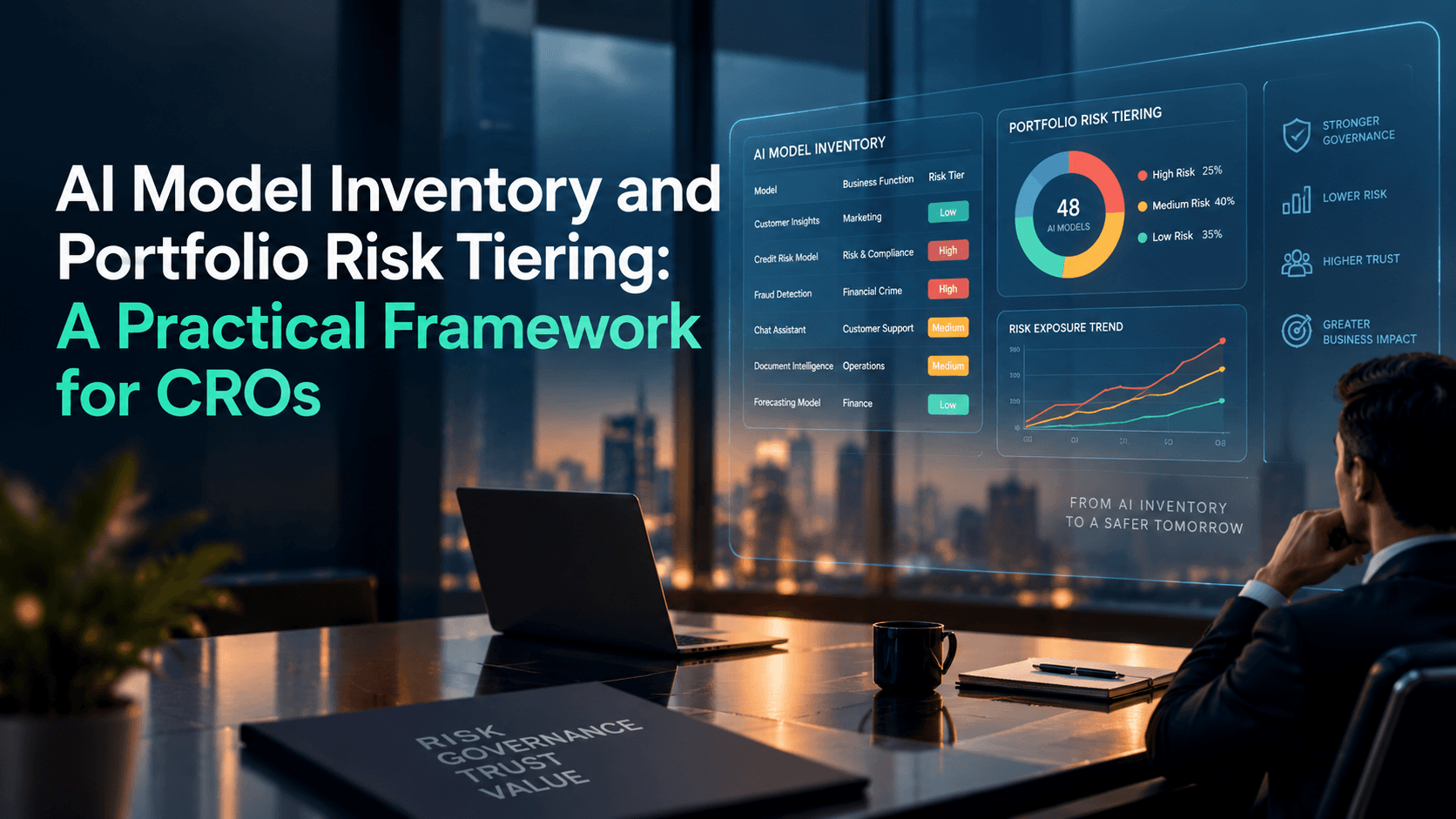
Most CROs already have an ai model inventory risk tiering problem hiding inside a spreadsheet they think is under control. The list of models exists, but every entry gets the same validation cadence and the same board attention, regardless of whether it is a marketing recommendation engine or an agent executing payments. A model inventory without tiering is not a governance tool, it is a list. Regulators on both sides of the Pacific now expect institutions to classify models by risk materiality, not just log that they exist, and the gap between those two things is where most examinations find friction.
AI Model Inventory Risk Tiering: The Direct Answer
Ai model inventory risk tiering means classifying every model and agent in an institution's inventory into risk tiers, based on impact, complexity, and reliance, so that validation frequency, documentation depth, and board reporting scale with actual risk rather than applying uniformly across a flat list. The Federal Reserve's SR 26-2 guidance explicitly calls for materiality based model tiering with quantified exposure, and MAS's proposed AI Risk Management Guidelines apply the same proportionate logic, assessing impact, complexity, and reliance to determine how much scrutiny a given system needs.
What a tiered model inventory actually looks like
What is a tiered risk assessment? It is a classification system that sorts every model in an inventory into a small number of risk tiers, typically three to five, based on defined criteria rather than subjective judgment applied inconsistently across business units.
A flat model inventory treats a customer segmentation model the same as an autonomous credit decisioning agent, both get logged, neither gets differentiated governance. Portfolio level governance requires the opposite: every model classified by how much harm it could cause, how hard it is to understand, and how heavily the business depends on it, with validation and reporting scaled accordingly. Our guide on AI model risk assessment covers the assessment methodology this tiering exercise draws on, and our companion piece on model risk management for agentic systems covers why agentic models specifically tend to get misclassified into lower tiers than their actual risk warrants.
Find Out How AI-Ready Your Business Is
Why tiering has become a board level expectation in 2026
Ai model portfolio risk management has moved from good practice to an explicit regulatory expectation for three reasons.
SR 26-2 names tiering directly. The revised interagency guidance that replaced SR 11-7 calls for materiality based model tiering with quantified exposure, not a uniform validation standard applied across every model regardless of risk.
MAS AIRG applies the same proportionate logic. Impact, complexity, and reliance determine how much scrutiny a system needs, meaning an institution's tiering criteria need to map cleanly to those three dimensions to satisfy an examiner.
Portfolio size has outgrown flat governance. Institutions running dozens or hundreds of models and agents cannot apply the same validation cadence to all of them without either under scrutinizing the highest risk systems or drowning the risk function in low value reviews.
Our guide on why AI governance for financial institutions has shifted toward proportionate, tiered oversight and our overview of AI risk compliance under NIST both cover the regulatory logic behind this shift in more depth.
The model inventory and tiering framework
Building a tiered inventory is a repeatable process, not a one time classification exercise.
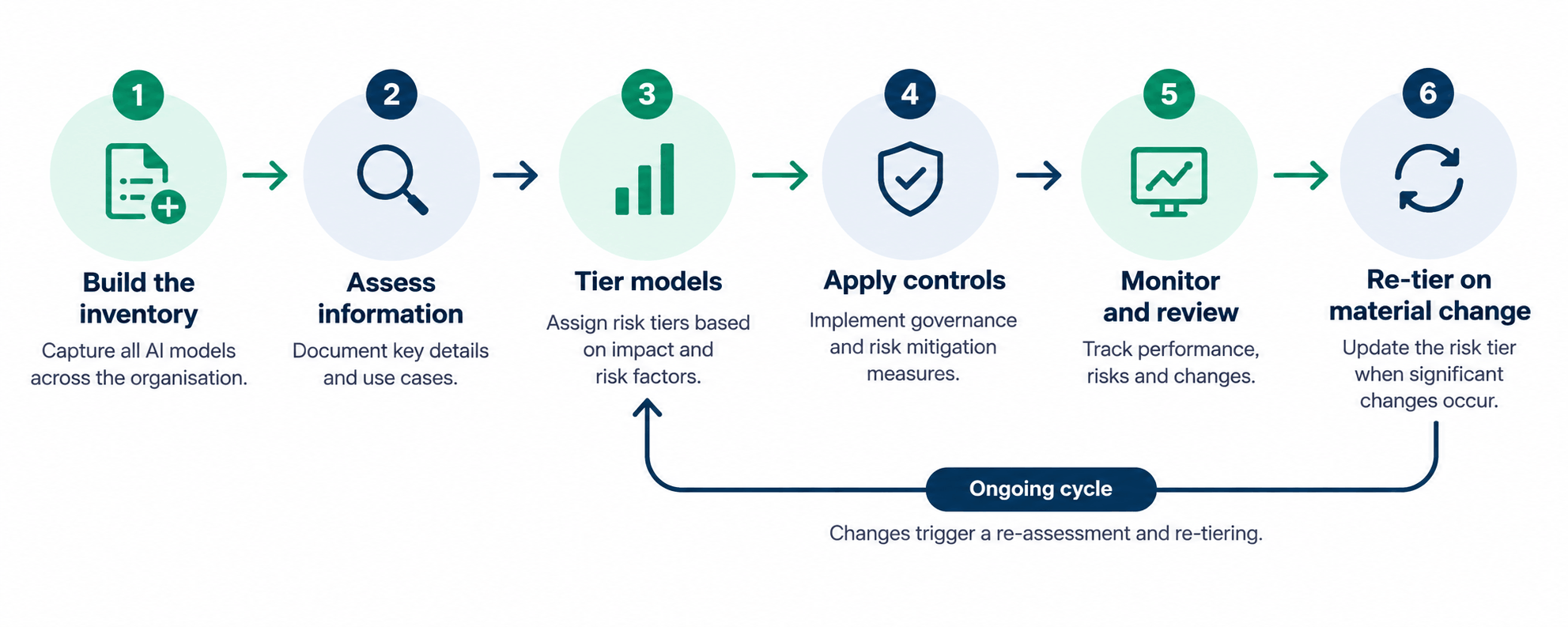
Build a complete model and agent inventory first. Every system generating a prediction, recommendation, decision, or autonomous action needs to be logged, including third party and embedded AI, before tiering can begin.
Define tier criteria against impact, complexity, and reliance. These three dimensions, drawn directly from MAS AIRG's proportionate approach, become the scoring basis for every model in the inventory.
Score and classify each model into a defined tier. Three to five tiers is typical, with clear, documented thresholds for what moves a model from one tier to the next.
Scale validation frequency and depth to tier. The highest tier needs continuous or quarterly validation, while a low risk model may only need review on a material change.
Scale board reporting cadence to tier. Critical and high tier models need visibility at every board risk meeting, while lower tiers can be summarized rather than itemized.
Reassess tier classification on material change. A model or agent whose scope, data source, or autonomy expands needs re tiering, not a static classification frozen at initial onboarding.
This is where the engineering execution layer matters. Samta.ai builds the VEDA AI decision analytics platform to hold the full inventory, tier classifications, and validation history in one system, often integrating with existing Databricks, Snowflake, or Microsoft data infrastructure through our data integration consulting services rather than requiring a separate inventory tool bolted onto systems already in place. Institutions evaluating whether a general analytics platform can hold this structure should see how VEDA compares to other data intelligence platforms, since most were not built to track tier classifications alongside validation and reporting history. The VEDA platform treats tiering as a first class part of the inventory record, not a manual overlay maintained in a separate spreadsheet. For a broader view of how this fits the rest of an institution's governance structure, our overview of the six components of a mature AI governance program covers where inventory tiering sits relative to the other building blocks.
Model risk tiers at a glance
Risk Tier | Criteria | Validation Frequency | Board Reporting Cadence | Example Model Type |
Critical | High impact, high complexity, high reliance, autonomous action capability | Continuous or quarterly | Every board risk meeting | Agentic AI credit decisioning or payments |
High | Material impact on customers or financial outcomes, limited autonomy | Semi annual | Quarterly | Fraud detection, credit scoring |
Medium | Moderate impact, decision support only, human in the loop | Annual | Semi annual | Marketing personalization, internal analytics |
Low | Minimal impact, informational or exploratory use | On material change only | Annual | Internal reporting dashboards, pilot models |
Get Clarity on Your AI Model Risk
Real world enterprise use cases
BFSI: a bank discovering its entire inventory was classified as one tier
A bank running its first formal tiering exercise found that its existing inventory, built years earlier, had never differentiated between a static marketing model and an autonomous fraud triage agent, both were logged identically with the same annual review cycle. Rebuilding the inventory with AI security and compliance services support surfaced twelve models that needed immediate reclassification into the critical tier, closing a gap the bank had not realized existed until the exercise began.
General enterprise: a proptech firm scaling its model portfolio without tiering
A proptech firm scaling from a handful of models to several dozen across pricing, leasing, and customer service had never introduced any tiering structure, applying the same light touch review to every model regardless of impact. Reviewing enterprise AI engineering in Singapore helped the firm introduce a proportionate three tier structure before its model count grew large enough to make retrofitting the exercise significantly harder.
Key risks and failure modes
Treating the inventory as a list rather than a classification system. A model inventory with no tiering cannot scale validation or reporting to actual risk, which is the specific gap SR 26-2 and MAS AIRG both call out.
Classifying models once and never re tiering them. A model whose scope or autonomy expands after initial classification needs re assessment, not a frozen tier assigned at onboarding.
Under classifying agentic systems. Autonomous agents often get scored using criteria built for static models, which tends to place them in a lower tier than their actual risk profile warrants.
Inconsistent tiering criteria across business units. Without a shared scoring methodology, one unit's high tier model may look like another unit's medium tier model, undermining board level comparability.
Board reporting that does not reflect tier structure. Reporting every model with equal weight defeats the purpose of tiering, since the board needs critical tier visibility distinct from a low tier summary.
When to rebuild your tiering framework versus refine the existing one
Rebuild the tiering framework when:
Your current inventory has no tiering structure at all, or applies one tier to every model regardless of risk
Agentic AI systems exist in the inventory with no criteria differentiating them from static models
Business units are applying inconsistent classification criteria with no shared methodology
Refine the existing framework when:
A tiering structure already exists and criteria map reasonably well to impact, complexity, and reliance
The gap is inconsistent re assessment on material change, not the tier definitions themselves
Board reporting already scales by tier, but reporting cadence needs adjustment rather than a full rebuild
Reviewing Samta.ai's case studies alongside your own inventory gives a useful benchmark for how other institutions have approached this exercise.
Talk to an AI Consulting Expert
Conclusion
Ai model inventory risk tiering turns a flat list of models into a portfolio a CRO can actually govern, scaling validation and board attention to where the real risk sits rather than treating every model the same. Institutions that build this structure now will not be retrofitting it under examination pressure once SR 26-2 and MAS AIRG's tiering expectations are fully in force.
About Samta
Samta.ai is a Singapore-headquartered AI Product Engineering & Data Intelligence partner helping enterprises build production-grade AI systems for regulated and data-intensive environments.We help organizations move beyond experimentation by engineering scalable, explainable, and enterprise-ready AI solutions from data foundations and model development to workflow automation and deployment.
Our capabilities combine deep AI expertise, data engineering, and product engineering to deliver measurable business impact across FinTech, BFSI, cybersecurity, regulatory technology, and enterprise operations.
Our enterprise AI products power real-world intelligence systems:
• TATVA : AI-driven data intelligence platform for governed analytics, monitoring, and operational insights
• VEDA : Explainable and audit-ready AI decisioning engine built for compliance-sensitive enterprise workflows
• CORA-Property Management Solutions: : Predictive intelligence platform for real-estate pricing, portfolio optimization, and investment analytics
Backed by ecosystem partnerships with Microsoft, Databricks, Snowflake, and AWS, Samta.ai delivers agile, cost-efficient AI engineering with faster turnaround and enterprise-grade scalability. Trusted by enterprises across FinTech, BFSI, and digital transformation initiatives, Samta.ai embeds AI governance, data privacy, and compliance-by-design principles directly into the AI lifecycle , enabling organizations to scale AI with transparency, accountability, and operational control.
Enterprises leveraging Samta.ai automate 65%+ of repetitive data, analytics, and decision workflows while maintaining governance, explainability, and measurable business outcomes. Samta.ai provides the strategic consulting, AI engineering, and data modernization expertise needed to align enterprise operations with next-generation AI transformation goals.
Frequently asked questions
What is AI model inventory risk tiering?
AI model inventory risk tiering is the practice of classifying every model and agent in an institution's inventory into risk tiers based on impact, complexity, and reliance, so validation frequency and board reporting scale with actual risk rather than applying uniformly.
What is a tiered risk assessment?
A tiered risk assessment is a classification system that sorts models into a small number of defined risk tiers, typically three to five, using documented criteria rather than inconsistent, subjective judgment applied differently across business units.
Does MAS require model risk tiering?
MAS's proposed AI Risk Management Guidelines apply a proportionate approach based on impact, complexity, and reliance, which functions as a tiering requirement even where the guidelines do not mandate a specific number of tiers or exact terminology.
How many risk tiers should a model inventory have?
Three to five tiers is typical. Fewer tiers risk oversimplifying genuinely different risk profiles, while too many tiers can make the classification system difficult to apply consistently across a large model portfolio.
How often should a model's tier be reassessed?
A model's tier should be reassessed whenever its scope, data source, autonomy, or reliance changes materially, not on a fixed calendar alone. A model whose use case expands can move tiers even without any technical change to the model itself.