
Summarize this post with AI
Singapore banks that budget only for model development and discover the full AI model risk assessment cost Singapore during pre production governance review consistently face two outcomes: a delayed go live while remediation funding is approved, or a governance gap that surfaces during the next MAS examination. AI model risk assessment pricing is not a variable that responsible AI programs leave to post development discovery. This guide gives Chief Risk Officers, model risk officers, and technology finance leads at Singapore financial institutions the complete 2026 cost breakdown for AI model risk assessments: what each engagement type costs, what is included at each price point, and what drives cost above benchmark.
AI Model Risk Assessment Cost Singapore:
AI model risk assessment cost Singapore ranges from SGD 45,000 for a scoped single model independent validation to SGD 380,000 for a full program covering portfolio model inventory, independent validation across multiple models, FEAT and VERITAS assessment, MAS TRM audit trail infrastructure review, and examination readiness documentation. MAS FEAT assessment cost as a standalone workstream for a single consumer facing AI model typically runs SGD 35,000 to 85,000 depending on model complexity and the VERITAS track required. Model validation cost Singapore for a single production AI model with out of time testing, stress testing, and independent validation report runs SGD 45,000 to 120,000 for a specialist engagement with MAS examination grade documentation standards.
What an AI Model Risk Assessment Includes
What is a MAS assessment in model risk terms: it is a structured evaluation of an AI model's development, validation, governance infrastructure, and ongoing monitoring against MAS Technology Risk Management guidelines, FEAT principles, and VERITAS framework requirements. A complete assessment produces documentation that satisfies MAS examination requests at the individual model level.
AI model risk management assessments cover seven distinct deliverable categories:
Model inventory review: establishing that the institution has a complete, current inventory of all production AI models with accurate risk classification, validation status, and accountable ownership documentation.
Development documentation review: assessing whether the model card, training data documentation, variable selection rationale, and performance benchmarking meet MAS TRM documentation standards.
Independent validation: replicating development results on holdout data, conducting out of time validation on data post the training period, stress testing under adverse scenarios, and producing a validation report with findings and recommendations.
FEAT and VERITAS assessment: applying MAS FEAT principles (Fairness, Ethics, Accountability, Transparency) to consumer facing model decisions and conducting the appropriate VERITAS track assessment for fairness testing.
Data lineage and quality review: assessing whether training data lineage is documented at the column level and whether data quality monitoring satisfies MAS TRM standards.
Governance infrastructure review: assessing whether audit trail generation, explainability APIs, drift monitoring, and Board level reporting are in place and operational.
Examination readiness assessment: producing a gap analysis and remediation roadmap that maps current documentation state against what MAS examiners would request for each production model.
Review AI model risk management framework requirements to understand the documentation standard each deliverable category must satisfy before the assessment is considered examination ready.
Is Your AI Strategy Ready for Enterprise Scale?
Why AI Model Risk Assessment Cost Is Increasing in 2026
Three regulatory developments have expanded the scope and therefore the cost of MAS compliant model risk assessment:
1. MAS examinations now request individual model documentation rather than enterprise policy evidence
MAS technology risk examinations in 2025 and 2026 have moved to individual model level inspection, requesting specific model cards, validation reports, FEAT assessment documentation, and drift monitoring records for named production models. This means the assessment scope for each model is materially broader than enterprise level governance policy review that preceded it (Source Required: MAS Technology Risk Management Guidelines).
2. VERITAS track selection and documentation is now an examination requirement
The MAS VERITAS framework for FEAT fairness assessment requires institutions to document which VERITAS track applies to each consumer facing AI model, complete the track specific fairness testing, and document the methodology and outcomes. This VERITAS component adds SGD 15,000 to 35,000 per model to the assessment cost depending on model type and VERITAS track complexity.
3. AI governance infrastructure review is now a standard assessment component
MAS examiners are no longer satisfied with policy statements that drift monitoring and audit trails exist. They are requesting technical evidence: configuration records for monitoring thresholds, sample audit trail outputs for specific inference dates, and explainability API documentation. This technical infrastructure review adds specialist engineering assessment hours to what was previously a documentation review engagement (Source Required: MAS FEAT Principles).
2026 AI Model Risk Assessment Cost Breakdown by Engagement Type
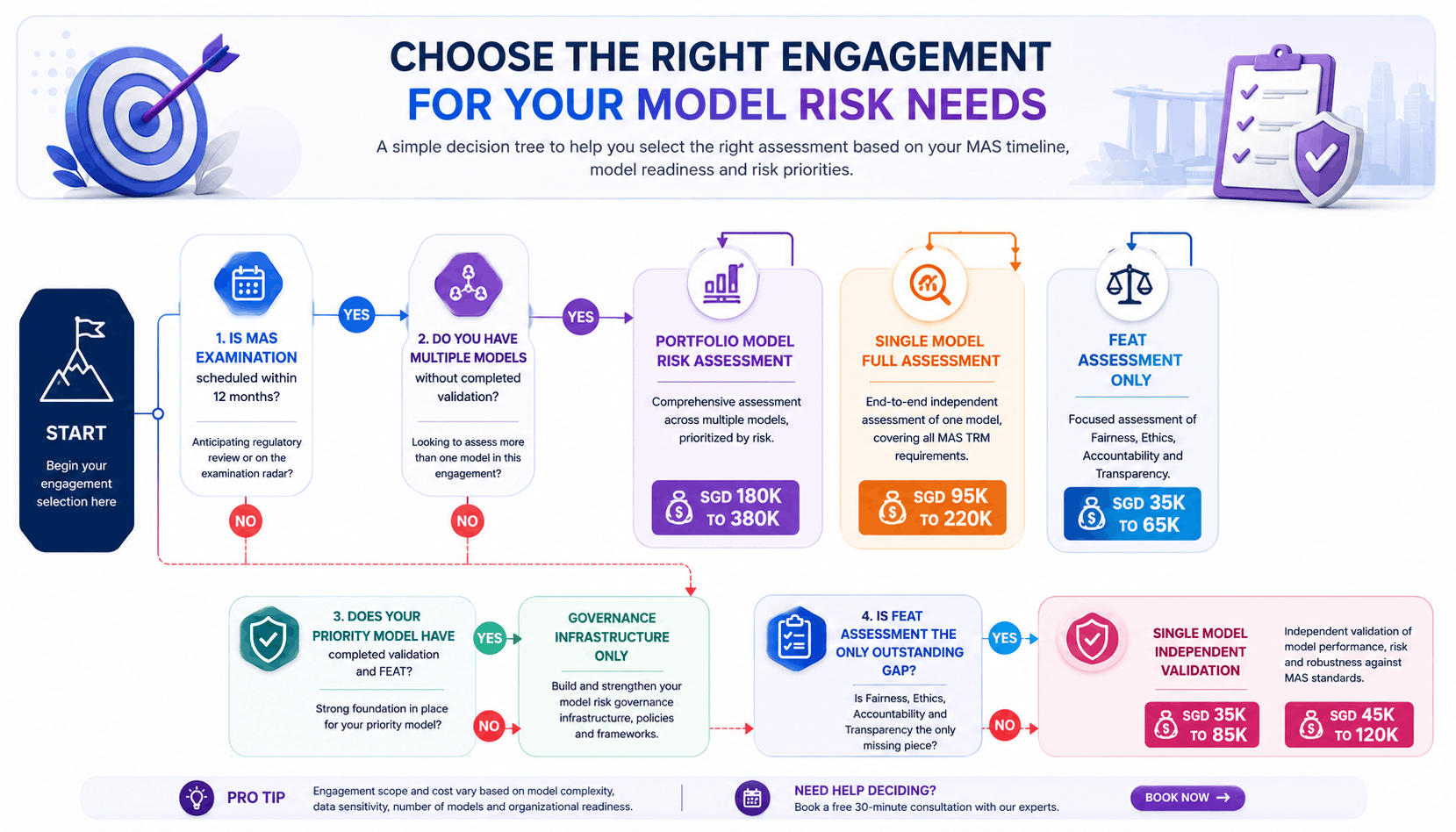
Engagement Type 1: Single Model Independent Validation
Scope: independent validation of one production AI model including out of time validation, stress testing, and validation report production. Does not include FEAT assessment, data lineage review, or governance infrastructure assessment.
Cost range: SGD 45,000 to 120,000
Cost drivers: model complexity (traditional logistic regression at the lower end, deep learning or ensemble models at the higher end), availability of development documentation (well documented models require less reconstruction time), and data availability for out of time validation (models with historical performance data are cheaper to validate than those requiring new data preparation).
Timeline: 4 to 8 weeks from engagement start to validation report delivery.
When appropriate: when the model has a reasonably complete model card and development documentation, FEAT assessment has been completed separately, and the primary gap is the absence of independent validation required by MAS model risk governance.
Engagement Type 2: Single Model Full Assessment
Scope: independent validation plus FEAT and VERITAS assessment plus data lineage review plus governance infrastructure review plus examination readiness gap analysis.
Cost range: SGD 95,000 to 220,000
Cost drivers: VERITAS track (Track 1 for credit models is more demanding than Track 3 for general financial advisory), data lineage maturity (column level lineage that exists is faster to review than lineage that must be reconstructed), and governance infrastructure state (monitoring and audit trails that are already configured are faster to review than those requiring assessment against a specification).
Timeline: 8 to 14 weeks from engagement start to examination readiness report.
When appropriate: for a priority production model ahead of an MAS examination cycle, where the institution needs to establish examination readiness for that model specifically before addressing the broader portfolio.
Engagement Type 3: Portfolio Model Risk Assessment Program
Scope: model inventory review and risk reclassification, independent validation of multiple models, FEAT and VERITAS assessment for consumer facing models, data lineage review across all models, governance infrastructure assessment and remediation planning, and portfolio level examination readiness report.
Cost range: SGD 180,000 to 380,000 for a portfolio of 4 to 8 production AI models.
Cost drivers: number of models in scope, proportion that are consumer facing (requiring FEAT and VERITAS assessment), data lineage maturity across the portfolio, and governance infrastructure state.
Timeline: 14 to 24 weeks depending on portfolio size and documentation maturity.
When appropriate: for institutions with MAS examination scheduled within 12 months, for post examination remediation programs where multiple findings must be addressed simultaneously, or for institutions implementing a new AI model risk governance framework across an existing model portfolio.
Samta.ai's AI security and compliance services deliver all three engagement types with fixed fee commercial structures, examination ready documentation standards, and Samta.ai's VEDA AI Decision Analytics Platform embedded for governance infrastructure audit trail generation and drift monitoring configuration where existing tooling is absent. Review the VEDA platform documentation for the specific governance infrastructure components that assessment engagements evaluate and deploy.
Engagement Type 4: MAS FEAT Assessment Only
Scope: FEAT principle assessment for one consumer facing AI model, VERITAS track selection documentation, fairness testing completion, and assessment report production.
Cost range: SGD 35,000 to 85,000
Cost drivers: VERITAS track (Track 1 credit decisioning most complex at the higher end), data availability for disparate impact analysis, and model documentation completeness for the accountability and transparency dimensions.
Timeline: 4 to 6 weeks.
When appropriate: when independent validation has been completed separately and the primary gap is FEAT compliance documentation for a consumer facing model.
AI Model Risk Assessment Cost:
Engagement Type | Scope | Cost Range SGD | Timeline | Best For |
Single Model Independent Validation | Validation report only, out of time testing, stress testing | SGD 45,000 to 120,000 | 4 to 8 weeks | Models with complete documentation needing only validation sign off |
MAS FEAT Assessment Only | FEAT and VERITAS assessment, fairness testing, assessment report | SGD 35,000 to 85,000 | 4 to 6 weeks | Models with completed validation needing FEAT compliance documentation |
Single Model Full Assessment | Validation, FEAT, VERITAS, data lineage, governance infrastructure | SGD 95,000 to 220,000 | 8 to 14 weeks | Priority model before MAS examination with multiple governance gaps |
Portfolio Model Risk Assessment | Inventory review, multi model validation, FEAT, portfolio remediation plan | SGD 180,000 to 380,000 | 14 to 24 weeks | MAS examination in 12 months or post examination multi model remediation |
Governance Infrastructure Only | Audit trail, drift monitoring configuration, explainability API review | SGD 25,000 to 65,000 | 3 to 5 weeks | Models with completed validation and FEAT but missing technical controls |
Identify Hidden Risks Across Your AI Models
Real World Use Cases
Use Case 1: Single Model Full Assessment, Singapore Digital Bank (BFSI)
A Singapore licensed digital bank's credit scoring model had been in production for 11 months without independent validation, FEAT assessment, or configured drift monitoring. An internal model risk review ahead of a planned MAS examination identified all three gaps simultaneously. A Single Model Full Assessment engagement covering independent validation, VERITAS Track 1 FEAT assessment, data lineage review across the Snowflake training pipeline, and governance infrastructure review and configuration delivered: a completed validation report with two minor findings and no material findings, a VERITAS Track 1 FEAT assessment with documented disparate impact analysis across three protected characteristics, column level lineage documentation for the training dataset, and configured drift monitoring with alert thresholds active on the production model. Total engagement cost: SGD 165,000. Total engagement duration: 11 weeks. MAS examination result: no model risk findings for this model. Estimated remediation cost if the gaps had been identified during MAS examination rather than pre examination: SGD 290,000 to 380,000 based on comparable post examination remediation engagements. Explore Samta.ai case studies for additional model risk assessment outcomes and review enterprise AI engineering in Singapore for the engineering infrastructure that examination ready model governance requires at the technical layer.
Use Case 2: Portfolio Model Risk Assessment, Regional Bank (BFSI)
A regional bank with Singapore operations had seven production AI models across credit scoring, fraud detection, customer churn prediction, and AML transaction monitoring. An MAS examination was scheduled 14 months forward. An internal assessment identified that only two of the seven models had completed independent validation, none had FEAT documentation, and three had no configured drift monitoring. A Portfolio Model Risk Assessment program was scoped as: model inventory review and risk reclassification for all seven models, independent validation for the five unvalidated models, FEAT and VERITAS assessment for the three consumer facing models, data lineage review across all seven models, and governance infrastructure configuration for the four models without drift monitoring. Total program cost: SGD 320,000 over 20 weeks. Seven models passed the subsequent MAS examination without model risk findings. The VEDA vs data intelligence platform comparison was used during the engagement to evaluate whether VEDA should replace the existing model monitoring tooling for models that lacked production grade drift detection infrastructure.
Key Risks That Drive AI Model Risk Assessment Costs Above Benchmark
Absent or reconstructed development documentation: adds 30 to 60% to single model assessment cost. Model cards and training documentation that must be reconstructed from notebooks, emails, and version control logs require significantly more assessment hours than contemporaneous documentation produced during development.
Column level data lineage absent from training pipelines: requires data lineage reconstruction as a separate workstream before the assessment can progress. On Databricks or Snowflake environments without Unity Catalog or Access History configured, lineage reconstruction adds SGD 15,000 to 40,000 to the engagement cost depending on source system complexity.
Samta.ai's data integration consulting services implement data lineage infrastructure on Databricks and Snowflake as a parallel workstream to the model risk assessment where absent lineage is identified during engagement scoping.
Multiple VERITAS tracks in a single engagement: increase MAS FEAT assessment cost materially. An institution with credit scoring (VERITAS Track 1), insurance underwriting (Track 2), and general financial advisory (Track 3) models in a single portfolio assessment requires separate fairness testing methodology for each track, which multiplies the FEAT assessment cost compared to a single track portfolio.
Time and materials commercial structure without scope ceiling: transfers budget risk to the institution without any accountability mechanism for the assessment firm. Require fixed fee per deliverable or fixed total engagement cost with defined scope, not time and materials with no ceiling. Fixed fee vs time and materials is the most important commercial decision in AI model risk assessment procurement after vendor capability assessment.
Engagement scoping: without a pre engagement model documentation review consistently produces cost surprises when the actual documentation state is worse than the institution's self assessment indicated. Require a 2 to 3 week scoping phase before committing to assessment engagement cost. Review AI engineering services cost for the broader AI program cost framework within which model risk assessment costs sit.
Decision Framework: Which Assessment Engagement Does Your Institution Need
Commission a Portfolio Model Risk Assessment when:
MAS examination is scheduled within 12 months and you have not completed independent validation across your model portfolio
A post examination remediation program requires multiple model governance gaps to be addressed simultaneously under a defined timeline
Your institution is implementing a new AI model risk governance framework and needs a portfolio baseline assessment before the new framework is applied
Commission a Single Model Full Assessment when:
One priority model has multiple governance gaps (validation, FEAT, governance infrastructure) and needs examination readiness before the broader portfolio program is approved
A new high risk production model is approaching go live and requires pre deployment validation and FEAT assessment before first inference
Commission a Single Model Independent Validation when:
The model has complete development documentation, completed FEAT assessment, and configured governance infrastructure, and the only remaining gap is independent validation
The model risk framework requires annual revalidation and the prior year scope was a full assessment
Commission a FEAT Assessment Only when:
Independent validation has been completed by another party and the only gap is FEAT principle documentation for the MAS examination file
Consider AI engineering ROI calculations and AI engineering team structure to understand how model risk assessment cost fits within the broader AI program investment structure and who within the engineering team is accountable for maintaining the governance infrastructure that assessments evaluate.
Build a Practical Roadmap for Enterprise AI

Conclusion
AI model risk assessment cost Singapore is not a variable that responsible AI programs discover after model development is complete. The cost benchmarks in this guide allow institutions to budget for validation, FEAT assessment, and governance infrastructure review as program line items from the first board investment approval, not as emergency remediation expenses triggered by examination findings. A pre examination assessment at SGD 95,000 to 220,000 per priority model consistently costs less than the post examination remediation program it prevents. Build the cost into the AI program budget from the start, and build it against a fixed fee scope that defines exactly what examination readiness looks like before engagement commencement.
About Samta
Samta.ai is a Singapore-headquartered AI Product Engineering & Data Intelligence partner helping enterprises build production-grade AI systems for regulated and data-intensive environments.We help organizations move beyond experimentation by engineering scalable, explainable, and enterprise-ready AI solutions from data foundations and model development to workflow automation and deployment.
Our capabilities combine deep AI expertise, data engineering, and product engineering to deliver measurable business impact across FinTech, BFSI, cybersecurity, regulatory technology, and enterprise operations.
Our enterprise AI products power real-world intelligence systems:
• TATVA : AI-driven data intelligence platform for governed analytics, monitoring, and operational insights
• VEDA : Explainable and audit-ready AI decisioning engine built for compliance-sensitive enterprise workflows
• CORA-Property Management Solutions: : Predictive intelligence platform for real-estate pricing, portfolio optimization, and investment analytics
Backed by ecosystem partnerships with Microsoft, Databricks, Snowflake, and AWS, Samta.ai delivers agile, cost-efficient AI engineering with faster turnaround and enterprise-grade scalability. Trusted by enterprises across FinTech, BFSI, and digital transformation initiatives, Samta.ai embeds AI governance, data privacy, and compliance-by-design principles directly into the AI lifecycle , enabling organizations to scale AI with transparency, accountability, and operational control.
Enterprises leveraging Samta.ai automate 65%+ of repetitive data, analytics, and decision workflows while maintaining governance, explainability, and measurable business outcomes. Samta.ai provides the strategic consulting, AI engineering, and data modernization expertise needed to align enterprise operations with next-generation AI transformation goals.
Frequently Asked Questions
What is the AI model risk assessment cost in Singapore?
AI model risk assessment cost Singapore ranges from SGD 35,000 for a standalone MAS FEAT assessment to SGD 380,000 for a portfolio program covering model inventory review, independent validation for multiple models, FEAT and VERITAS assessment, data lineage review, and governance infrastructure configuration. The primary cost driver is the number of models in scope and the gap between current documentation state and MAS examination standards. Institutions with contemporaneous development documentation pay 30 to 60% less than those requiring documentation reconstruction.
What is a MAS assessment and what does it examine?
What is a MAS assessment in model risk terms: an MAS technology risk examination reviews individual production AI model documentation rather than enterprise level AI governance policy. Examiners request specific model cards, independent validation reports, FEAT assessment documentation with VERITAS track selection, data lineage records, drift monitoring configuration evidence, and audit trail samples for specific inference dates. Institutions that cannot produce these documents for named production models receive remediation findings with defined resolution deadlines.
What does MAS FEAT assessment cost in Singapore?
MAS FEAT assessment cost for a single consumer facing AI model in Singapore runs SGD 35,000 to 85,000 depending on model complexity and the VERITAS track required. VERITAS Track 1 (credit decisioning) is the most complex and expensive, typically at the higher end of this range. Track 3 (general financial advisory) is less demanding and typically at the lower end. A standalone FEAT assessment takes 4 to 6 weeks and produces VERITAS track documentation, fairness testing results, and a FEAT assessment report ready for MAS examination.
What is the model validation cost in Singapore for AI models?
Model validation cost Singapore for an independent validation of a single production AI model runs SGD 45,000 to 120,000 depending on model complexity, documentation completeness, and data availability for out of time validation. Traditional logistic regression credit scorecards are at the lower end. Deep learning or ensemble models with complex feature engineering and limited historical performance data are at the higher end. All validation engagements should include out of time testing, stress testing under adverse scenarios, and an independent validation report with findings.
What is the AI model risk management framework for Singapore banks?
The AI model risk management framework for Singapore banks is defined by MAS Technology Risk Management guidelines, which require: a complete model inventory with risk classification, independent validation by a team not involved in development, ongoing drift monitoring, periodic revalidation, FEAT principle assessment for consumer facing decisions, and Board level AI risk reporting. The model and AI risk management obligations for AI models are more demanding than for traditional statistical models because of additional explainability, fairness testing, and governance infrastructure requirements.