
Summarize this post with AI
Singapore enterprises that commission an AI readiness assessment without understanding what the deliverable should include consistently receive one of two outcomes: a high level maturity scorecard that does not produce an actionable remediation roadmap, or an overscoped consulting engagement that takes six months to produce a document the organisation does not act on. AI readiness assessment cost Singapore ranges from zero for self serve digital tools to SGD 180,000 for a full enterprise engagement, and the price difference reflects deliverable depth, not necessarily advice quality. This guide gives CTOs, CDOs, and technology investment leads the complete 2026 pricing breakdown for AI readiness assessment engagements in Singapore, covering what each tier includes, what drives cost above benchmark, and how to match engagement tier to your specific decision requirement.
AI Readiness Assessment Cost Singapore:
AI readiness assessment cost Singapore ranges across four engagement tiers in 2026: self serve digital tools at SGD 0 to 5,000 producing a maturity score without remediation roadmap, workshop based assessments at SGD 15,000 to 45,000 covering 3 to 5 readiness dimensions with a facilitated output, structured specialist assessments at SGD 45,000 to 95,000 covering all six dimensions with automated data profiling and a scoped remediation roadmap, and enterprise program assessments at SGD 80,000 to 180,000 covering multi business unit or multi use case portfolios with regulatory alignment mapping for MAS TRM and PDPA. AI consulting assessment pricing is driven by three variables: the number of dimensions assessed, whether automated tooling is used for data and infrastructure dimensions, and whether the output is a board investment gate document or an internal team planning tool.
What AI Readiness Assessment Actually Delivers
What is AI readiness in assessment terms: it is a scored evaluation of an organisation's current capability to initiate, deploy, and sustain production AI for a defined use case, producing a gap analysis and prioritised remediation investment roadmap as its primary output.
AI readiness assessment deliverables vary significantly by engagement tier. Understanding what each tier produces is the prerequisite for matching cost to decision requirement:
Maturity scorecard only: a benchmark against industry peers or a maturity model, producing a level classification (typically 1 to 5) without dimension level gap analysis or remediation investment estimates. Useful for board benchmarking presentations, not useful for program investment decisions.
Dimension level gap analysis: a scored assessment across data, infrastructure, talent, governance, strategy, and change readiness dimensions, identifying specific gaps at each dimension and their severity relative to production AI requirements.
Remediation roadmap with cost estimates: a prioritised, sequenced remediation plan specifying what must be fixed before engineering investment begins, in what order, at what estimated cost, and on what timeline. This is the deliverable that enables board investment approval for AI programs.
Regulatory alignment mapping: for BFSI clients, an additional layer mapping each dimension gap to specific MAS TRM, PDPA, and FEAT compliance requirements, identifying which gaps create regulatory exposure rather than just program delay.
What is AI readiness without a remediation roadmap: it is a benchmark report. AI readiness assessment without regulatory alignment for BFSI buyers: it is an incomplete deliverable that will require a supplemental engagement before an AI program in a regulated institution can be responsibly scoped. Review why an AI readiness assessment matters for the decision context that each deliverable tier is designed to support.
Discover Your AI Readiness with Our Free Assessment
Why Assessment Pricing Varies So Widely in Singapore in 2026
Three factors drive the wide cost range for AI readiness assessments in the Singapore market:
1. Automated tooling for data and infrastructure dimensions reduces cost materially
The data readiness and infrastructure readiness dimensions require either automated profiling tools (Great Expectations, Databricks Data Quality, Azure Purview) or manual assessment by specialist practitioners. Engagements using automated tooling produce more accurate dimension scores at lower cost than equivalent manual assessment. Self serve tools that require the client to input data manually are the lowest cost option but the least accurate because they rely on self reported quality estimates rather than measured actuals.
2. MAS regulatory alignment adds specialist cost for BFSI engagements
General enterprise AI readiness assessments do not require MAS TRM, PDPA, and FEAT mapping. BFSI assessments require a specialist practitioner with MAS model risk and PDPA expertise to map each dimension gap to specific regulatory obligations. This specialist layer adds SGD 15,000 to 35,000 to the engagement cost relative to an equivalent general enterprise assessment (Source Required: MAS Technology Risk Management Guidelines).
3. Board investment gate output requires more rigorous deliverable standards than internal planning tools
An AI readiness assessment produced as a board investment gate document requires: quantified gap analysis with cost estimates, regulatory risk mapping, a sequenced remediation roadmap with defined completion criteria, and executive summary formatting that non technical board members can act on. An internal planning tool produced for the data engineering team requires less of this presentation layer. The additional effort for board grade output adds SGD 10,000 to 25,000 to equivalent scope engagements.
The Four AI Readiness Assessment Engagement Tiers
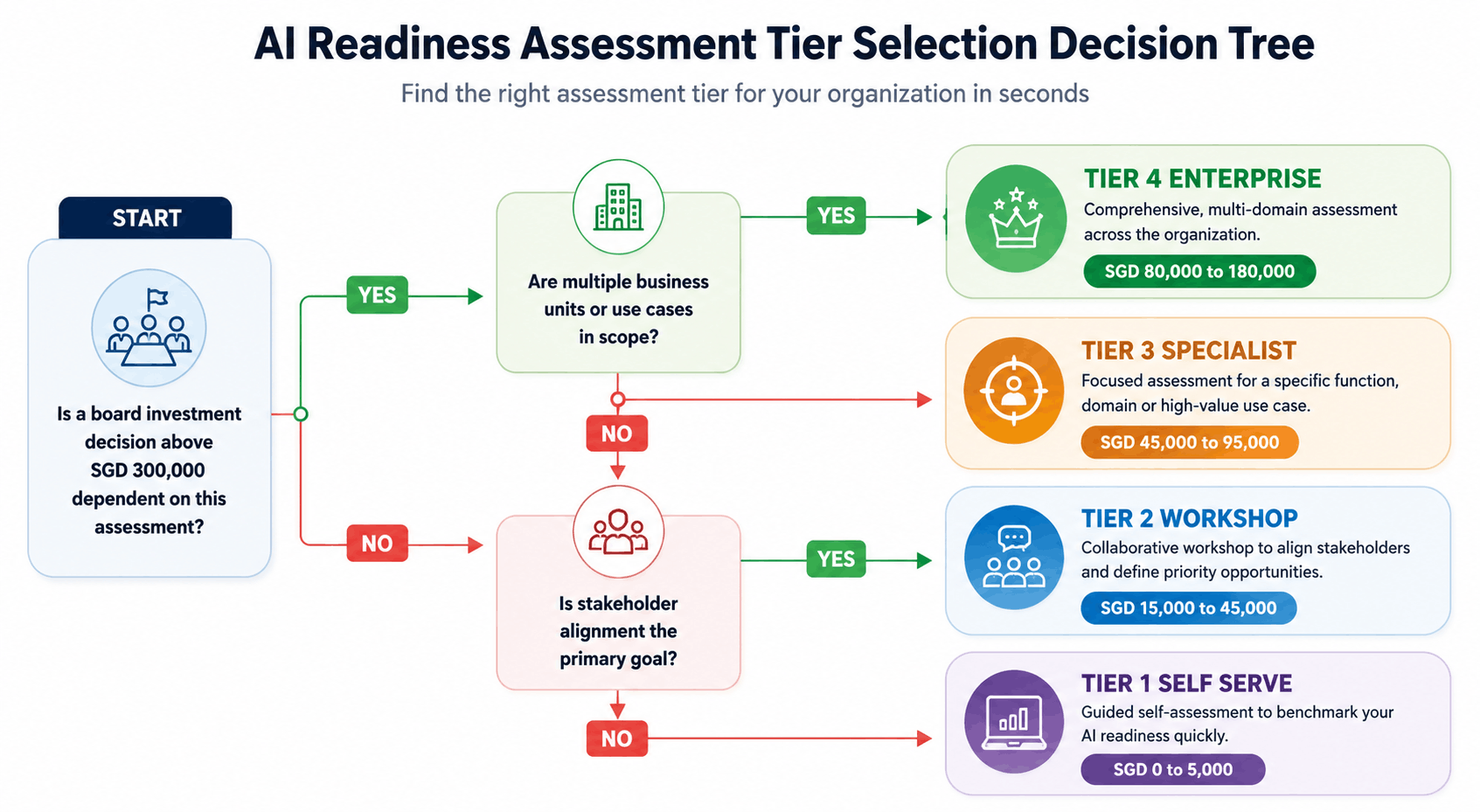
Tier 1: Self Serve Digital Assessment Tool
Cost range: SGD 0 to 5,000 (typically subscription or per use basis)
What is included: a questionnaire based assessment covering 4 to 6 readiness dimensions, completed by the client using self reported inputs. Produces a maturity score and peer benchmark comparison. Typically takes 2 to 8 hours of internal time to complete.
What is not included: automated data profiling, independent validation of self reported scores, remediation roadmap with cost estimates, regulatory alignment mapping, or board investment gate documentation.
Best for: executive awareness building and internal AI program advocate preparation. Not appropriate as the sole basis for AI program investment decisions above SGD 200,000. Review which tools or frameworks are used for AI readiness assessment in Singapore to understand how self serve tools compare to specialist assessments on accuracy and actionability.
Tier 2: Workshop Based Assessment
Cost range: SGD 15,000 to 45,000
What is included: 2 to 4 facilitated workshops with technical and business stakeholders covering readiness dimensions, qualitative scoring based on workshop discussions, gap identification at the dimension level, and a readiness report with high level recommendations. Typically 3 to 5 weeks elapsed time.
What is not included: automated data profiling (data dimension score is based on stakeholder input, not measured actuals), independent infrastructure assessment, regulatory alignment mapping, or quantified remediation cost estimates.
Best for: organisations beginning their AI readiness journey where the primary goal is stakeholder alignment and awareness rather than board investment gate documentation.
Tier 3: Structured Specialist Assessment
Cost range: SGD 45,000 to 95,000
What is included: automated data profiling on the client's data platform (Databricks, Snowflake, or Azure) producing measured data quality and lineage assessment, infrastructure assessment against production AI requirements, talent gap analysis against the five core AI engineering roles, governance readiness review against MAS TRM and PDPA for regulated clients, strategy and use case readiness scoring, and a remediation roadmap with sequenced investment recommendations and cost estimates.
What is not included: multi business unit or multi use case portfolio coverage, full regulatory alignment mapping beyond the primary use case, or change readiness workshops for operational teams.
Best for: organisations with a specific AI program approved or in consideration, where the board needs a quantified gap analysis and remediation roadmap before committing engineering budget. Samta.ai's AI readiness assessment engagements at this tier use automated Databricks and Snowflake profiling for the data dimension, producing measured quality scores rather than self reported estimates. Samta.ai's data integration consulting services and AI security and compliance services provide the specialist practitioner layers for infrastructure and governance dimensions respectively.
Tier 4: Enterprise Program Assessment
Cost range: SGD 80,000 to 180,000
What is included: all Tier 3 components plus multi business unit coverage, multiple AI use case portfolio prioritisation, full MAS TRM and PDPA regulatory alignment mapping for all use cases in scope, Board ready investment gate documentation with risk adjusted ROI hypothesis for each use case, and a prioritised program roadmap with phased investment sequencing.
Best for: large enterprises with multiple business units or use cases competing for AI investment, BFSI institutions with MAS examination pressure requiring regulatory alignment documentation, or organisations where the AI program investment decision requires board level approval with comprehensive risk and ROI documentation. Review AI readiness for CTOs in 2026 to understand the specific decision context that Tier 4 assessments are designed to support at the executive level.
AI Readiness Assessment Cost Singapore: 5 Column Tier Comparison
Dimension | Tier 1 Self Serve | Tier 2 Workshop | Tier 3 Specialist | Tier 4 Enterprise | Samta.ai Tier 3 and 4 |
Cost Range SGD | SGD 0 to 5,000 | SGD 15,000 to 45,000 | SGD 45,000 to 95,000 | SGD 80,000 to 180,000 | Scoped per engagement, fixed fee |
Data Dimension Method | Self reported | Stakeholder input | Automated platform profiling | Automated profiling, multi source | Databricks and Snowflake measured actuals |
Regulatory Alignment | None | Basic reference | Single use case, primary regulations | Full MAS TRM, PDPA, FEAT mapping | MAS examination grade documentation |
Remediation Roadmap | None | High level only | Sequenced with cost estimates | Full program with phased investment plan | Board investment gate standard |
Elapsed Time | 2 to 8 hours | 3 to 5 weeks | 4 to 8 weeks | 8 to 16 weeks | 4 to 12 weeks per scope |
Measure Your AI Model Risk Before It Becomes a Business Risk
Real World Use Cases
Use Case 1: Tier 3 Specialist Assessment, Singapore Insurance Company (BFSI)
A Singapore licensed insurer had board approval for an AI underwriting program but no quantified gap analysis to support a SGD 1.2M engineering investment request. The CFO required a remediation roadmap with cost estimates before approving the engineering budget. A Tier 3 Specialist Assessment produced: measured data quality scores across 4 source systems (Snowflake automated profiling), infrastructure gap analysis identifying absent MLOps tooling, talent gap analysis identifying the need for an MLOps engineer and AI governance lead before production deployment, MAS FEAT alignment mapping for the underwriting use case, and a phased remediation roadmap with SGD 180,000 in data and governance remediation required before the SGD 1.2M engineering program could begin.
The remediation roadmap identified that without data remediation first, the SGD 1.2M engineering program would stall in the data preparation phase and require SGD 320,000 in mid program remediation. Assessment cost: SGD 68,000. Estimated savings from identifying the sequencing requirement pre engineering investment: SGD 140,000 in avoided mid program remediation plus 5 months in delayed production delivery. Explore Samta.ai case studies for additional readiness assessment outcomes and review what your AI readiness score means for the investment sequencing decisions that dimension scores drive.
Use Case 2: Tier 4 Enterprise Assessment, Regional Conglomerate (General Enterprise)
A regional conglomerate with six business units across logistics, retail, insurance, and financial services needed to prioritise AI investment across competing use cases for a SGD 8M three year AI program budget. Each business unit had submitted AI program proposals, none of which included readiness evidence for the data and governance dimensions. A Tier 4 Enterprise Assessment covered all six business units, automated data profiling across 12 data systems, infrastructure assessment per business unit, and use case portfolio prioritisation producing a phased investment sequence based on data readiness score and ROI hypothesis strength per use case.
Assessment output: four use cases recommended for Year 1 investment (data readiness above 70%, strong ROI hypothesis), two recommended for Year 2 after data remediation investment in Year 1. Total assessment cost: SGD 145,000. The phased investment sequence prevented a SGD 2.4M engineering investment in two use cases that would have stalled on data readiness in Year 1. Compare AI vs traditional development companies to understand how the assessment output affects subsequent engineering partner selection decisions. The VEDA AI Data Analytics Platform was deployed for Year 1 use cases on the data foundation established during the remediation phase, with the VEDA platform documentation informing the platform selection decision during the Tier 4 assessment.
Key Risks That Drive Assessment Cost Above Benchmark
Self reported data quality scores used as investment basis: consistently overstate data readiness by 20 to 35 percentage points compared to automated profiling results. Organisations that act on self reported Tier 1 assessments for engineering investment decisions above SGD 500,000 consistently discover the gap during model development at significantly higher remediation cost.
Workshop based assessments substituted for specialist assessments: when regulatory alignment is required produce assessments that are not examination grade. MAS model risk examination readiness requires measured data lineage, not stakeholder reported data quality estimates. Tier 2 assessments that claim MAS alignment without automated profiling and specialist regulatory mapping produce compliance gaps that the assessment itself cannot surface.
Overscoped Tier 4 assessments when Tier 3 meets the requirement: extend timelines unnecessarily and consume board investment gate budget that could fund the first phase of remediation. A single use case with a defined business unit does not require six business unit coverage. Match scope to decision requirement.
Time and materials commercial structure: for assessments without defined scope ceilings produces cost overruns when data dimension assessment reveals more complexity than the scoping phase identified. Require fixed fee per deliverable tier with defined scope, particularly for Tier 3 and Tier 4 engagements where automated profiling scope determines a significant portion of the engagement cost.
Review AI transformation cost benchmarks to understand how assessment cost sits within the broader AI program investment structure and how the remediation roadmap output from the assessment connects to subsequent engineering program scoping.
Decision Framework: Which Assessment Tier Does Your Organisation Need
Commission Tier 1 Self Serve when:
The primary goal is executive awareness building or internal AI program advocacy preparation
No immediate board investment decision depends on the assessment output
Budget for assessment is below SGD 5,000 and a maturity benchmark is the required output
Commission Tier 2 Workshop when:
Multiple stakeholders need alignment on AI readiness before a formal program is proposed
The organisation is in early exploration and the primary value is facilitated discussion rather than quantified gap analysis
A board presentation introducing AI program consideration is the deliverable
Commission Tier 3 Specialist when:
A specific AI program above SGD 300,000 is being considered for board investment approval
The data, infrastructure, and governance dimensions require measured assessment rather than stakeholder input
A remediation roadmap with quantified cost estimates is required to sequence engineering investment correctly
Commission Tier 4 Enterprise when:
Multiple business units or use cases are competing for AI investment and portfolio prioritisation is required
MAS examination is within 12 months and regulatory alignment documentation across multiple use cases is required
The AI program investment decision requires board level approval with comprehensive risk, ROI, and regulatory documentation
Explore the Right AI Strategy for Your Enterprise
Conclusion
AI readiness assessment cost Singapore is the smallest line item in an AI program budget and the one with the highest return on investment when it prevents a mid program data or governance remediation that costs 3 to 10 times more than the assessment itself. The four tier framework in this guide matches assessment scope to the investment decision the output must support. A Tier 1 self serve tool cannot support a SGD 1M engineering investment decision. A Tier 4 enterprise program assessment is unnecessary for a single use case with a defined business unit. Match the tier to the decision. Require automated data profiling for assessments above Tier 2. Require fixed fee commercial structure. And commission the assessment before the engineering budget is committed, not after the data gaps are discovered mid program.
About Samta
Samta.ai is a Singapore-headquartered AI Product Engineering & Data Intelligence partner helping enterprises build production-grade AI systems for regulated and data-intensive environments.We help organizations move beyond experimentation by engineering scalable, explainable, and enterprise-ready AI solutions from data foundations and model development to workflow automation and deployment.
Our capabilities combine deep AI expertise, data engineering, and product engineering to deliver measurable business impact across FinTech, BFSI, cybersecurity, regulatory technology, and enterprise operations.
Our enterprise AI products power real-world intelligence systems:
• TATVA : AI-driven data intelligence platform for governed analytics, monitoring, and operational insights
• VEDA : Explainable and audit-ready AI decisioning engine built for compliance-sensitive enterprise workflows
• CORA-Property Management Solutions: : Predictive intelligence platform for real-estate pricing, portfolio optimization, and investment analytics
Backed by ecosystem partnerships with Microsoft, Databricks, Snowflake, and AWS, Samta.ai delivers agile, cost-efficient AI engineering with faster turnaround and enterprise-grade scalability. Trusted by enterprises across FinTech, BFSI, and digital transformation initiatives, Samta.ai embeds AI governance, data privacy, and compliance-by-design principles directly into the AI lifecycle , enabling organizations to scale AI with transparency, accountability, and operational control.
Enterprises leveraging Samta.ai automate 65%+ of repetitive data, analytics, and decision workflows while maintaining governance, explainability, and measurable business outcomes. Samta.ai provides the strategic consulting, AI engineering, and data modernization expertise needed to align enterprise operations with next-generation AI transformation goals.
Frequently Asked Questions
What is the AI readiness assessment cost in Singapore?
AI readiness assessment cost Singapore ranges from SGD 0 for self serve digital tools to SGD 180,000 for enterprise program assessments. The most common engagement for an organisation with a specific AI program in consideration is a Tier 3 Specialist Assessment at SGD 45,000 to 95,000, which produces automated data profiling, dimension level gap analysis, and a remediation roadmap with cost estimates. AI maturity assessment cost at this tier is consistently lower than the mid program remediation cost it prevents.
What is the difference between AI readiness assessment pricing tiers?
AI readiness assessment pricing differs across four tiers: self serve tools (SGD 0 to 5,000) produce maturity scores from self reported inputs; workshop based (SGD 15,000 to 45,000) produce qualitative gap analysis from facilitated discussions; specialist structured (SGD 45,000 to 95,000) produce automated data profiling and remediation roadmaps; enterprise program (SGD 80,000 to 180,000) cover multi business unit portfolios with full regulatory alignment. The tier should match the investment decision the assessment output must support.
What is included in a workshop based AI readiness assessment?
A workshop based AI maturity assessment includes 2 to 4 facilitated sessions with technical and business stakeholders, qualitative scoring across readiness dimensions based on discussion inputs, dimension level gap identification, and a readiness report with high level recommendations. It does not include automated data profiling, quantified remediation cost estimates, or regulatory alignment mapping. It is appropriate for stakeholder alignment and early stage AI program advocacy, not for board investment gate documentation for programs above SGD 300,000.
What is AI readiness and why does it require a specialist assessment?
What is AI readiness: it is the current organisational capability to initiate a specific AI use case and bring it to production within a defined timeline at a defined cost with a governance standard that satisfies internal risk teams and external regulators. It requires specialist assessment because self reported readiness consistently overestimates data quality by 20 to 35 percentage points compared to automated profiling results. For BFSI clients, regulatory alignment requires MAS TRM and PDPA specialist expertise that generic readiness assessment tools do not provide.
What is the AI maturity assessment framework used in Singapore?
The most widely referenced AI maturity assessment framework in Singapore combines NIST AI Risk Management Framework dimensions for governance and risk, MIT CISR digital maturity benchmarks for strategic and operational dimensions, and MAS TRM aligned assessment for regulated sector clients. Self serve tools typically use simplified versions of these frameworks. Specialist assessments use the full frameworks with automated tooling for data and infrastructure dimensions. Review which tools or frameworks are used in Singapore to understand how each framework maps to the assessment tier that produces the most actionable output.