
Summarize this post with AI
Most logistics heads approve freight invoices faster than they can actually check them. That gap is exactly where money quietly disappears. Freight cost leakage is not usually one large error, it is hundreds of small ones, accessorial charges, duplicate invoices, rate contract mismatches, that never get caught individually. This piece shows where leakage actually hides in shipment data and how to find it systematically.
Freight cost leakage:
Freight cost leakage is the gap between what a shipper should pay under its contracted rates and what it actually pays, caused by accessorial overcharges, duplicate invoices, and rate contract noncompliance that go undetected in manual invoice review. Freight audit practitioner estimates put the share of freight invoices carrying some form of billing error between 5 and 10 percent, with recoverable spend through professional audit typically running 3 to 10 percent of total freight cost. For logistics heads in Singapore and the wider APAC region, finding this leakage requires joining invoice, contract and shipment data directly, not reviewing invoices in isolation from the contract terms that should govern them.
What is freight cost leakage?
Freight cost leakage is the difference between the freight cost a shipper is contractually obligated to pay and what they actually pay, driven by invoice errors that go uncaught in normal review. This differs from a general freight audit, which is the practice of checking invoices against contract terms. Leakage is the outcome that audit is designed to catch, the actual dollars lost when that checking does not happen consistently.
Related terms include freight cost analysis, the broader practice of understanding cost drivers across a shipping program, and freight invoice audit, the specific, often manual, process of line by line invoice verification that most leakage escapes. For a deeper breakdown of the data foundation this depends on, see logistics decision analytics and logistics analytics platform fundamentals.
Bring AI-Powered Intelligence to Every Decision
Why this matters now for logistics teams
Three developments make systematic leakage detection a priority in 2026.
The scale of the problem is well documented, even if it is rarely discussed. Freight audit practitioner Jim Tompkins of Tompkins Ventures estimates that 5 to 10 percent of freight and parcel invoices carry some kind of billing error, with recoverable spend through professional audit typically running 3 to 10 percent of total freight cost, and cases running as high as 40 percent in some shipping programs.
Most supply chain analytics investment still underdelivers. Gartner found that eight in ten supply chain leaders investing in analytics are not realising the expected benefits, which often traces back to invoice and contract data that was never properly joined for analysis.
AI driven reporting is becoming standard, but depends on connected data. Gartner predicts 25 percent of logistics KPI reporting will run on generative AI by 2028, which only works reliably when invoice, contract and shipment data already sit in one connected model.
See how this connects to the broader ROI case in data engineering ROI and enterprise AI engineering in Singapore.
A five step framework to find leakage in shipment data
Here is the sequence that surfaces leakage systematically, rather than catching it by accident.
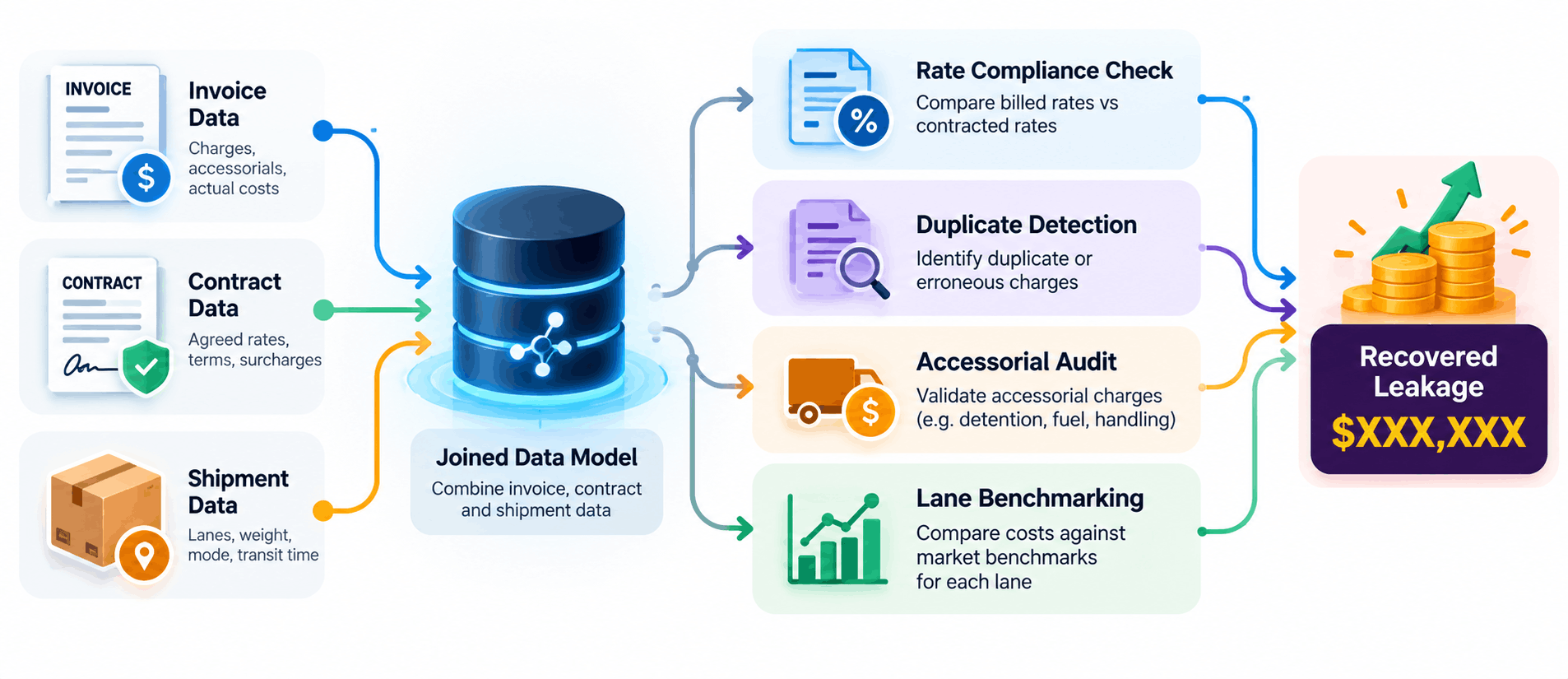
Consolidate invoice, contract and shipment data in one place. Leakage is invisible when invoices are reviewed separately from the rate contracts that should govern them. Data integration consulting services connect these sources, often scattered across TMS, finance and carrier portals.
Check every invoice against rate contract compliance. Rate contract compliance checking flags any line item billed above the contracted rate, which is the single largest recoverable category in most freight audits.
Flag duplicate invoices automatically. Duplicate invoices, the same shipment billed twice under slightly different reference numbers, are among the easiest leakage sources to catch once invoice and shipment data are joined, yet among the most commonly missed in manual review.
Audit accessorial charges line by line. Accessorial charges, fuel surcharges, detention, residential delivery fees, are the highest error category in most freight audit research, since they are applied inconsistently and rarely questioned individually.
Benchmark cost per kg by lane. Cost per kg compared through lane benchmarking reveals which specific lanes are paying above market rate, a pattern invisible when looking at total freight spend alone. Enterprise data integration engineering supports building this kind of lane level model, and AI ready data engineering covers the data foundation it depends on.
Samta.ai's Veda platform and the Veda AI decision analytics product support this full framework directly, resolving leakage questions against connected invoice, contract and shipment data rather than requiring a separate audit tool and a separate reporting dashboard.
Comparing five approaches to finding freight cost leakage
Approach | Coverage of invoices | Detection speed | Accessorial charge coverage | Best fit |
Manual spot check | Partial, small sample only | Slow, reactive | Weak, inconsistent | Very low invoice volume |
Spreadsheet based audit | Full, but labour intensive | Slow, manual joining required | Medium, depends on analyst diligence | Small shippers with simple contracts |
Rule based freight audit software | Full, automated rule checking | Fast for known rule violations | Strong for predefined rules | Mid sized shippers with standardised contracts |
AI powered freight analytics | Full, including pattern based anomalies | Fast, continuous | Strong, catches inconsistent patterns | Shippers with complex, multi carrier contracts |
Integrated decision analytics platform, for example VEDA | Full, joined with contract and shipment context | Fastest, resolves leakage questions directly | Strongest, cross references against lane benchmarks | Enterprise and 3PLs scaling across multiple carriers and lanes |
Only the last two rows catch pattern based leakage that rule based systems miss entirely. For a platform level comparison, see Veda versus a general Data Intelligence Platform.
Know Your AI Readiness Before Your Next Move
Real world use cases
Regulated freight angle: 3PL discovering duplicate billing across carriers
A 3PL managing freight for a regulated manufacturing client found that two carriers had separately billed the same cross dock transfer under different reference numbers, a duplicate that had gone uncaught for months because the invoices arrived through different channels. Joining invoice data against shipment records directly, rather than reviewing each carrier's invoices separately, surfaced the duplicate immediately, along with several smaller instances of the same pattern. See related delivery work in Samta.ai's case studies.
General enterprise: manufacturer overpaying on one specific lane
A manufacturer's total freight spend looked consistent with budget, but nobody had compared cost per kg across individual lanes. One lane, handled by a single carrier with no competitive benchmark, was running meaningfully above comparable lanes elsewhere in the network. Lane benchmarking surfaced the gap directly, turning an invisible cost into a specific renegotiation conversation with that one carrier.
Key risks and failure modes
Reviewing invoices without contract context. An invoice that looks reasonable in isolation can still violate a specific negotiated rate, which only shows up when the two are compared directly.
Treating accessorial charges as fixed costs. These are consistently the highest error category in freight audit research, yet are rarely questioned individually during manual review.
Missing duplicate invoices across carrier channels. The same shipment billed under slightly different reference numbers by different systems rarely gets caught without a direct data join.
Benchmarking total spend instead of cost per kg by lane. A healthy total freight budget can still hide one or two significantly overpriced lanes.
Auditing once a year instead of continuously. Leakage accumulates between audit cycles, and a once a year review misses months of recoverable spend.
Assuming rule based software catches everything. Rule based systems catch known violation patterns but miss anomalies that require comparing invoices against shipment and lane context directly.
When to invest in systematic leakage detection, and when not to
Invest now if:
Your freight spend is reviewed primarily through manual or spreadsheet based audit
You operate across multiple carriers and lanes without a direct cost per kg comparison
A recent audit uncovered unexpected leakage, suggesting more exists undetected
You are piloting AI driven logistics reporting and need the underlying invoice data connected first
Hold off if:
Your freight spend volume is too low for systematic detection to be cost effective yet
You operate with a single carrier under a simple, well monitored contract
You have not yet connected your invoice, contract and shipment data, in which case integration comes before detection
Turn AI Model Risk Into Actionable Insights
Conclusion
Freight cost leakage rarely shows up as one obvious error. It accumulates quietly across accessorial charges, duplicate invoices and rate mismatches that manual review was never designed to catch at scale. Joining invoice, contract and shipment data directly turns that invisible leakage into a specific, recoverable number. The next step is finding out how much is sitting in your own freight spend right now.
About Samta
Samta.ai is a Singapore-headquartered AI Product Engineering & Data Intelligence partner helping enterprises build production-grade AI systems for regulated and data-intensive environments.We help organizations move beyond experimentation by engineering scalable, explainable, and enterprise-ready AI solutions from data foundations and model development to workflow automation and deployment.
Our capabilities combine deep AI expertise, data engineering, and product engineering to deliver measurable business impact across FinTech, BFSI, cybersecurity, regulatory technology, and enterprise operations.
Our enterprise AI products power real-world intelligence systems:
• TATVA : AI-driven data intelligence platform for governed analytics, monitoring, and operational insights
• VEDA : Explainable and audit-ready AI decisioning engine built for compliance-sensitive enterprise workflows
• CORA-Property Management Solutions: : Predictive intelligence platform for real-estate pricing, portfolio optimization, and investment analytics
Backed by ecosystem partnerships with Microsoft, Databricks, Snowflake, and AWS, Samta.ai delivers agile, cost-efficient AI engineering with faster turnaround and enterprise-grade scalability. Trusted by enterprises across FinTech, BFSI, and digital transformation initiatives, Samta.ai embeds AI governance, data privacy, and compliance-by-design principles directly into the AI lifecycle , enabling organizations to scale AI with transparency, accountability, and operational control.
Enterprises leveraging Samta.ai automate 65%+ of repetitive data, analytics, and decision workflows while maintaining governance, explainability, and measurable business outcomes. Samta.ai provides the strategic consulting, AI engineering, and data modernization expertise needed to align enterprise operations with next-generation AI transformation goals.
Frequently asked questions
What is freight cost leakage?
Freight cost leakage is the gap between what a shipper should pay under its negotiated carrier contracts and what it actually pays, caused by billing errors that go undetected in normal invoice review. It typically accumulates through accessorial overcharges, duplicate invoices, and rate contract noncompliance, rather than through one large, obvious error.
How do you find overbilling in freight invoices?
Join invoice data directly against the contracted rates and actual shipment records, rather than reviewing invoices on their own. This surfaces rate contract violations, duplicate billing across reference numbers, and inconsistent accessorial charges that are invisible when an invoice is checked in isolation. Lane level cost per kg benchmarking adds a further layer, revealing overpricing that would otherwise look like normal freight spend.
How much freight spend is lost to leakage?
Industry estimates from freight audit practitioners put recoverable spend through professional audit at roughly 3 to 10 percent of total freight and parcel cost, based on a finding that 5 to 10 percent of invoices carry some form of billing error, with some shipping programs running as high as 40 percent. These are practitioner derived industry estimates rather than figures from a controlled academic study, so actual leakage varies significantly by shipper and contract complexity.
How can AI detect freight invoice errors?
AI detects freight invoice errors by comparing invoice line items against contracted rates, shipment records and historical lane benchmarks simultaneously, catching pattern based anomalies that rule based systems miss. This includes duplicate invoices billed under different reference numbers, accessorial charges applied inconsistently, and lanes priced above comparable benchmarks elsewhere in the network.
Tools to analyse freight cost leakage in India
Tools suited to this analysis need to join invoice, contract and shipment data directly rather than auditing invoices in isolation, since most leakage in Indian freight operations, like elsewhere, hides in accessorial charges and duplicate billing across carriers. Evaluate any tool on whether it connects to your existing TMS and finance systems directly, rather than requiring invoices to be manually uploaded for each audit cycle.