
Summarize this post with AI
The average time-to-hire for professional roles in Singapore runs 45–60 days and most of that time is spent on manual screening and scheduling, not on evaluating candidates. Enterprises that have deployed AI assessment platforms to reduce time to hire in Singapore are consistently cutting that window to 18–28 days without sacrificing candidate quality or assessment rigour. This guide breaks down exactly how AI recruitment Singapore leaders are achieving those results the platforms, the process changes, the governance requirements, and the failure modes that slow adoption rather than accelerate it.
Reduce Time to Hire AI Assessment Singapore:
Singapore enterprises reduce time to hire with AI assessment platforms by automating three stages that consume the most recruiter time: initial screening and shortlisting, skills and aptitude assessment administration, and candidate progression decisions. The highest-performing programs combine role-specific adaptive assessment not generic test batteries with direct ATS integration that eliminates manual data transfer between systems. For BFSI and regulated sectors in Singapore, AI hiring platforms must also produce explainable scoring output to satisfy PDPA and MAS fair-dealing obligations, which rules out black-box scoring tools regardless of their speed advantage.
What AI Assessment Platforms Actually Do to Reduce Time to Hire
AI hiring platforms are frequently described as screening tools. That undersells what the best ones do and oversells what the weakest ones deliver.
A genuine AI-powered recruitment platform reduces time to hire by automating decisions that previously required manual recruiter judgment at each stage:
Stage 1: Initial screening: AI models score inbound applications against role-specific criteria, eliminating the manual resume review that consumes 4–6 recruiter hours per role per day
Stage 2: Assessment administration: Candidates are automatically invited, assessed, and scored without recruiter coordination; assessment results feed directly into the ATS
Stage 3: Shortlist generation: Scored candidates are ranked and shortlisted automatically, with explainable scoring rationale provided to the hiring manager rather than a black-box ranking
Stage 4: Interview scheduling: Qualified candidates are automatically advanced to interview scheduling without manual progression decisions
Each of these automations is available independently, but time-to-hire reduction is maximised when all four are connected into a single workflow. The AI-driven assessment platform architecture that delivers the largest time savings integrates all four stages in a single pipeline rather than automating them in isolation.
Discover Your AI Readiness with a Free Assessment Report
Why Time-to-Hire Reduction Is a Strategic Priority in Singapore in 2026
Three market conditions have elevated faster hiring with AI assessments from an HR efficiency goal to a business continuity priority:
1. Talent scarcity is compressing hiring windows
For AI engineering, data science, credit risk, and compliance roles in Singapore, top candidates hold competing offers within 10–14 days of entering the market (Source Required: LinkedIn Singapore Talent Insights Report). Enterprises with 45-day hiring cycles are systematically losing their first-choice candidates to organisations with faster processes.
2. Hiring volume is increasing while recruiter headcount is not
Singapore's tight labour market for experienced recruiters means most enterprise talent teams are being asked to hire more roles with the same or smaller teams. Using AI for hiring is no longer optional for volume hiring programs it is the only way to maintain quality at increasing scale without proportional headcount increases.
3. PDPA and fair-dealing obligations require explainable AI
AI tools for recruitment that produce black-box scores are not viable for regulated employers in Singapore. PDPA obligations require that candidates can request the basis of employment decisions involving automated processing. MAS fair-dealing guidelines extend similar explainability requirements to BFSI sector hiring. This means speed and governance must be solved together not traded off against each other. Review how Tatva compares to traditional online assessments on both speed and explainability dimensions to understand where the biggest performance gap between AI-native and legacy assessment tools sits.
The 5-Stage Framework for Reducing Time to Hire with AI Assessment
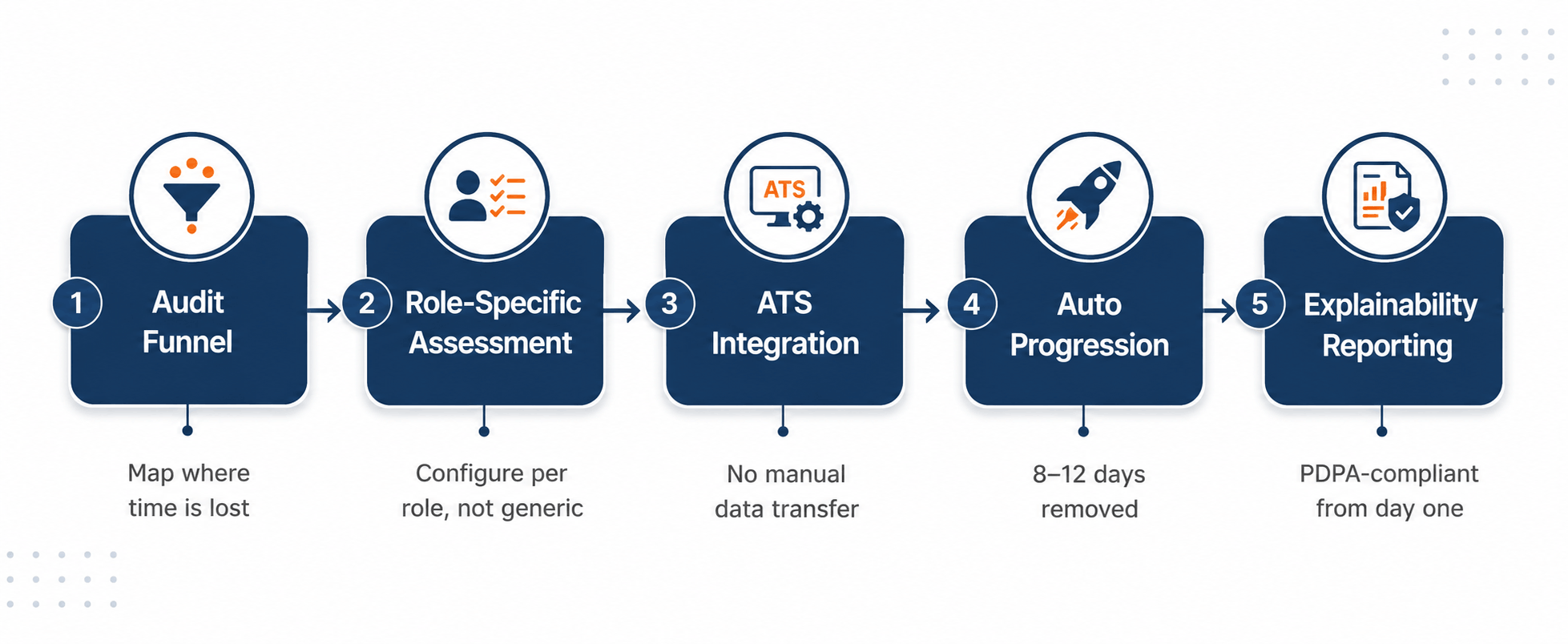
Stage 1: Audit Your Current Hiring Funnel for Time Loss
Before selecting any platform, map where time is actually lost in your current process. For most Singapore enterprises, the largest time sinks are: manual resume screening (average 4–6 hours per role per day), assessment scheduling and coordination (average 3–5 days per candidate), and shortlist review by hiring managers without structured scoring context. Quantify each stage in days. This becomes the baseline against which AI assessment ROI is measured.
Stage 2: Select Role-Specific Assessment, Not Generic Test Batteries
The single biggest mistake in AI recruitment Singapore programs is deploying a generic aptitude test battery across all roles. A generic test administered to 500 candidates produces a ranking it does not produce role-relevant differentiation. Adaptive, role-specific assessment calibrated to the seniority level, function, and regional context of the role produces shortlists that hiring managers actually trust and act on faster. Samta.ai's TATVA Hiring Assessment Platform deploys adaptive assessment models configured per role and seniority rather than applying one test template to every candidate which directly reduces the shortlist review time that follows assessment, not just the assessment administration time.
Stage 3: Integrate Assessment Directly Into Your ATS
Assessment results that require manual data transfer between systems add 1–3 days to every hiring cycle and introduce data entry errors that undermine scoring integrity. Require native ATS integration as a non-negotiable procurement criterion. Any AI-powered recruitment platform that requires manual result export is not reducing time to hire it is moving the bottleneck rather than removing it.
Samta.ai's workflow automation consulting practice implements the ATS integration layer as part of every assessment platform deployment ensuring candidate progression is automated end-to-end, not just at the assessment stage.
Stage 4: Set Automated Progression Thresholds
Define scoring thresholds above which candidates automatically advance to the next stage without manual recruiter review. This is the step most enterprises skip configuring the platform to administer assessments but leaving progression decisions manual. Automated progression based on validated scoring thresholds is where the largest time-to-hire reduction is achieved: typically 8–12 days removed from the standard hiring cycle.
Stage 5: Embed Explainability Reporting for Compliance
Configure scoring explainability output from the start not as an afterthought when a candidate requests the basis of a decision. Every shortlisted and rejected candidate record should carry a documented scoring rationale tied to the role-specific criteria applied. This is both a PDPA compliance requirement and a hiring manager trust-building mechanism: managers who understand why candidates were scored as they were act on shortlists faster. Compare how leading platforms handle this in Tatva vs Mercer Mettl to see the governance gap between AI-native and legacy assessment approaches.
AI Assessment Platform Comparison: 5-Column Benchmark
Evaluation Dimension | Manual / Legacy Process | Generic AI Assessment | Adaptive AI Assessment | |
Average Time to Shortlist | 25–35 days | 12–18 days | 7–12 days | 5–9 days |
Screening Automation | None — fully manual | Partial — resume scoring only | Full — screening to shortlist | Full — with ATS integration |
Role Specificity | Recruiter judgment | Generic test battery | Role-configured assessment | Adaptive per role and seniority |
PDPA Explainability | Manual documentation | Limited — black-box scoring | Partial — score-level only | Full — criterion-level rationale |
ATS Integration | Manual data entry | API export required | Native in select ATS | Native with workflow automation |
Understand Your Enterprise AI Risk Profile
Real-World Use Cases: Time-to-Hire Reduction in Singapore
Use Case 1: Graduate Hiring Program, Singapore Bank (BFSI)
A Singapore-licensed bank ran an annual graduate hiring program requiring assessment of 1,800 applicants across five analyst tracks credit, risk, operations, technology, and compliance within a fixed 8-week window. The previous process used a generic aptitude test administered centrally, with manual shortlisting by the HR team consuming 3 weeks of the 8-week window. Deploying adaptive, role-specific AI assessment with automated ATS progression reduced the shortlisting phase from 3 weeks to 6 days. Hiring manager shortlist acceptance rate the proportion of AI-shortlisted candidates who were advanced to offer increased from 61% to 84%, because the scoring context provided was role-specific rather than generic. Total time-to-hire reduced from 52 days to 29 days. Explore how similar BFSI hiring programs are structured in 10 best AI hiring platforms for regulated sectors.
Use Case 2: Technology Hiring at Scale, Regional Logistics Company (General Enterprise)
A regional logistics technology company needed to hire 120 software engineers and data engineers across Singapore and Malaysia within a 16-week period to support a platform rebuild program. Previous technical screening consumed 6–8 recruiter hours per candidate across resume review and phone screening before a technical assessment was even administered. AI assessment deployment with automated resume scoring, role-specific technical assessment, and direct ATS integration reduced pre-assessment recruiter time from 6–8 hours per candidate to under 45 minutes. Time to technical shortlist: from 28 days to 11 days. Offer acceptance rate held at 78%, consistent with the previous manual process, indicating no quality loss from the automated screening layer. Discuss about AI in hiring process outcomes at this scale: the primary value was not replacing recruiter judgment on final decisions it was eliminating recruiter time on screening that added no differentiation value. Review the 8 best talent assessment platforms to see how adaptive assessment compares across technical hiring contexts.
Case Studies See how Singapore enterprise and BFSI organisations have reduced time to hire with TATVA AI assessment →
Key Risks That Prevent Time-to-Hire Reduction
Generic test deployment: applying one assessment to all roles produces shortlists hiring managers do not trust, creating a manual review bottleneck that offsets the assessment automation gain
No ATS integration: assessment platforms without native ATS integration shift the data transfer bottleneck rather than removing it; manual result export adds 2–4 days per hiring cycle
Automated progression not configured: platforms set to administer assessments but leave progression decisions manual remove only a fraction of available time savings
Black-box scoring in regulated sectors: assessment tools without explainable scoring output create PDPA compliance exposure that forces manual documentation after the fact, adding time rather than saving it
Candidate experience not optimised: lengthy, irrelevant assessment batteries increase candidate drop-off, particularly for high-demand technical and financial services roles; drop-off at assessment stage extends time to fill, not shortens it
Understand how Tatva vs traditional hiring platforms compares on each of these risk dimensions before selecting any assessment platform for your hiring program.
Decision Framework: When AI Assessment Delivers Maximum Time-to-Hire Reduction
Deploy AI assessment for maximum time reduction when:
Hiring volume exceeds 50 roles per quarter per recruiter
Multiple distinct role types require differentiated assessment criteria
ATS integration is available to automate candidate progression
PDPA explainability requirements have been mapped and the platform can satisfy them
Expect limited time reduction when:
Generic assessment is applied without role-specific configuration
ATS integration is absent and manual data transfer is required
Hiring managers do not trust AI-generated shortlists without manual review
Assessment battery length exceeds 45 minutes and candidate drop-off is high
Use Samta.ai's digital transformation managed services when:
Assessment deployment needs to integrate into a broader HR workflow automation program
Multiple ATS environments across business units require coordinated integration
Ongoing platform optimisation and scoring threshold refinement is needed beyond initial deployment
Get Personalized AI Strategy Advice
Conclusion
Singapore enterprises that successfully reduce time to hire with AI assessment share three characteristics: they deploy role-specific adaptive assessment rather than generic test batteries, they integrate assessment directly into their ATS to automate progression, and they configure explainability reporting from day one rather than treating it as a compliance afterthought. Speed without governance creates PDPA exposure. Assessment without role specificity creates shortlists hiring managers reject. Getting both right simultaneously is what separates programs that cut time-to-hire from those that create new bottlenecks in different places.
Request a Free Product Demo See TATVA's adaptive AI assessment platform reduce your hiring cycle in a live demo built around your actual role profiles →
About Samta
Samta.ai is a Singapore-headquartered AI Product Engineering & Data Intelligence partner helping enterprises build production-grade AI systems for regulated and data-intensive environments.We help organizations move beyond experimentation by engineering scalable, explainable, and enterprise-ready AI solutions from data foundations and model development to workflow automation and deployment.
Our capabilities combine deep AI expertise, data engineering, and product engineering to deliver measurable business impact across FinTech, BFSI, cybersecurity, regulatory technology, and enterprise operations.
Our enterprise AI products power real-world intelligence systems:
• TATVA : AI-driven data intelligence platform for governed analytics, monitoring, and operational insights
• VEDA : Explainable and audit-ready AI decisioning engine built for compliance-sensitive enterprise workflows
• CORA-Property Management Solutions: : Predictive intelligence platform for real-estate pricing, portfolio optimization, and investment analytics
Backed by ecosystem partnerships with Microsoft, Databricks, Snowflake, and AWS, Samta.ai delivers agile, cost-efficient AI engineering with faster turnaround and enterprise-grade scalability. Trusted by enterprises across FinTech, BFSI, and digital transformation initiatives, Samta.ai embeds AI governance, data privacy, and compliance-by-design principles directly into the AI lifecycle , enabling organizations to scale AI with transparency, accountability, and operational control.
Enterprises leveraging Samta.ai automate 65%+ of repetitive data, analytics, and decision workflows while maintaining governance, explainability, and measurable business outcomes. Samta.ai provides the strategic consulting, AI engineering, and data modernization expertise needed to align enterprise operations with next-generation AI transformation goals.
Frequently Asked Questions
How does AI assessment reduce time to hire in Singapore?
AI assessment platforms reduce time to hire in Singapore by automating the four most time-consuming stages of the hiring funnel: initial application screening, assessment administration and scheduling, shortlist generation with scored rationale, and candidate progression to interview. The largest time savings come from automating progression decisions not just assessment administration which removes 8–12 days from the average hiring cycle when configured correctly.
What are the best AI tools for recruitment in Singapore in 2026?
The best AI tools for recruitment in Singapore in 2026 are those that combine role-specific adaptive assessment with native ATS integration and PDPA-compliant explainability reporting. Generic aptitude test platforms with AI scoring layered on top consistently underperform on hiring manager shortlist acceptance rates. Platforms built AI-natively with adaptive scoring calibrated to role, seniority, and regional context deliver the largest combined time-to-hire and quality improvement.
Is AI hiring legal and compliant in Singapore?
Using AI for hiring in Singapore is legal and increasingly common, but PDPA obligations require that candidates can request the basis of any automated employment decision. This means any AI-powered recruitment platform used in Singapore must produce explainable, documented scoring rationale not just a ranked candidate list. BFSI employers face additional MAS fair-dealing considerations for consumer-facing and regulated role categories.
How much does AI recruitment in Singapore typically reduce time to hire?
AI recruitment Singapore programs with properly configured adaptive assessment and ATS integration consistently reduce time to hire by 35–50% versus manual processes (Source Required: SHRM AI in Recruiting Report). The specific reduction depends on where time loss is concentrated in the current process: organisations with manual screening bottlenecks achieve the largest reductions; those with manual progression decisions achieve additional reductions on top.
What is the risk of using AI assessments without PDPA explainability?
Deploying AI hiring platforms without documented explainability output in Singapore creates two risks: regulatory risk if a candidate requests the basis of a decision and the organisation cannot produce a documented rationale; and reputational risk if rejected candidates perceive the process as opaque or potentially biased. Both risks are higher in regulated sectors where fair treatment obligations extend beyond general employment law.
Reduce Time-to-Hire by 70% with AI Skill Verification
TATVA helps enterprises screen, assess, and benchmark software engineers and tech talent with audit-ready AI evaluations.
Explore TATVA Platform >