
Summarize this post with AI
Selecting a data engineering company based on platform certifications alone is how enterprises end up with technically capable pipelines that do not satisfy MAS TRM lineage requirements, PDPA consent tracking obligations, or the AI model training data standards that their AI programs depend on. The right data engineering company in Singapore is one that understands the regulatory and downstream AI context of the data it builds infrastructure for, not just the ingestion and transformation mechanics. This guide gives Singapore CTOs, CDOs, and data leads a structured evaluation framework covering criteria, engagement models, cost benchmarks, and commercial terms that determine real program outcomes in 2026.
Data Engineering:
A data engineering company in Singapore should be evaluated on six criteria beyond platform certification: regulatory alignment capability (MAS TRM lineage documentation and PDPA consent tracking built as standard pipeline components), downstream AI readiness (data pipelines that produce training data meeting model governance standards), engagement model flexibility (fixed SOW versus staff augmentation versus managed services), knowledge transfer terms, data platform depth across Databricks and Snowflake, and references from production deployments in your industry and regulatory context. Data engineering firms that build pipelines without understanding the AI governance and regulatory obligations downstream from those pipelines consistently create expensive remediation programs for their clients within 12 to 18 months of delivery.
What a Data Engineering Company Actually Delivers
Data engineering companies are often described as pipeline builders. That undersells the scope of what production data engineering for enterprise and BFSI requires in Singapore in 2026.
A production data engineering engagement covers six distinct delivery layers:
Data pipeline architecture: designing the ingestion, transformation, and storage patterns that balance latency, cost, and governance requirements for the specific use case portfolio. This includes ETL vs ELT architecture decisions that affect downstream AI model training latency and data quality consistency.
Data platform implementation: building and configuring the governed data warehouse or lakehouse on Snowflake, Databricks, or Microsoft Azure, including access controls, quality monitoring, and lineage tracking infrastructure.
Data quality framework: implementing automated quality scoring across completeness, accuracy, consistency, and timeliness dimensions with alerting for threshold breaches and time series quality records producible for regulatory review.
Governance and compliance engineering: building PDPA consent metadata tracking through transformation layers, MAS TRM column level lineage documentation, and cross border data transfer controls for cloud training environments.
Data platform migration: managing structured migration from legacy data warehouses, on premise systems, or fragmented SaaS environments to a governed modern data platform without data loss or quality regression during transition.
AI readiness engineering: structuring data pipelines and training dataset versioning to satisfy the AI model governance requirements that downstream ML programs will depend on.
Data consulting firms that deliver only the first two layers and treat the remaining four as optional add ons consistently create data foundations that block AI program deployment rather than enabling it. Review enterprise data integration services for the full delivery scope that AI ready data infrastructure requires.
Turn AI Ambitions into Measurable Results
Why Data Engineering Company Selection Is More Consequential in 2026
Three developments have changed the evaluation criteria for data engineering firms:
1. MAS TRM lineage requirements now reach the column level
MAS Technology Risk Management examinations in 2026 request column level data lineage documentation for AI models deployed in Singapore financial institutions. A data pipeline that does not produce this lineage automatically creates a retroactive documentation exercise that costs significantly more than building lineage tracking into the original pipeline architecture (Source Required: MAS Technology Risk Management Guidelines).
2. AI program success is bounded by data engineering quality
Gartner estimates that poor data quality costs organisations an average of USD 12.9 million annually and is the primary cause of AI program stalls and production deployment failures (Source Required: Gartner Data Quality Research). Data science consulting firms that scope data engineering as a separate upstream investment from AI program delivery consistently produce data platforms that are not AI ready when the model development phase begins.
3. Data platform migration complexity is increasing
Singapore enterprises are managing a growing portfolio of legacy data environments that predate modern lakehouse architecture. Data engagement models for migration programs require specialist migration experience that generic cloud implementation firms do not have, including data reconciliation methodology, cutover risk management, and quality validation against pre migration baselines.
The 6 Criteria Evaluation Framework for Data Engineering Companies
Criterion 1: Regulatory Alignment Capability
Does the firm build MAS TRM column level lineage, PDPA consent tracking, and cross border data transfer controls as standard pipeline components, or as optional add ons requested by the client after delivery? For Singapore BFSI and regulated enterprise, regulatory alignment must be an engineering standard, not a compliance afterthought. Ask vendors to describe specifically how PDPA consent metadata is tracked through their standard ETL or ELT transformation patterns. Firms that cannot answer this question without escalating to a compliance specialist do not have regulatory alignment capability embedded in their engineering practice.
Criterion 2: Downstream AI Readiness
Does the firm scope data pipelines to satisfy the training data governance requirements of AI programs that will consume them? This includes training dataset versioning, feature lineage tracking, inference data pipeline design distinct from batch analytics pipelines, and data quality standards calibrated to model performance thresholds rather than reporting accuracy thresholds. Data pipeline architecture decisions made during data engineering engagements have direct consequences for AI model governance. Review AI ready data engineering to understand what the downstream AI model requirements impose on upstream data engineering design decisions.
Criterion 3: Data Platform Depth
Does the firm have production certified engineers on Databricks Unity Catalog, Snowflake Data Sharing, and Microsoft Azure Purview, or is its platform capability limited to standard warehouse implementation? Column level lineage on Databricks, time travel on Snowflake Delta Lake, and data governance on Azure Purview require specialist configuration that differs materially from standard platform deployment. Samta.ai's data integration consulting services implement production certified configurations on Databricks and Snowflake with MAS TRM examination ready lineage and PDPA consent tracking as standard delivery components, not optional engineering additions.
Criterion 4: Engagement Model Flexibility
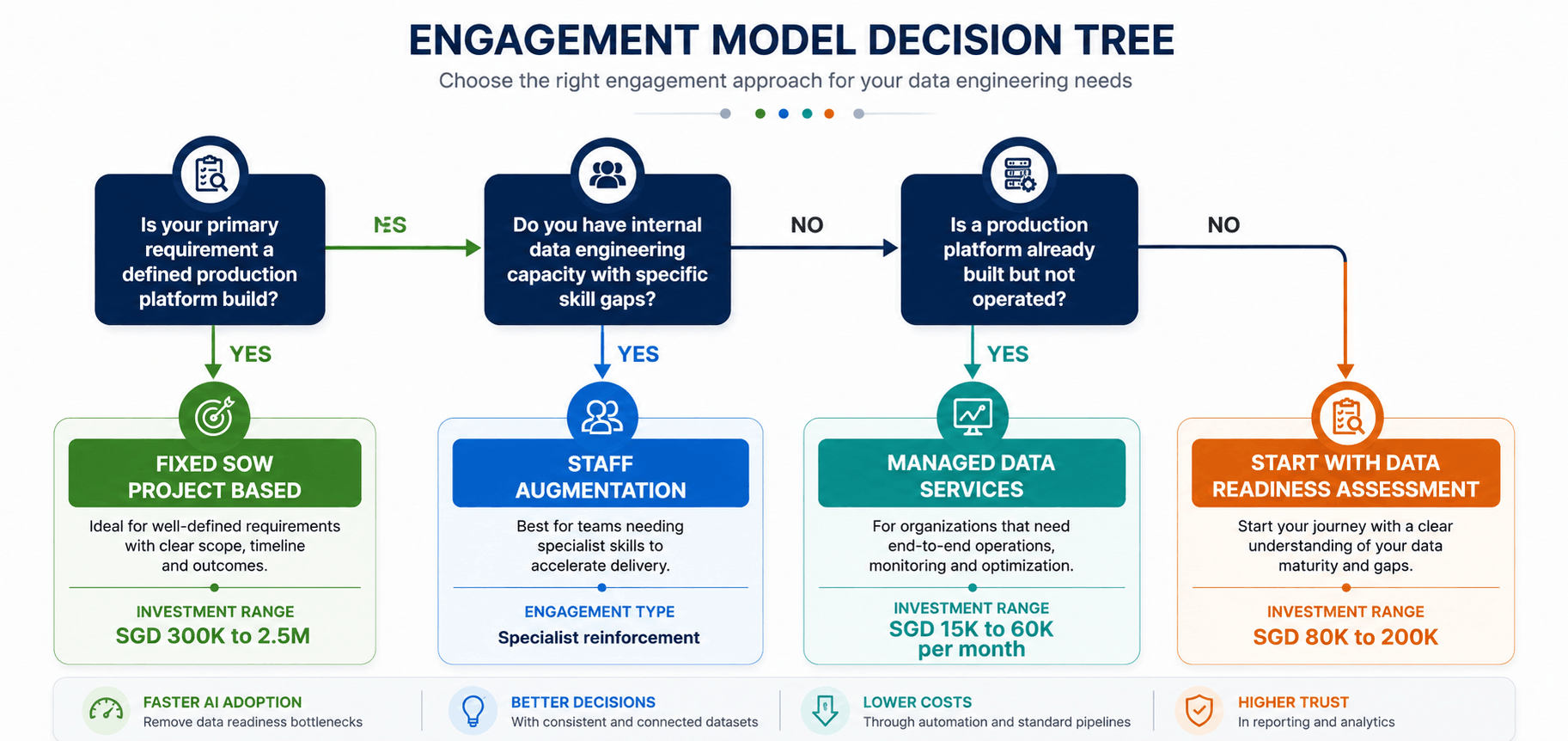
Can the firm deliver across three engagement models: project based fixed SOW for defined platform builds, staff augmentation for organisations with internal data engineering capability that needs specialist reinforcement, and managed data services for ongoing pipeline operations after the initial build? Firms with only one engagement model create commercial inflexibility that increases switching cost when program requirements change.
Criterion 5: Knowledge Transfer Terms
Does the commercial agreement specify contractual knowledge transfer with defined completion criteria, or is knowledge transfer a verbal commitment that disappears from the SOW between proposal and contract? Require: all pipeline code delivered to client repositories, documentation for every pipeline covering source to destination mapping and transformation logic, internal team training on platform operations, and a defined hypercare period after handover. Data science consulting engagements that do not transfer operational knowledge create permanent managed services dependency at costs that were not in the original program budget.
Criterion 6: SLA Structure for Managed Services
If the engagement includes ongoing pipeline operations, does the SLA structure specify data freshness SLAs (maximum acceptable latency from source event to data availability), pipeline availability SLAs (maximum downtime per month), data quality SLAs (minimum quality score thresholds with alerting response time), and incident response SLAs (maximum time to detection, investigation, and resolution by severity level)? Managed data services agreements without defined SLAs transfer operational risk to the client without any accountability mechanism for the vendor. Require all four SLA categories before signing any managed services component.
Data Engineering Company Evaluation:
Evaluation Criterion | Global SI | Regional Boutique | Cloud Platform Vendor | |
Regulatory Alignment | Varies by practice, often policy level | Strong in 1 to 2 regulated sectors | Platform compliance features only | MAS TRM and PDPA built into standard pipeline delivery |
Downstream AI Readiness | Separate AI and data teams, coordination gap | Varies, often limited AI governance depth | Platform AI features, not AI governance | AI governance and data engineering scoped together |
Data Platform Depth | Multi platform, generic depth | Specialist in 1 to 2 platforms | Own platform only | Databricks, Snowflake, Azure, production certified |
Engagement Model | Fixed SOW and T and M, limited managed services | Fixed SOW, limited managed services | Platform subscription plus professional services | Fixed SOW, staff augmentation, and managed services |
Knowledge Transfer | Structured but inconsistent, often verbal | Varies, often informal | Product training only | Contractual with defined completion criteria in standard SOW |
Strengthen AI Governance with a Risk Assessment
Real World Use Cases
Use Case 1: Data Platform Build for AI Program, Singapore Bank (BFSI)
A Singapore licensed bank's AI credit risk program was blocked 8 weeks into model development because the data engineering engagement that preceded it had not built column level lineage documentation or PDPA consent tracking into the training data pipelines. The model risk team could not validate the training data governance before the independent validation could proceed. A targeted data engineering remediation on Databricks Unity Catalog implemented column level lineage and PDPA consent metadata tracking across the three source systems feeding the credit model. Remediation duration: 10 weeks. Remediation cost: SGD 185,000. Estimated cost if built correctly in the original engagement: SGD 45,000 as a standard engineering addition.
Explore similar outcomes in Samta.ai case studies and review data engineering for BFSI for the specific pipeline governance requirements that prevent this failure pattern.
Use Case 2: Data Platform Migration, Regional Insurance Group (General Enterprise)
A regional insurance group needed to migrate 14 years of claims, policy, and customer data from an on premise Oracle data warehouse to a Snowflake lakehouse architecture across Singapore, Malaysia, and Thailand operations. The migration required: data reconciliation validation at the record level against pre migration baselines, PDPA compliance mapping for personal data moving to a cloud environment, and zero downtime cutover for reporting systems that operated 24 hours a day. The engagement used a project based fixed SOW with milestone based payment tied to: data reconciliation validation completion, PDPA compliance documentation sign off, parallel run validation, and cutover completion with defined rollback capability. Total engagement: 22 weeks. Post migration data quality score: 94% across all three dimensions (completeness, accuracy, timeliness) versus 71% pre migration. The Snowflake platform delivered also served as the AI ready data foundation for the group's subsequent AI claims fraud detection program, demonstrating the compounding value of scoping data engineering to downstream AI readiness requirements from the start. The VEDA AI Decision Analytics Platform was deployed on this foundation, with the VEDA platform documentation covering the specific governance infrastructure that the Snowflake foundation enabled.
Key Risks When Selecting the Wrong Data Engineering Company
Pipeline delivery without regulatory alignment: is the most common and most expensive failure mode. Data pipelines built without PDPA consent tracking and MAS TRM lineage documentation satisfy the immediate analytics or reporting requirement and create a governance remediation program for every AI use case that follows.
ETL vs ELT architecture decisions made without AI downstream context: create training data pipeline designs that are efficient for batch reporting but cannot support the data versioning, feature lineage, and quality scoring that AI model governance requires. The architecture decision made in Week 1 of a data engineering engagement has consequences across every AI program the platform enables.
Staff augmentation without knowledge transfer planning: creates practitioners embedded in the organisation who hold all operational knowledge in their heads rather than in documentation. When the augmentation contract ends, the pipeline operations knowledge leaves with the practitioners.
Fixed SOW without data quality baseline assessment: produces contracts where the engineering scope is defined before the actual state of the source data is understood. Data quality issues discovered during engineering extend timelines by 30 to 70% when not identified during scoping (Source Required: McKinsey Data Infrastructure Report).
Managed services without defined SLA structure: transfers operational risk to the client without any contractual accountability for pipeline availability, data freshness, quality maintenance, or incident response time.
Review enterprise data integration engineering for the technical patterns that avoid each of these failure modes in production data engineering engagements, and compare VEDA vs data intelligence platform to understand how platform selection decisions made during data engineering engagements affect downstream AI deployment options.
Decision Framework: Which Engagement Model Fits Your Organisation
Engage on a fixed SOW project basis when:
A defined data platform build or migration with clear deliverables and a defined timeline is the primary requirement
Board investment approval has been granted for a specific program with defined scope and budget
You need full vendor accountability tied to production milestones rather than time billed
Engage on a staff augmentation basis when:
Your internal data engineering team has capacity for standard pipeline work but needs specialist capability for specific platforms (Databricks Unity Catalog, Snowflake time travel, Azure Purview) or specific governance requirements (MAS TRM lineage, PDPA consent tracking)
The engagement duration is less than 6 months and the specific gap is well defined
Engage on a managed data services basis when:
A production data platform exists but your organisation does not have internal MLOps or DataOps capability to operate it reliably with defined SLAs
Ongoing PDPA compliance documentation, MAS TRM data quality records, and AI model training data management require specialist ongoing operations rather than internal headcount
Consider data engineering ROI to build the board investment case for whichever engagement model you select, and enterprise AI engineering in Singapore to understand how data engineering engagement decisions connect to the broader AI program investment structure.
Start Your Enterprise AI Transformation Today
Conclusion
Selecting a data engineering company in Singapore on platform certification alone is a scoping error that creates regulatory remediation risk, AI program delays, and managed services dependency that were not in the original program budget. The six criteria in this guide evaluate the dimensions that determine whether a data engineering engagement produces a governed, AI ready data foundation that sustains value across regulatory examination cycles, or a technically functional platform that requires expensive retrofit when the first AI model or MAS examination reveals what the original engineering missed. Evaluate on regulatory alignment, downstream AI readiness, knowledge transfer, and SLA structure. Weight production references in your regulatory sector above all other criteria.
About Samta
Samta.ai is a Singapore-headquartered AI Product Engineering & Data Intelligence partner helping enterprises build production-grade AI systems for regulated and data-intensive environments.We help organizations move beyond experimentation by engineering scalable, explainable, and enterprise-ready AI solutions from data foundations and model development to workflow automation and deployment.
Our capabilities combine deep AI expertise, data engineering, and product engineering to deliver measurable business impact across FinTech, BFSI, cybersecurity, regulatory technology, and enterprise operations.
Our enterprise AI products power real-world intelligence systems:
• TATVA : AI-driven data intelligence platform for governed analytics, monitoring, and operational insights
• VEDA : Explainable and audit-ready AI decisioning engine built for compliance-sensitive enterprise workflows
• CORA-Property Management Solutions: : Predictive intelligence platform for real-estate pricing, portfolio optimization, and investment analytics
Backed by ecosystem partnerships with Microsoft, Databricks, Snowflake, and AWS, Samta.ai delivers agile, cost-efficient AI engineering with faster turnaround and enterprise-grade scalability. Trusted by enterprises across FinTech, BFSI, and digital transformation initiatives, Samta.ai embeds AI governance, data privacy, and compliance-by-design principles directly into the AI lifecycle , enabling organizations to scale AI with transparency, accountability, and operational control.
Enterprises leveraging Samta.ai automate 65%+ of repetitive data, analytics, and decision workflows while maintaining governance, explainability, and measurable business outcomes. Samta.ai provides the strategic consulting, AI engineering, and data modernization expertise needed to align enterprise operations with next-generation AI transformation goals.
Frequently Asked Questions
What does a data engineering company do in Singapore?
A data engineering company in Singapore designs, builds, and operates data pipelines, data platforms, and data infrastructure that moves raw data from source systems to governed, queryable storage environments for analytics and AI consumption. In Singapore's regulatory context, production data engineering also includes PDPA consent tracking, MAS TRM lineage documentation for BFSI clients, cross border data transfer compliance controls, and AI training data governance infrastructure that generic engineering firms often scope separately.
What is the difference between ETL and ELT for enterprise data engineering?
ETL vs ELT in enterprise data engineering: ETL (Extract, Transform, Load) transforms data before loading into the target platform, suitable for structured sources with stable schemas and high quality requirements before storage. ELT (Extract, Load, Transform) loads raw data into the platform and transforms it there, suitable for high volume diverse sources where raw data preservation and transformation flexibility are priorities. For AI training data pipelines, ELT typically provides better data versioning and lineage tracking capability, which makes it the preferred pattern for AI ready data infrastructure.
What are the typical costs for a data engineering engagement in Singapore?
Data engineering firms in Singapore typically charge: SGD 80,000 to 200,000 for a data readiness assessment and platform architecture design; SGD 300,000 to 1.2M for a full data platform build on Snowflake or Databricks including governance and lineage infrastructure; SGD 500,000 to 2.5M for a complex data platform migration from legacy on premise environments; and SGD 15,000 to 60,000 per month for managed data services operations post build. Engagements without data quality baseline assessments before scoping routinely overrun initial estimates by 30 to 70%.
What is staff augmentation for data engineering and when should enterprises use it?
Staff augmentation vs project based data engineering: staff augmentation embeds specialist data engineers within your internal team on a time based contract without fixed deliverable accountability. It is appropriate when your internal team has delivery capacity but needs specific platform or governance expertise for a defined short term requirement. It is not appropriate as a substitute for a fixed SOW when the deliverable is a production data platform build, because staff augmentation without outcome accountability consistently extends project timelines.
What SLA structure should managed data services agreements include?
A SLA structure for managed data services should specify four SLA categories: data freshness SLAs defining maximum latency from source event to data availability in the target platform; pipeline availability SLAs defining maximum acceptable downtime per month; data quality SLAs defining minimum quality score thresholds with alerting response times; and incident response SLAs defining maximum time to detection, investigation commencement, and resolution for pipeline failures by severity level. Managed services agreements without all four SLA categories transfer operational risk to the client.