
Summarize this post with AI
Most RFPs for AI projects ask about technology stack and team size. Few ask who owns the code, what happens if the model degrades after launch, or how security gets reviewed. Choosing an ai development company india offers hundreds of depends less on their tech stack slide and more on how they answer the questions most RFPs never ask. This guide gives you both, a selection framework and the specific RFP questions to include.
AI development company india:
An AI development company in India should be evaluated on pricing model, fixed price versus time and materials, MLOps maturity, code ownership terms, security review process, and the composition of the actual delivery team, not just technology stack or past client logos. NASSCOM's AI Adoption Index confirms India's AI market is growing at 25 to 35 percent CAGR through 2027, which means the pool of vendors is expanding fast, making a structured RFP more important than ever. Deloitte's 2026 State of AI in the Enterprise report found that regulatory and compliance requirements are the top AI integration challenge for Indian enterprises, so any credible vendor shortlist needs to test specifically for that capability.
What is an AI development company?
An ai development company builds, deploys and maintains AI systems for enterprise clients, covering everything from model development to the underlying data engineering that makes those models work reliably in production. This differs from a general ai software development company, which may build software that incorporates AI features without specialising in the model development, MLOps and data engineering discipline specifically.
A machine learning development company narrows this further, focusing specifically on the model building and training layer, often as a subcontracted specialist within a larger AI development engagement. For a broader breakdown of what a full service engagement includes, see AI engineering consulting services and enterprise AI consulting services.
Measure Your AI Readiness with a Free Assessment
Why this matters now for enterprises evaluating India based AI vendors
Three developments make a structured RFP essential in 2026.
The vendor pool is expanding rapidly, making structured comparison harder without a framework. NASSCOM's AI Adoption Index, developed with Microsoft, Capgemini, EY and EXL, confirms India's AI market is set to grow at 25 to 35 percent CAGR through 2027, with the Annual Strategic Review 2026 projecting India's broader technology industry will reach 315 billion dollars in revenue this fiscal year, driven substantially by AI moving from experimentation to scaled deployment.
Regulatory and compliance capability is now a top differentiator, not a nice to have. Deloitte's 2026 State of AI in the Enterprise report for India found that regulatory and compliance requirements are the single largest AI integration challenge at 39 percent, ahead of resistance to change at 34 percent, meaning a vendor's security and governance capability deserves as much RFP attention as their technical skill.
Global AI risk standards increasingly shape what a credible vendor should already practice. The NIST AI Risk Management Framework gives enterprises a reference point for evaluating whether a vendor's own development practices, documentation, testing, monitoring, meet a recognised bar.
See how this compares to an in house build in in house AI engineering, and a specific vendor comparison in Samta.ai versus Deloitte.
A five step framework for evaluating and selecting a vendor
Here is the sequence that gets you to a defensible shortlist, not just a list of names with similar sounding pitches.
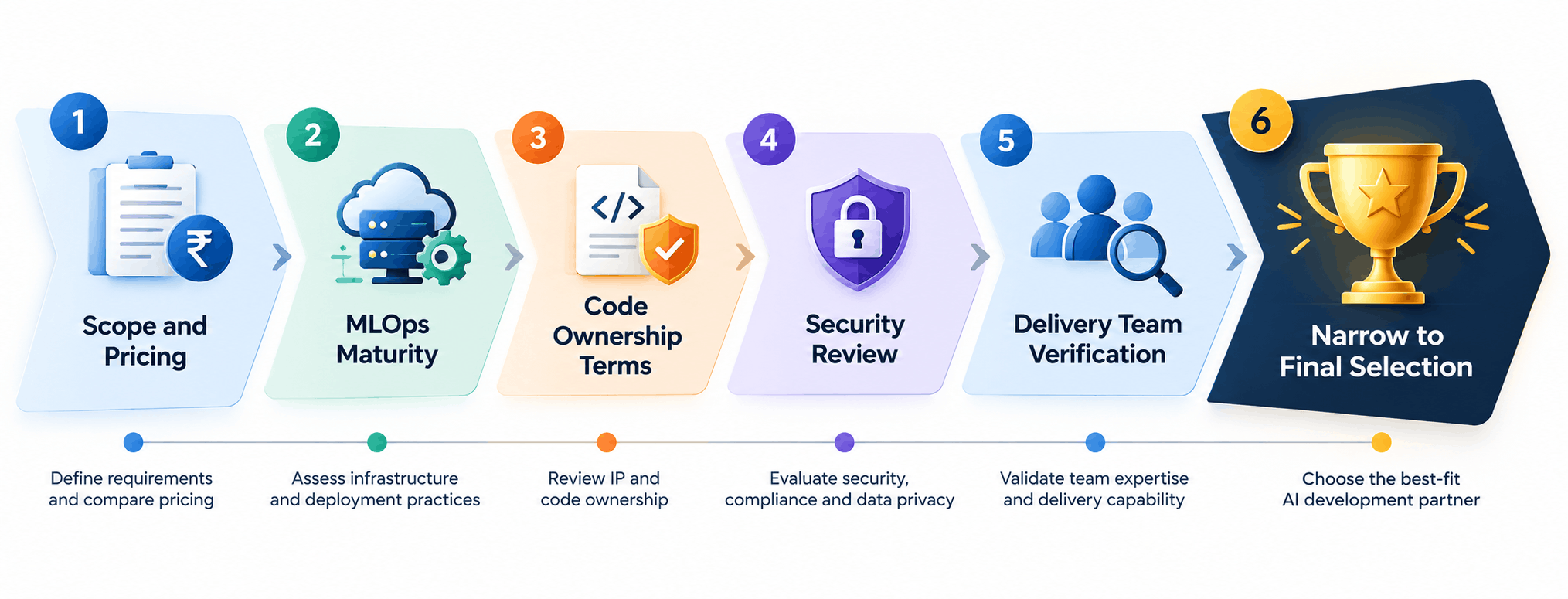
Define scope clearly before requesting pricing. Decide whether you need fixed price vs T&M pricing for your specific engagement, fixed price suits well defined, bounded scope, while time and materials suits exploratory or evolving work. Vendors who push one model regardless of your scope are a warning sign.
Ask about MLOps maturity directly, not just model building skill. MLOps covers how a vendor deploys, monitors and retrains models in production, and this is where many vendors who demo well in a proof of concept actually fall short once a system is live.
Clarify code ownership and intellectual property terms upfront. Code ownership disputes after a project ends are common and expensive to resolve, so this needs to be in the contract before work starts, not negotiated after delivery. Data integration consulting services and the surrounding data pipeline work often carries its own ownership questions worth clarifying separately.
Require a documented security review process. A security review process that exists only verbally is not a process. AI security and compliance services should be something any credible vendor can describe concretely, not gesture at.
Meet the actual delivery team, not just the sales team. A delivery team that differs significantly from the people in your sales pitch is one of the most common sources of post contract disappointment. Samta.ai's Veda platform and the Veda AI decision analytics product are built and delivered by the same engineering team that scopes a client's engagement, which is worth asking any vendor to confirm about their own structure.
For a platform level comparison relevant to the engineering layer vendors deliver, see Veda versus a general Data Intelligence Platform.
Comparing five AI development engagement models
Engagement model | Typical pricing | MLOps maturity | Code ownership | Best fit |
Freelance or independent developers | Low cost, usually T&M | Low, rarely includes production monitoring | Often ambiguous unless contracted carefully | Small, low stakes prototypes |
Boutique AI development shop | Mid range, mixed pricing models | Variable, depends heavily on the specific team | Usually clear, smaller contracts easier to negotiate | Focused, well scoped single use cases |
Large IT services firm | Higher cost, often fixed price for defined scope | Established, but can be slow to adapt to new use cases | Clear contractually, but IP terms can be complex | Large, well defined enterprise programs |
Specialised AI engineering consultancy | Mid to high, scoped per engagement | Strong, built around production deployment specifically | Typically negotiable, client owned by default | Enterprises needing both build and ongoing engineering support |
In house team build, vendor supported | Highest upfront investment, ongoing internal cost | Depends entirely on internal capability built over time | Fully client owned by definition | Enterprises with long term, strategic AI dependency |
The middle rows are where most enterprise RFPs should focus comparison effort, since freelance and pure in house builds rarely suit a serious enterprise AI program on their own. See data and AI consulting for how this engagement model question connects to the underlying data work.
Know Your AI Model Risk Before You Scale
Real world use cases
Regulated industry angle: bank vetting vendors for a credit model build
A bank issued an RFP for a credit scoring model build without specifying security review requirements in detail. Three vendors responded with similar technical proposals, but only one could describe a documented, repeatable security review process when asked directly in a follow up interview. Requiring this detail in the RFP itself, rather than discovering the gap in a later interview round, would have saved a full review cycle. See related delivery patterns in Samta.ai's case studies.
General enterprise: manufacturer caught by a code ownership dispute
A manufacturer completed an AI forecasting model build with a vendor under a contract that never explicitly addressed code ownership. When the manufacturer later wanted to bring maintenance in house, the vendor claimed partial ownership of custom components built during the engagement. A clear code ownership clause in the original RFP and contract would have prevented months of renegotiation before the manufacturer could take the model in house.
Key risks and failure modes
Choosing on price alone without evaluating MLOps maturity. A low upfront cost vendor without production deployment discipline often costs more once the model needs ongoing monitoring and retraining.
Leaving code ownership ambiguous in the contract. This surfaces as a costly dispute specifically when a client later wants to switch vendors or bring work in house.
Accepting a verbal description of security practices instead of documentation. A security review process that cannot be described in writing is not reliably repeatable.
Meeting only the sales team during evaluation. The delivery team's actual composition and experience matters more than the pitch team's polish.
Choosing a fixed price model for genuinely exploratory work. Fixed pricing works against both parties when scope is still evolving, leading to scope disputes mid project.
Ignoring regulatory and compliance capability during evaluation. Given this is now the top integration challenge Indian enterprises report, a vendor untested on this specifically is a real risk.
What should an AI RFP include, and when to skip the full process
A thorough RFP process is worth running if:
The engagement involves a production system with ongoing maintenance needs
Regulatory or compliance requirements apply to the AI system being built
Budget and timeline commitments are significant enough to justify the evaluation effort
Multiple stakeholders need a documented, defensible vendor selection process
A lighter evaluation may be sufficient if:
The engagement is a small, low stakes proof of concept with limited budget
You already have a trusted, existing vendor relationship for similar work
The AI system has no production deployment or regulatory exposure
Talk to an AI Expert About Your Business Needs
Conclusion
A vendor’s technology stack slide tells you almost nothing about whether they can actually deliver and maintain a production AI system. The five areas in this framework, pricing fit, MLOps, code ownership, security review and delivery team, tell you much more. Build these into your RFP directly, and ask vendors to answer concretely rather than generically. The next step is applying this framework to your own specific engagement.
About Samta
Samta.ai is a Singapore-headquartered AI Product Engineering & Data Intelligence partner helping enterprises build production-grade AI systems for regulated and data-intensive environments.We help organizations move beyond experimentation by engineering scalable, explainable, and enterprise-ready AI solutions from data foundations and model development to workflow automation and deployment.
Our capabilities combine deep AI expertise, data engineering, and product engineering to deliver measurable business impact across FinTech, BFSI, cybersecurity, regulatory technology, and enterprise operations.
Our enterprise AI products power real-world intelligence systems:
• TATVA : AI-driven data intelligence platform for governed analytics, monitoring, and operational insights
• VEDA : Explainable and audit-ready AI decisioning engine built for compliance-sensitive enterprise workflows
• CORA-Property Management Solutions: : Predictive intelligence platform for real-estate pricing, portfolio optimization, and investment analytics
Backed by ecosystem partnerships with Microsoft, Databricks, Snowflake, and AWS, Samta.ai delivers agile, cost-efficient AI engineering with faster turnaround and enterprise-grade scalability. Trusted by enterprises across FinTech, BFSI, and digital transformation initiatives, Samta.ai embeds AI governance, data privacy, and compliance-by-design principles directly into the AI lifecycle , enabling organizations to scale AI with transparency, accountability, and operational control.
Enterprises leveraging Samta.ai automate 65%+ of repetitive data, analytics, and decision workflows while maintaining governance, explainability, and measurable business outcomes. Samta.ai provides the strategic consulting, AI engineering, and data modernization expertise needed to align enterprise operations with next-generation AI transformation goals.
Frequently asked questions
How do I choose an AI development company?
Evaluate vendors on pricing model fit for your scope, fixed price versus time and materials, MLOps maturity for production deployment, clear code ownership terms, a documented security review process, and the actual delivery team you will work with, not just the sales pitch. Given India's rapidly expanding vendor pool, a structured RFP covering these five areas produces a far more defensible selection than comparing technology stacks alone.
How much does AI development cost in India?
Ai development cost india varies significantly by scope, engagement model and vendor type, with freelance developers typically cheapest and large IT services firms or specialised consultancies commanding higher rates for production grade, maintained systems. There is no single reliable industry wide figure, since cost depends heavily on project complexity, ongoing MLOps requirements and the specific pricing model chosen. Scope your requirements clearly before requesting quotes to get comparable numbers across vendors.
What should an AI RFP include?
A strong RFP should specify your preferred pricing model and why, ask directly about the vendor's MLOps practices for production deployment, require clear code ownership terms in the response, request documentation of their security review process, and ask for the specific delivery team who will work on your project, not just company level credentials. Most generic RFP templates miss several of these entirely.
Top AI development companies in India for enterprises
There is no single verified ranking of AI development companies in India, since rankings vary by methodology and update frequently as the market grows at the 25 to 35 percent CAGR NASSCOM's own research confirms. Evaluate any shortlist against the five step framework above, pricing fit, MLOps maturity, code ownership clarity, security review process and delivery team quality, rather than relying on a third party ranking alone.
RFP questions for an AI development partner
Key questions should cover whether they recommend fixed price or time and materials for your specific scope and why, how they handle model monitoring and retraining once deployed, what code ownership terms apply to custom components, what their documented security review process looks like, and who specifically will make up your delivery team. A vendor who answers all five concretely, rather than generically, is a stronger candidate.