
Summarize this post with AI
Most finance leaders accept that management reporting takes too long as a fixed cost of running a large organization, something to manage rather than fix. It does not have to be. The median finance team still takes eight days to close its books each month, according to APQC's benchmarking research, and that number barely moves even as companies invest heavily in dashboards and reporting tools. The real cost is not the eight days themselves, it is every decision waiting on those eight days to finish. That gap between a business question and an answer has a name, decision latency, and it is more measurable, and more fixable, than most organizations treat it.
Management Reporting Takes Too Long:
Management reporting takes too long because most organizations still route every business question through a batch reporting cycle, manual consolidation, scheduled dashboard refreshes, or a request queue, rather than connecting decision makers directly to live data. APQC's research puts the median monthly close at eight days, with slower performers taking ten days or more, and top performing organizations completing annual close in ten days versus a median of eighteen and thirty five days for the slowest. The fix is not a faster version of the same batch process, it is removing the batch step entirely for the questions that do not need to wait for a full close cycle.
What decision latency actually is
What is decision latency? It is the time between when a business question arises and when a decision maker has enough reliable information to act on it. This differs from reporting cycle time specifically, since decision latency includes every delay along the way, waiting for a report, waiting for a dashboard to be built, and waiting for someone to interpret what the numbers mean.
Reporting bottleneck patterns tend to repeat across organizations regardless of size. A question arrives, it gets routed to an analyst or a finance team, that team assembles data from multiple systems, and the answer arrives days or weeks after the question was first asked, often after the decision it was meant to inform has already been made another way. Our guide on the real cost of slow decision making covers how this latency compounds across an organization, not just within a single report.
Assess Your AI Readiness Before You Scale
Why this matters more in 2026 than it used to
Automated management reporting has become a genuine differentiator, not an efficiency nice to have, for three reasons.
AI adoption in reporting processes is still surprisingly low. APQC's own research finds only 31% of organizations actively use AI in record to report processes, with another 39% still in early adoption stages, meaning most organizations have not yet closed a gap the technology to close it has existed for some time.
Real time business intelligence has become achievable, not aspirational. The technical barrier to connecting decision makers directly to live data has fallen significantly, meaning organizations still running purely batch based reporting are choosing that latency, not enduring it out of necessity.
Competitive pressure now includes decision speed directly. An organization that can answer a new business question in minutes has a structural advantage over one still routing every question through a multi day reporting cycle, regardless of how accurate that slower answer eventually is.
Our overview of AI powered insights platforms covers the category of tools built specifically to close this gap, and our guide to AI decision intelligence platforms covers how these tools go beyond reporting to recommend action directly.
How to reduce management reporting cycle time
Closing the gap between a business question and a usable answer follows a consistent progression.
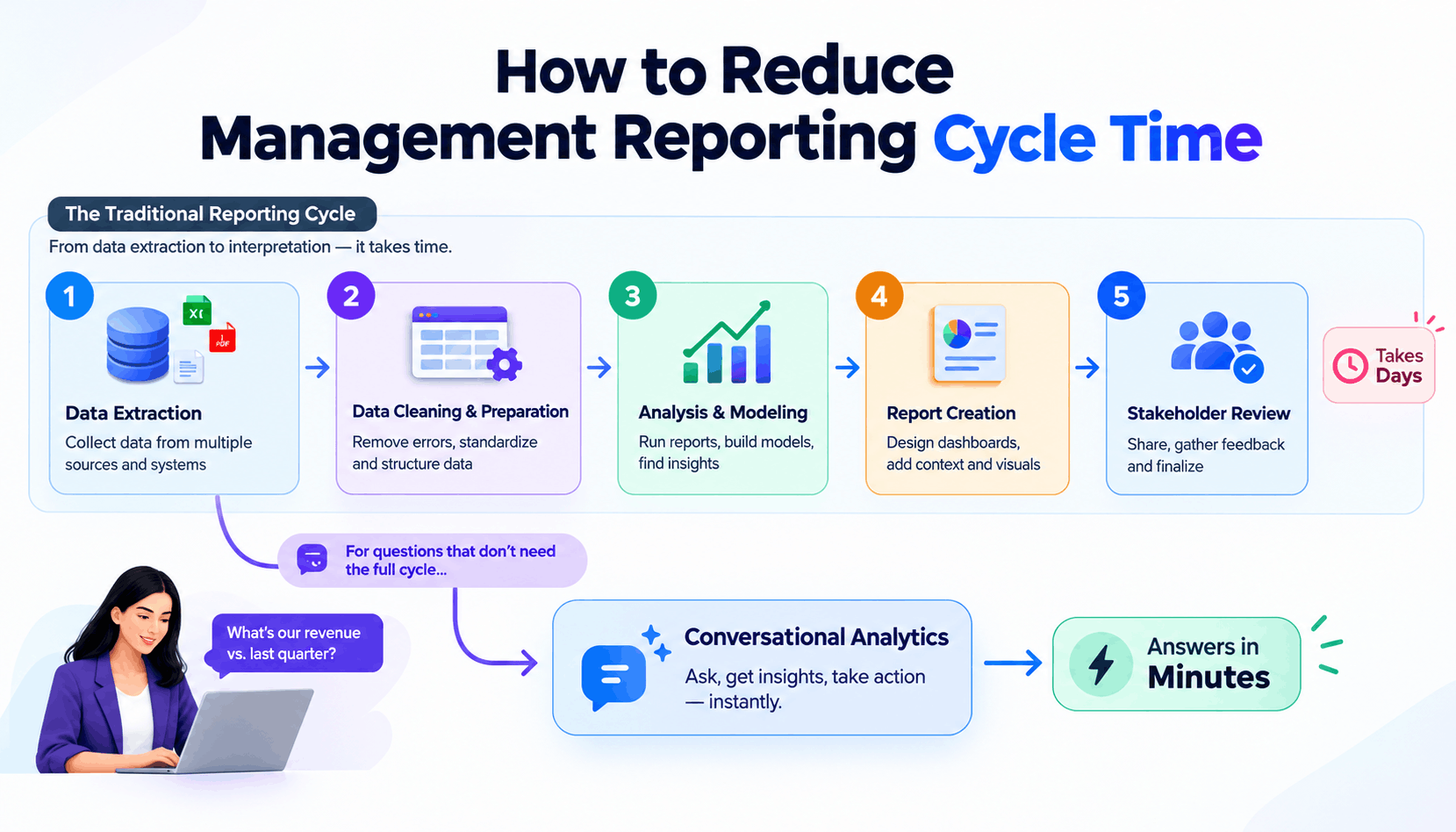
Map your current reporting cycle stage by stage. Identify exactly where time is spent, data extraction, manual consolidation, dashboard building, or waiting for interpretation, before assuming which stage is the actual bottleneck.
Separate questions that need a full cycle from those that do not. Not every business question requires a formally reconciled report, many can be answered directly from live operational data with appropriate caveats.
Automate data consolidation before automating the analysis layer. A faster dashboard sitting on top of manual data consolidation still inherits that manual step's delay.
Connect decision makers directly to a conversational analytics layer. Removing the request queue between a question and an answer often reduces latency more than any single technical improvement to the reporting pipeline itself.
Measure decision latency directly, not just reporting cycle time. Track the actual gap between a question being asked and a decision being made, since that full latency, not just the report's production time, is what actually costs the organization.
This is where the engineering execution layer matters. Samta.ai builds the VEDA AI decision analytics platform specifically to remove the request queue step, connecting decision makers directly to live business data through a conversational interface rather than routing every new question through a report request. Institutions weighing whether a general dashboard tool can achieve this should see how VEDA compares to other data intelligence platforms, and the VEDA platform is built around answering a new question in minutes rather than waiting for the next scheduled reporting cycle. Our roundup of the 10 best AI use cases for reducing decision latency covers where this approach delivers the fastest measurable return.
Reporting approaches compared by decision latency impact
Our full VEDA versus traditional BI comparison covers the platform level detail, but the table below summarizes how five common reporting approaches compare on the metric that actually matters, how long a new question takes to answer.
Reporting Approach | Typical Cycle Time | Data Source Method | Decision Latency Impact | Best For |
Manual spreadsheet consolidation | Median 8 days for monthly close, per APQC benchmarking | Manual export and consolidation across systems | Highest, decisions wait on the full cycle to complete | Small teams with few systems and low reporting complexity |
Traditional BI dashboard | Fast once built, but a new question requires a new build cycle | Scheduled batch refresh from a data warehouse | Moderate, fast for known questions, slow for new ones | Organizations with stable, repeatable reporting needs |
Automated data pipeline plus dashboard | Reduces manual consolidation time significantly | Automated pipelines feeding a warehouse | Lower, but still bound by the dashboard refresh cycle | Organizations that have already automated data movement |
Conversational AI insights platform | Answers available in a live conversation | Direct connection to existing data infrastructure | Low, new questions answered without a new build cycle | Organizations needing to answer varied, ad hoc questions quickly |
Real time data integration with recommendations | Continuous, insights available as data updates | Streaming or near real time data connections | Lowest, decisions supported as conditions change | Organizations where decision timing directly affects outcomes |
Discover Where Your AI Models Are Most Exposed
Real world enterprise use cases
Regulated industry: a bank reducing period end close delay for board reporting
A bank's finance team spent most of each month end cycle manually reconciling figures across lending, deposits, and treasury systems before board reporting could begin, leaving little time for the board to ask follow up questions before decisions were needed. Automating data consolidation with workflow automation consulting support cut the manual reconciliation stage significantly, giving the board additional days to actually discuss the numbers rather than waiting for them.
General enterprise: a retail company answering ad hoc sales questions live
A retail company's regional managers routinely asked sales performance questions that fell outside the standard dashboard's scope, each requiring a custom report request that took days to fulfill. Moving to a conversational analytics layer let regional managers ask new questions directly during weekly planning calls, removing the multi day wait entirely for exactly the kind of ad hoc question that previously caused the most delay.
Key risks and failure modes
Treating a faster dashboard as the whole fix. A faster dashboard sitting on top of the same manual data consolidation still inherits that consolidation delay, just with a shinier front end.
Automating analysis before automating data movement. Analysis layer improvements deliver limited latency reduction if the underlying data still requires manual extraction and consolidation first.
Measuring reporting cycle time instead of decision latency. A report that completes faster does not reduce decision latency if decision makers still wait for a scheduled review meeting to see it.
Assuming every question needs the same reporting rigor. Routine operational questions do not need the same reconciliation standard as board level financial statements, and treating them identically slows down decisions that did not need to wait.
Underestimating the change management required. Teams accustomed to requesting reports need active encouragement to start asking questions directly once a faster option exists, or old habits keep the queue alive regardless of new capability.
When to prioritize reducing decision latency now
Prioritize immediately when:
Decision makers routinely wait multiple days for answers to questions your data could already answer
Your organization's reporting cycle time has not improved despite prior investment in dashboards or BI tools
Ad hoc questions outside your standard dashboard's scope are common and currently require a custom report request
A standard reporting cycle may be enough when:
Your reporting needs are highly standardized with little variation from period to period
Current cycle times do not meaningfully delay the decisions your organization actually needs to make
No new business questions arise often enough to justify the investment in a conversational analytics layer
Reviewing Samta.ai's case studies alongside your own reporting cycle gives a useful benchmark for how much latency reduction is realistic for your specific data environment.
Ready to Move Your AI Initiative Forward?
Conclusion
Management reporting takes too long at most organizations not because the underlying data is unavailable, but because every question still routes through the same multi day batch cycle regardless of whether it actually needs that level of reconciliation. Reducing decision latency, not just reporting cycle time, is what actually changes how fast a business can act on what it already knows.
About Samta
Samta.ai is a Singapore-headquartered AI Product Engineering & Data Intelligence partner helping enterprises build production-grade AI systems for regulated and data-intensive environments.We help organizations move beyond experimentation by engineering scalable, explainable, and enterprise-ready AI solutions from data foundations and model development to workflow automation and deployment.
Our capabilities combine deep AI expertise, data engineering, and product engineering to deliver measurable business impact across FinTech, BFSI, cybersecurity, regulatory technology, and enterprise operations.
Our enterprise AI products power real-world intelligence systems:
• TATVA : AI-driven data intelligence platform for governed analytics, monitoring, and operational insights
• VEDA : Explainable and audit-ready AI decisioning engine built for compliance-sensitive enterprise workflows
• CORA-Property Management Solutions: : Predictive intelligence platform for real-estate pricing, portfolio optimization, and investment analytics
Backed by ecosystem partnerships with Microsoft, Databricks, Snowflake, and AWS, Samta.ai delivers agile, cost-efficient AI engineering with faster turnaround and enterprise-grade scalability. Trusted by enterprises across FinTech, BFSI, and digital transformation initiatives, Samta.ai embeds AI governance, data privacy, and compliance-by-design principles directly into the AI lifecycle , enabling organizations to scale AI with transparency, accountability, and operational control.
Enterprises leveraging Samta.ai automate 65%+ of repetitive data, analytics, and decision workflows while maintaining governance, explainability, and measurable business outcomes. Samta.ai provides the strategic consulting, AI engineering, and data modernization expertise needed to align enterprise operations with next-generation AI transformation goals.
Frequently asked questions
Why does management reporting take so long in large organizations?
Management reporting takes long because most organizations route every business question through a multi stage batch process, manual data consolidation, scheduled dashboard refreshes, and a request queue, rather than connecting decision makers directly to live data for questions that do not require full reconciliation.
What causes decision latency in enterprises?
Decision latency is caused by the cumulative delay across every stage between a question arising and a decision maker having reliable information to act on it, including data extraction, consolidation, dashboard building, and waiting for a scheduled review to discuss the results.
How can companies speed up management reporting cycles?
Companies can speed up reporting cycles by automating data consolidation first, separating questions that need full reconciliation from those that do not, and connecting decision makers directly to a conversational analytics layer that answers new questions without a new dashboard build cycle.
What is the real cost of slow decision making?
The real cost is not the reporting delay itself but every decision made without current information, or delayed until information becomes available, compounding across an organization as multiple teams wait on the same slow reporting cycle repeatedly.
Why do management reports take days to prepare in companies with multiple systems?
Reports take days because data must be manually extracted and reconciled across each separate system before a unified report can be produced, and every additional system in that chain adds another manual consolidation step to the total cycle time.