
Summarize this post with AI
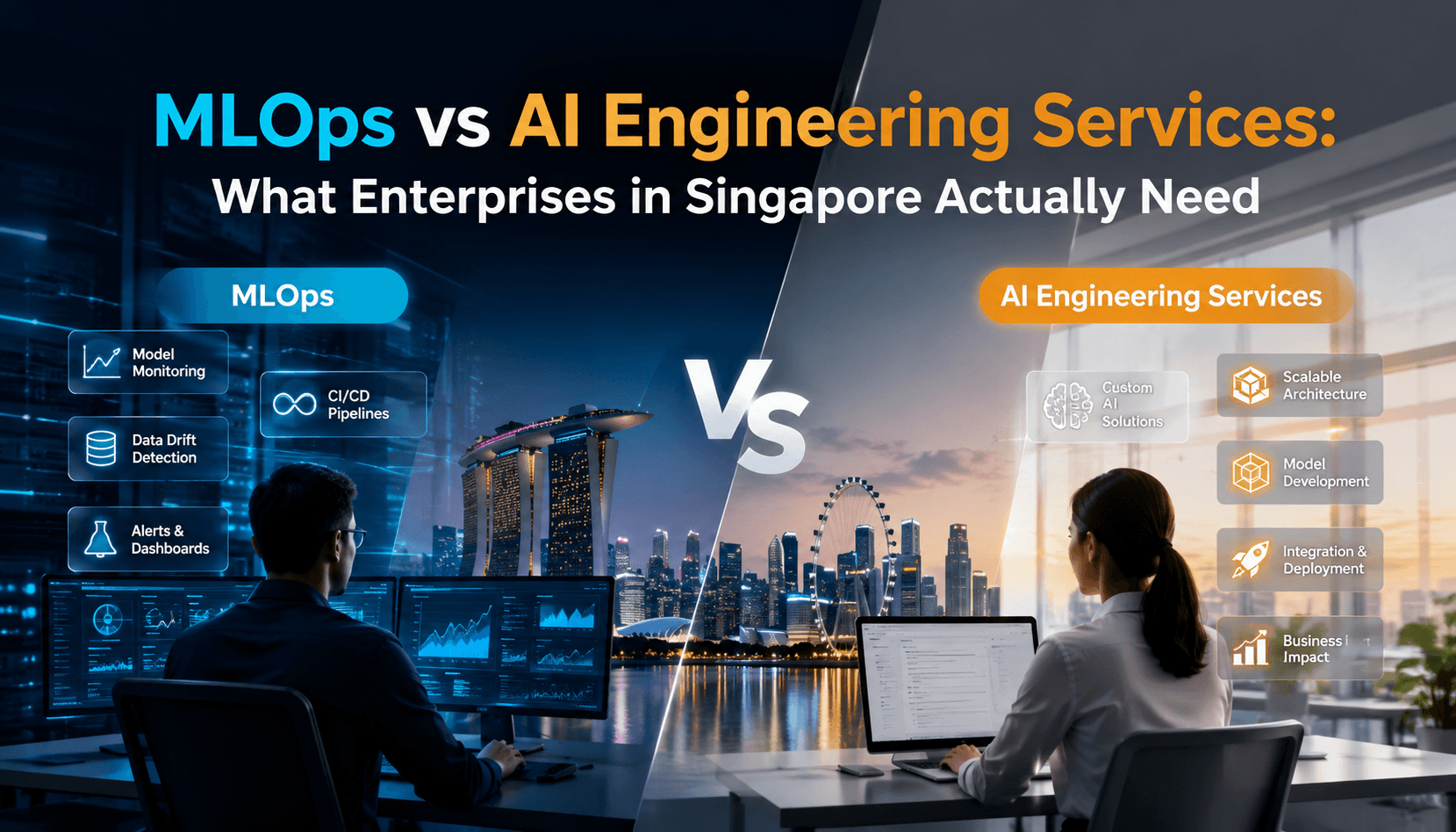
Organisations that treat MLOps and AI engineering as the same discipline consistently scope their production AI programs incorrectly either underinvesting in the operational infrastructure that keeps models reliable or overinvesting in deployment tooling before the models are ready to deploy. MLOps vs AI engineering services is not a vocabulary question. It is a scoping decision that determines what your program builds, in what order, and at what cost. This guide gives Singapore CTOs, engineering leads, and technology transformation heads a clear framework for understanding both disciplines, how they interact, and which your organisation needs at each stage of an AI program in 2026.
MLOps vs AI Engineering Services:
AI engineering vs MLOps differs on scope and sequence: AI engineering services cover the full technical stack required to build production AI, including data pipelines, model development, serving infrastructure, governance, and integration; MLOps is a subset of AI engineering focused specifically on the operational practices that keep deployed models reliable, monitored, and governable over time. For Singapore BFSI and enterprise organisations, do you need MLOps or AI engineering first depends on whether you have models in development (AI engineering needed) or models in production that are failing, drifting, or ungoverned (MLOps needed). Most organisations starting from scratch need AI engineering that includes MLOps as a built in component, not as a separate layer added after deployment.
What MLOps and AI Engineering Services Actually Cover
What Is AI Engineering
AI engineering vs ML engineering begins with understanding that AI engineering is the broader discipline. It covers every technical layer required to go from a validated use case to a governed, production deployed AI system:
Data pipeline design and build on Databricks, Snowflake, or Microsoft Azure
Feature engineering and training data pipeline management
Model development, training, and statistical validation
Model serving infrastructure including containerisation and API development
MLOps tooling including CI/CD pipelines and model registry
Governance infrastructure including audit trails and explainability APIs
Integration layer engineering connecting model outputs to business systems
AI engineering services engage a specialist partner to deliver some or all of these layers for a defined use case or program. The output is a production ready AI system, not a notebook model or a proof of concept.
What Is MLOps
What is AI/ML ops specifically: MLOps (Machine Learning Operations) is the discipline of applying software engineering and DevOps practices to the deployment, monitoring, and operations of machine learning models in production. It sits within AI engineering as the operational layer rather than the build layer.
MLOps covers:
CI/CD pipelines for automated model training, validation, and deployment
Model registry and versioning (MLflow, Azure ML Registry, SageMaker Model Registry)
Containerised model serving (Kubernetes, Docker) with defined SLAs
Inference logging and monitoring at the individual prediction level
Drift detection: input drift (feature distribution shift) and output drift (decision pattern shift)
Automated retraining pipelines triggered by performance threshold breaches
Rollback procedures with defined recovery time objectives
Automating MLOps using agentic AI is the emerging extension of this discipline: agentic systems that autonomously detect model performance degradation, trigger retraining, validate the new model against defined thresholds, and promote it to production without human intervention at each step.
Data Engineering vs MLOps: Where the Confusion Starts
Data engineering vs MLOps is another distinction Singapore technology leaders frequently conflate. Data engineering builds the pipelines that deliver clean, governed data to models at training time and inference time. MLOps operates the model serving and monitoring infrastructure that consumes that data. Both are required; neither substitutes for the other. A model that has excellent MLOps monitoring but receives drifting, ungoverned data at inference time will produce degrading outputs that the monitoring correctly detects but cannot prevent. The AI ready data engineering foundation must precede MLOps implementation, not follow it.
Uncover Opportunities to Improve AI Performance
Why This Distinction Matters More for Singapore Enterprises in 2026
Three regulatory and market conditions have raised the stakes:
1. MAS model risk governance requires MLOps as a regulatory deliverable
MAS Technology Risk Management guidelines require Singapore financial institutions to demonstrate continuous monitoring of production AI model performance, documented retraining procedures, and audit trails for every inference. These are MLOps engineering requirements, not policy documentation requirements. Institutions that have model risk policies without MLOps infrastructure to implement them carry examination risk regardless of how well the policy is written (Source Required: MAS Technology Risk Management Guidelines).
2. Production AI systems in APAC are failing silently without MLOps
Gartner estimates that 40% of production AI models experience significant performance degradation within 6 months of deployment without continuous monitoring infrastructure in place (Source Required: Gartner AI Model Monitoring Research). In BFSI contexts where model outputs drive credit decisions, fraud alerts, and insurance underwriting, silent degradation carries both financial and regulatory consequences.
3. Agentic AI introduces new MLOps requirements that static frameworks do not address
Automating MLOps using agentic AI in 2026 means that MLOps systems themselves are becoming AI agents: monitoring drift, triggering retraining, validating models, and promoting deployments autonomously. This changes the governance requirement for MLOps from human approved operations to human defined policy with machine executed implementation, requiring a different set of audit trail and accountability controls.
The Framework: Sequencing AI Engineering and MLOps Correctly
AI engineering vs MLOps is not a choice between two alternatives. It is a sequencing decision. Use this framework to determine where your organisation sits and what it needs next:
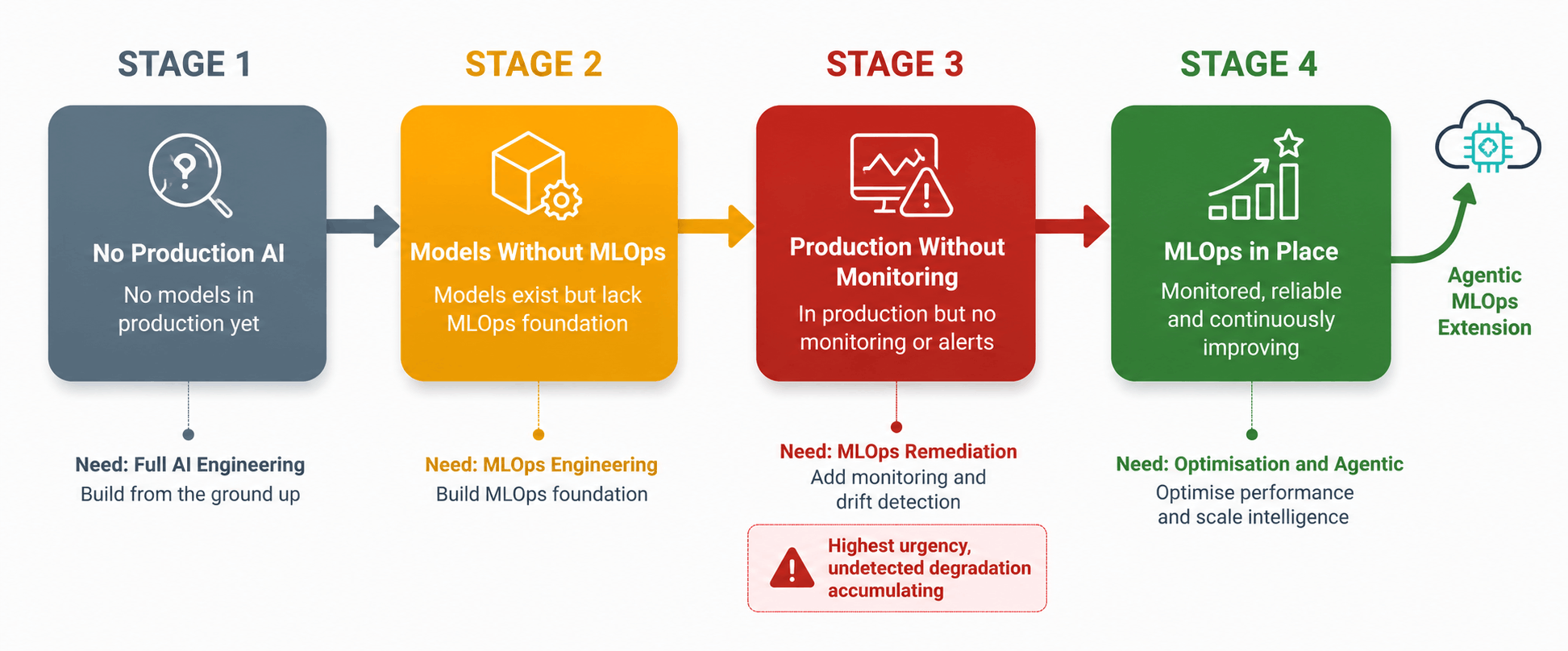
Stage 1: No Production AI (Need Full AI Engineering Services)
If your organisation has AI use cases approved but no production deployed models, you need AI engineering services that include MLOps as a built in component, not as a separate layer.
Scope should cover: data pipeline build, model development, serving infrastructure, MLOps CI/CD, monitoring configuration, governance layer, and integration, all delivered as a single engagement with production deployment as the defined commercial milestone. Samta.ai's digital transformation managed services implement this full stack on Databricks, Snowflake, and Azure ML for Singapore enterprise and BFSI programs, with MLOps tooling and governance infrastructure embedded during build rather than added after deployment.
Stage 2: Models in Development Without MLOps Infrastructure (Need MLOps Engineering)
If your organisation has models in development or recently deployed without CI/CD, monitoring, or governance infrastructure, you need targeted MLOps engineering to build the operational layer before the models are exposed to production load. Scope should cover: MLOps pipeline build (MLflow or equivalent), containerised serving configuration, inference logging implementation, drift detection threshold definition and configuration, automated alerting, and rollback procedure design and testing. Review what does a production ready AI system look like to assess the gap between your current model state and the MLOps infrastructure required before production deployment is responsible.
Stage 3: Models in Production Without Monitoring (Need Urgent MLOps Remediation)
If your organisation has models in production that are not monitored for drift, do not have inference logging, or cannot produce audit trails for regulatory review, you need MLOps remediation as the highest priority investment in your AI program. Models in production without monitoring are not assets. They are liabilities with undetected degradation accumulating daily. Scope should prioritise inference logging and drift detection above all other engineering activity until monitoring is live on every production model. Samta.ai's AI security and compliance services include MLOps remediation as a structured engagement for organisations whose production AI models are not examination ready, delivering monitoring, audit trail, and governance infrastructure on an accelerated timeline.
Stage 4: Models in Production With MLOps (Need Optimisation and Agentic Extension)
If your organisation has production models with monitoring in place, the next stage is optimising the MLOps layer for cost efficiency, extending it with agentic automation for retraining and promotion workflows, and scaling it across a growing model portfolio. This is where the AI lifecycle vs MLOps framework becomes most relevant: the lifecycle perspective connects MLOps operations back to use case value measurement and governance reporting, ensuring that operational investment is tied to business outcome accountability rather than treated as standalone infrastructure maintenance.
MLOps vs AI Engineering Services:
Dimension | AI Engineering Services | MLOps Only | Data Engineering Only | Samta.ai Full Stack |
Scope | Full build stack: data, model, serving, governance, integration | Model operations: CI/CD, monitoring, retraining, rollback | Pipeline infrastructure: ingestion, quality, lineage, storage | All three layers plus governance, examination ready |
When Needed | No production models or new use case in scope | Production models without operational infrastructure | No governed data foundation for training or inference | Any stage from first use case to portfolio scale |
Singapore BFSI Alignment | Covers MAS TRM if governance layer included | Covers MAS TRM monitoring and audit trail requirements | Covers MAS TRM data lineage requirements | MAS TRM, PDPA, FEAT aligned across all layers |
Commercial Model | Fixed SOW by use case or program | Fixed SOW or managed service retainer | Fixed SOW by data domain | Fixed SOW with managed operations option |
Typical Singapore Engagement Cost | SGD 400K to 2.5M per production use case | SGD 120K to 400K for MLOps infrastructure build | SGD 200K to 800K per data domain | Scoped per program, governance included in base |
Know Your AI Model Risk Before You Scale
Real World Use Cases: MLOps and AI Engineering in Singapore Practice
Use Case 1: Fraud Detection Model Remediation, Singapore Bank (BFSI)
A Singapore licensed bank had a gradient boosting fraud detection model in production for 14 months with no inference logging, no drift detection, and no automated alerting. A quarterly model review identified that the model's fraud recall rate had declined from 89% at deployment to 61% at review. The degradation had been accumulating undetected for an estimated 8 months. Deploying MLOps remediation as a priority engagement, Samta.ai implemented: inference logging on all production predictions within week 2, output drift detection with automated alerting within week 4, and a retraining pipeline with validated threshold promotion within week 8. The model was retrained and promoted to production in week 9. The estimated fraud losses attributable to the 8 month undetected degradation period exceeded SGD 2.8M (Source Required: institution disclosure). Full MLOps infrastructure built at original deployment would have cost approximately SGD 180K.
This is the core financial argument for MLOps vs AI engineering services investment sequencing: MLOps is cheaper than the undetected degradation it prevents. Review AI model lifecycle management for the governance framework that structures ongoing model performance accountability beyond the initial MLOps build.
Use Case 2: Demand Forecasting AI, Regional FMCG Enterprise (General Enterprise)
A regional FMCG company built a demand forecasting model that reached production deployment without a CI/CD pipeline, model registry, or retraining schedule. When the model began drifting due to post holiday demand pattern shifts, the data science team retraining the model manually overwrote the production version without validation testing, deploying a model that had regressed on 4 of 9 product categories. The incorrect model ran in production for 3 days before a business analyst noticed anomalous forecast outputs. Inventory decisions made on incorrect forecasts during that period required SGD 1.1M in emergency stock adjustments.
Building the MLOps CI/CD pipeline, model registry with versioned rollback, and validation gate before production promotion as a targeted MLOps engagement after this incident took 6 weeks and cost SGD 95K. The same infrastructure built before the first production deployment would have cost the same and prevented the incident entirely. The VEDA AI Decision Analytics Platform embeds retraining pipeline management, model version registry, and drift monitoring as platform features rather than custom built MLOps infrastructure, which reduces the MLOps build cost for analytics and decision AI use cases significantly compared to custom engineering.
Key Risks When MLOps and AI Engineering Are Misaligned
MLOps without AI engineering foundation: installs operational infrastructure on top of models that were built without governed data pipelines, documented architecture, or governance alignment. The monitoring works correctly but cannot prevent the data quality failures and governance gaps the underlying models were built with.
AI engineering without MLOps: delivers production ready models that become ungoverned liabilities the moment they are deployed, because there is no infrastructure to detect their degradation, trigger their retraining, or produce their audit trails for regulatory review.
Treating MLOps as a Phase 2 deliverable: is the most common and most expensive sequencing mistake in Singapore enterprise AI programs. By the time Phase 2 is approved and budgeted, the Phase 1 models are already degrading in production without detection.
Data engineering without MLOps integration planning: builds governed data pipelines that are not connected to the inference pipeline the model will use in production, creating a gap between training data quality and inference data quality that drift detection cannot bridge.
Review how AI compares to traditional development companies to understand how MLOps requirements differ from standard software operations practices that many Singapore technology teams have experience with but incorrectly assume transfer to AI system operations. Also consider whether in house AI team capability or external AI engineering engagement is the right delivery model before committing to either a standalone MLOps build or a full AI engineering engagement.
Decision Framework: MLOps or AI Engineering Services for Your Organisation
Engage full AI engineering services including MLOps when:
You have no production AI models and need to build from use case validation to production deployment
You have approved AI use cases with clean data foundations but no engineering team to build the model and serving infrastructure
Your board has approved a multi use case AI program and you need a single partner accountable from data pipeline to production monitoring
Engage targeted MLOps engineering when:
You have production models that are monitored manually, not automatically
Your models lack inference logging, CI/CD pipelines, or versioned rollback capability
MAS examination has identified monitoring or audit trail gaps in your production AI systems
You have an internal data science team that builds models but lacks MLOps tooling and infrastructure expertise
Start with an AI readiness assessment when:
You are uncertain whether your primary gap is data engineering, model development, MLOps, or governance
Your existing AI investment is not delivering expected value and you need to diagnose the cause before committing to further investment
You need a board ready diagnosis of your current AI program's production readiness before requesting additional budget
The AI readiness assessment framework provides the structured diagnostic that connects your current data, infrastructure, talent, and governance state to a specific investment recommendation, preventing the common mistake of investing in MLOps when the primary gap is actually data engineering, or investing in AI engineering when the primary gap is an ungoverned data platform. Compare how VEDA positions against other data intelligence platforms to understand how platform selection decisions intersect with your MLOps and AI engineering scoping decisions.
Explore the Right AI Strategy for Your Business
Conclusion
MLOps vs AI engineering services is a sequencing and scoping question, not a choice between two alternatives. AI engineering builds the system that produces value. MLOps keeps that system reliable, monitored, and governable over the weeks, months, and years it operates in production. Singapore enterprises that treat MLOps as optional or defer it to Phase 2 consistently discover the cost of that decision through undetected model degradation, regulatory examination findings, and emergency remediation engagements that cost more than the original MLOps build would have. Build MLOps into your AI engineering engagement from the first sprint. Govern from day one. Monitor from deployment day.
About Samta
Samta.ai is a Singapore-headquartered AI Product Engineering & Data Intelligence partner helping enterprises build production-grade AI systems for regulated and data-intensive environments.We help organizations move beyond experimentation by engineering scalable, explainable, and enterprise-ready AI solutions from data foundations and model development to workflow automation and deployment.
Our capabilities combine deep AI expertise, data engineering, and product engineering to deliver measurable business impact across FinTech, BFSI, cybersecurity, regulatory technology, and enterprise operations.
Our enterprise AI products power real-world intelligence systems:
• TATVA : AI-driven data intelligence platform for governed analytics, monitoring, and operational insights
• VEDA : Explainable and audit-ready AI decisioning engine built for compliance-sensitive enterprise workflows
• CORA-Property Management Solutions: : Predictive intelligence platform for real-estate pricing, portfolio optimization, and investment analytics
Backed by ecosystem partnerships with Microsoft, Databricks, Snowflake, and AWS, Samta.ai delivers agile, cost-efficient AI engineering with faster turnaround and enterprise-grade scalability. Trusted by enterprises across FinTech, BFSI, and digital transformation initiatives, Samta.ai embeds AI governance, data privacy, and compliance-by-design principles directly into the AI lifecycle , enabling organizations to scale AI with transparency, accountability, and operational control.
Enterprises leveraging Samta.ai automate 65%+ of repetitive data, analytics, and decision workflows while maintaining governance, explainability, and measurable business outcomes. Samta.ai provides the strategic consulting, AI engineering, and data modernization expertise needed to align enterprise operations with next-generation AI transformation goals.
Frequently Asked Questions
What is the difference between MLOps and AI engineering services?
AI engineering vs MLOps differs on scope: AI engineering services cover the full technical stack including data pipelines, model development, serving infrastructure, governance, and integration; MLOps is the operational subset that covers CI/CD pipelines, model registry, monitoring, drift detection, retraining automation, and rollback. AI engineering builds the system; MLOps keeps the system reliable and governable after it is built. Enterprises need both, and MLOps must be scoped during the engineering phase, not added as a separate engagement after deployment.
Do you need MLOps or AI engineering services first?
Do you need MLOps or AI engineering first depends on where you are in the program lifecycle. If you have no production models, you need AI engineering services that include MLOps as a built in component. If you have models in development without operational infrastructure, you need MLOps engineering before production deployment. If you have models in production without monitoring, you need MLOps remediation as the highest priority investment. If you have models with monitoring in place, you need MLOps optimisation and agentic automation extension.
What is AI/ML ops and how does it differ from standard DevOps?
What is AI/ML ops versus standard DevOps: DevOps applies continuous integration and delivery practices to software releases; MLOps applies equivalent practices to machine learning model training, validation, deployment, monitoring, and retraining. The critical difference is that ML models degrade over time as data distributions shift, which standard software does not. MLOps therefore includes monitoring and retraining components that have no equivalent in standard DevOps, making it a distinct discipline requiring specialist tooling and expertise.
What is the difference between AI engineering and ML engineering?
AI engineering vs ML engineering in common usage: ML engineering focuses specifically on model development and serving, including feature engineering, model training, validation, and API development. AI engineering is the broader discipline that includes ML engineering plus data pipeline engineering, MLOps infrastructure, governance layer engineering, and integration layer build. For enterprise programs, ML engineering capability alone is insufficient; AI engineering encompasses all the surrounding infrastructure that makes ML models reliable, governed, and integrated in production.
How does automating MLOps using agentic AI change what Singapore enterprises need to build?
Automating MLOps using agentic AI means that retraining triggers, model validation, and production promotion decisions are made by AI agents operating within defined policy guardrails rather than by human engineers approving each step manually. This reduces operational overhead for mature MLOps programs but increases governance complexity: the agent's decision logic, its access permissions, and its action audit trail must be documented and examination ready, creating a new governance layer on top of the existing MLOps infrastructure.