
Summarize this post with AI
Most operators bought AI for the front door and left the back office untouched. That is where margin quietly leaks: slow service requests, manual invoice handling, and reports assembled by hand. The best multifamily ai tools now cover the whole operating chain, not just AI leasing chat and revenue management. This guide shows where multifamily ai helps operators beyond leasing and pricing, which workflows suit automation first, and how to sequence adoption without breaking the systems you already run.
AI for Multifamily Operators:
Multifamily ai works best in high-volume, rule-bound workflows with clean data: service requests, work order triage, invoice and lease document processing, resident communication, and portfolio reporting. Start with one workflow that has measurable baselines, connect it to your property management system, and keep a human reviewer on any decision that affects a resident. Leasing and pricing tools are the most common entry point, but back-office AI is where operating cost and response times usually improve next.
What is AI in multifamily operations?
In practice, multifamily ai means software that automates or assists tasks across leasing, operations, maintenance, accounting, and resident service in apartment communities. It spans machine learning models, language models, and workflow automation connected to a property management system.
The category is often called ai property management, and it covers five areas.
Front office: inquiry handling, tour scheduling, and AI leasing assistants
Pricing: revenue management models that set and adjust rents
Operations: service requests, dispatch, and vendor coordination
Back office: invoices, lease abstraction, compliance checks, and reconciliations
Insight: reporting, forecasting, and anomaly detection across properties
Most operators started with the first two because the payback is easy to see. The next gains sit in operations and back office work, which is why the shift from manual tools to SaaS property management matters as a foundation.
Measure Your AI Readiness with a Free Assessment
Why it matters now
AI adoption is broad but shallow. In a 2026 survey of 350 US multifamily decision makers, EliseAI reports that 89 percent of operators have introduced AI to some degree, yet only 34 percent feel they have fully deployed it. This is a vendor commissioned survey, so treat it as directional.
Integration is the usual blocker. A 2026 MRI Software Pulse Check of more than 700 multifamily professionals found that 87 percent plan to increase centralization, a shift that depends on shared data and connected systems.
Industry bodies describe the same pattern. The National Apartment Association's research summary on AI in rental housing says operators use AI for communication, marketing, workflow management, and information gathering, but adoption remains uneven.
Three pressures explain the push beyond leasing.
Margin squeeze. Operators cannot raise rent endlessly, so cost per unit managed becomes the lever
Resident expectations. Response speed on maintenance now shapes renewals as much as price
Data fragmentation. Leasing, maintenance, and finance data live in separate tools, which blocks portfolio level insight
The data side of this problem is covered in more depth in our piece on proptech consulting and where data decides outcomes.
Where AI helps operators beyond leasing and pricing
Service requests and maintenance triage
Service requests are the highest volume workflow in most portfolios. AI can classify the request, detect urgency, suggest the right vendor, and keep the resident updated automatically.
The payoff shows up in the weekly numbers: backlog age, mean time to repair, and first time fix rate. Our guide to the property maintenance report explains which metrics to track so you can prove the gain.
Back office processing
Back-office multifamily ai handles repetitive document work: reading vendor invoices, matching them to purchase orders, abstracting lease terms, and flagging exceptions for a human to approve.
These are rule bound tasks with clear right answers, which makes them safer than resident facing decisions. Many teams build them through workflow automation consulting because the value comes from redesigning the process, not just adding a model.
Resident communication
AI assistants can answer routine resident questions, send status updates, and route complaints. The risk is tone and accuracy, so keep escalation to a person simple and fast.
A useful test is whether a resident can reach a human in one step. If they cannot, the tool is saving staff time at the cost of renewals.
Reporting and portfolio insight
AI can assemble weekly reports, flag anomalies in spend, and forecast turnover or maintenance load. This only works when the underlying data is joined up, which is why data integration consulting services often come before any model work.
What AI should a multifamily operator adopt first?
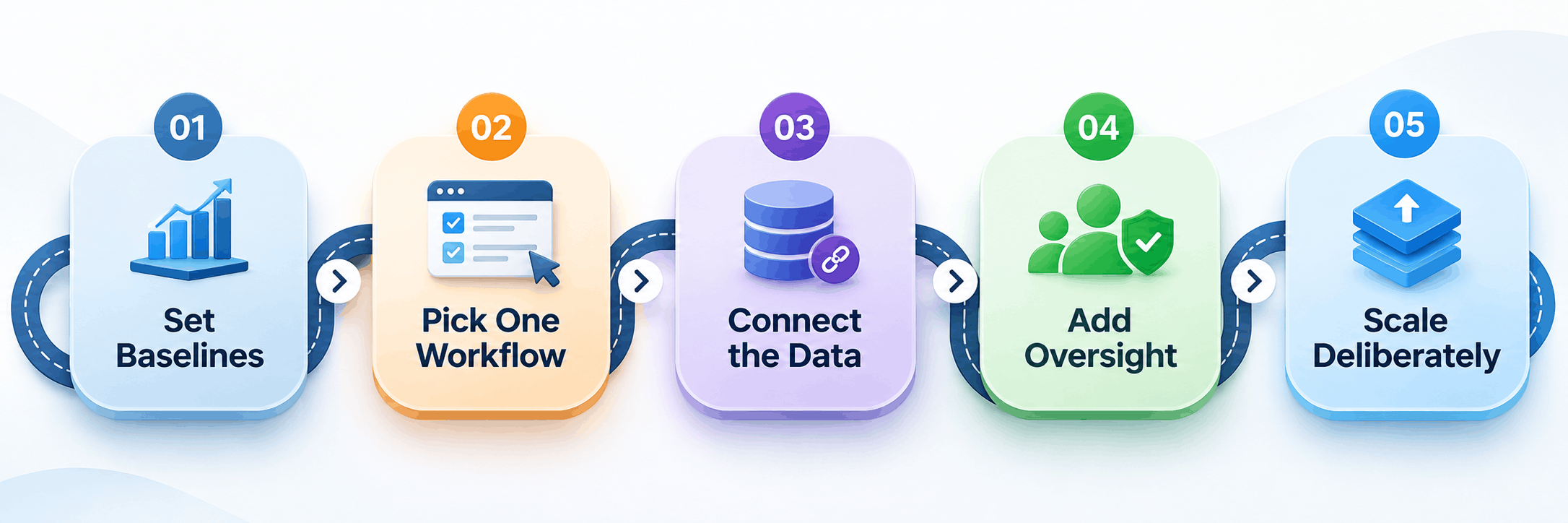
Adoption goes best as a sequence, not a big bang. Use five steps.
Set baselines. Measure current response time, backlog, invoice cycle time, and cost per work order before changing anything
Pick one workflow. Choose a high volume, low risk process such as service request triage
Connect the data. Link the AI layer to your property management system, accounting, and vendor records so it works on live information
Add oversight. Define what the AI can decide alone, what needs approval, and how errors are logged
Scale deliberately. Extend to the next workflow only after the first shows a measurable gain
Integration is where plans stall. Samta.ai acts as the engineering execution layer here, building pipelines into governed stores such as Snowflake or Databricks and reporting through Microsoft Power BI.
On the product side, CORA AI driven property management software brings service requests, dispatch, and completion into one workflow. The wider CORA property management platform adds portfolio reporting and alerts on top.
Comparison: where AI fits across the operating chain
Area | What AI does | Data it needs | Risk level | Adoption order |
AI leasing | Answers inquiries, books tours, follows up with prospects | Listings, availability, FAQs | Medium, resident facing | Often first, already common |
Revenue management | Recommends and adjusts rents | Occupancy, comps, demand signals | Medium, financial impact | Early, with human approval |
Service requests | Classifies, prioritises, dispatches, updates residents | Work orders, assets, vendor data | Low to medium | Strong early candidate |
Back office AI | Reads invoices and leases, flags exceptions | Documents, purchase orders, ledgers | Low, rule bound | Strong early candidate |
Portfolio reporting | Builds reports, detects anomalies, forecasts load | Joined data across systems | Low | After data integration |
Choosing tools without rebuilding your stack
Operators usually face three options: add point solutions, move to a suite, or adopt a connected AI platform. The right choice depends on how many systems you already run and how well they talk to each other.
Our property management software comparison walks through the evaluation criteria. For a head to head view against one widely used incumbent, read CORA vs AppFolio AI.
If you are weighing a modern platform against older systems, the CORA versus traditional property management software comparison covers where legacy tools fall short on automation and reporting.
Whichever route you take, test every vendor against the same four questions.
Integration depth. Does it read and write to your property management system, or only export data?
Data ownership. Can you extract your data and models if you leave?
Human override. Can staff review, correct, and log decisions easily?
Reporting. Does it produce before and after numbers without manual assembly?
Is Your AI Model Risk-Ready? Find Out
Real world use cases
These are illustrative scenarios based on common portfolio patterns, not client results.
Regulated owner example. A bank or insurer owning residential rental assets must show control over vendor spend, resident data, and fair treatment of applicants. AI in service requests and invoice processing adds an audit trail, while governance rules limit what the model can decide alone. In the US, HUD issued guidance in 2024 stating that the Fair Housing Act applies when AI is used in tenant screening and advertising, so confirm current requirements with counsel. Data protection rules such as the PDPA in Singapore also shape what resident data a model can use.
General operator example. A mid sized operator running several thousand units sees slow maintenance response and rising overtime. Automating service request triage and routine resident updates shortens response time, while invoice matching removes manual keying from the finance team. Staff move from data entry to exception handling.
For measured outcomes from real deployments, review the Samta.ai case studies before setting your own targets.
Key risks and failure modes
Most multifamily AI projects stall for predictable reasons.
Starting with the tool, not the workflow. Buying software before defining the process produces a pilot that never scales
Poor data underneath. Duplicate units, inconsistent categories, and missing work order fields make every model unreliable
Integration gaps. An AI layer that cannot read or write to the property management system creates double entry
No human review on resident impact. Decisions about applicants, fees, or maintenance priority need a person in the loop
Vendor sprawl. Five point tools with five dashboards recreate the fragmentation AI was meant to solve
No baseline. Without before and after numbers, nobody can prove the gain or justify the next phase
When to adopt, and when to wait
Adopt now when:
Service requests, invoices, or reporting consume significant staff time
You can name one workflow with a measurable baseline
Your property management system exposes the data and integrations you need
Leadership will fund integration, not just licences
Wait or fix foundations first when:
Unit, asset, and vendor data are inconsistent across properties
No one owns the process you want to automate
You cannot define what the AI is allowed to decide without approval
Explore What AI Can Do for Your Business
Conclusion
Multifamily ai delivers the most for operators who treat it as an operating model change, not a leasing add-on. Pick one workflow with a baseline, connect it to live data, keep humans on resident impact, and measure before scaling. To see how a connected multifamily ai platform supports that sequence, explore Samta.ai and its CORA product.
About Samta
Samta.ai is a Singapore-headquartered AI Product Engineering & Data Intelligence partner helping enterprises build production-grade AI systems for regulated and data-intensive environments.We help organizations move beyond experimentation by engineering scalable, explainable, and enterprise-ready AI solutions from data foundations and model development to workflow automation and deployment.
Our capabilities combine deep AI expertise, data engineering, and product engineering to deliver measurable business impact across FinTech, BFSI, cybersecurity, regulatory technology, and enterprise operations.
Our enterprise AI products power real-world intelligence systems:
• TATVA : AI-driven data intelligence platform for governed analytics, monitoring, and operational insights
• VEDA : Explainable and audit-ready AI decisioning engine built for compliance-sensitive enterprise workflows
• CORA-Property Management Solutions: : Predictive intelligence platform for real-estate pricing, portfolio optimization, and investment analytics
Backed by ecosystem partnerships with Microsoft, Databricks, Snowflake, and AWS, Samta.ai delivers agile, cost-efficient AI engineering with faster turnaround and enterprise-grade scalability. Trusted by enterprises across FinTech, BFSI, and digital transformation initiatives, Samta.ai embeds AI governance, data privacy, and compliance-by-design principles directly into the AI lifecycle , enabling organizations to scale AI with transparency, accountability, and operational control.
Enterprises leveraging Samta.ai automate 65%+ of repetitive data, analytics, and decision workflows while maintaining governance, explainability, and measurable business outcomes. Samta.ai provides the strategic consulting, AI engineering, and data modernization expertise needed to align enterprise operations with next-generation AI transformation goals.
Frequently asked questions
Where is AI used in multifamily today?
AI is used most in leasing, pricing, and resident communication, with growing use in service request triage, invoice processing, and reporting. Surveys describe adoption as broad but uneven, with many operators still piloting. The next wave moves from front office tools into operations and back office workflows.
Which back office tasks suit AI?
Rule bound document tasks suit AI best: reading vendor invoices, matching them to purchase orders, abstracting lease terms, checking compliance documents, and flagging exceptions for approval. These tasks have clear right answers and a clear audit trail, which makes them safer to automate than decisions that directly affect residents.
What AI should a multifamily operator adopt first?
Start with one high volume, low risk workflow that has a measurable baseline, such as service request triage or invoice matching. Connect it to your property management system, set oversight rules, and measure results for a full cycle. Extend to leasing or pricing tools once the data foundation is stable.
What are multifamily AI tools?
Multifamily AI tools are software products that automate tasks in apartment operations, including leasing assistants, pricing engines, maintenance triage, document processing, and reporting. Some are single purpose point solutions, while others are platforms that connect several workflows on shared data. Choose based on integration with your existing systems.
How does AI leasing differ from revenue management?
AI leasing handles prospect conversations, tour booking, and follow up. Revenue management sets and adjusts rents using occupancy, market comparables, and demand signals. They use different data and carry different risks, so many operators run them as separate tools with separate approval rules.