
Summarize this post with AI
Most multifamily operators do not have a software problem. They have a visibility problem. A PMS records every lease and charge, yet it rarely shows an owner how dozens of properties perform side by side.
Property management software comparison:
A PMS is the system of record for leases, rent and work orders. A portfolio visibility layer is the reporting and decision layer across properties. Operators with 15 to 60 properties usually need both, either in one AI driven platform such as CORA or by adding a layer over Yardi, AppFolio, Entrata or RealPage. Replace the PMS only when its data model, not its reporting, is the constraint.
What is a PMS, and what is a portfolio visibility layer?
A PMS (property management system) is the system of record for leases, rent roll, charges, resident communication and work orders. Yardi, AppFolio, Entrata and RealPage all sit in this category.
A portfolio visibility layer sits above one or more systems. It standardises data from every property into portfolio reporting on occupancy, delinquency, SLA performance and NOI.
The two answer different questions:
PMS: What happened on this lease, unit or work order?
Visibility layer: Which properties are underperforming, and why?
Operators moving to SaaS property management gain cloud access, but not automatically a cross portfolio view. Our notes on proptech consulting show where that data usually breaks.
Discover the Future of AI-Driven Property Management
Why this decision matters in 2026
Three pressures make the architecture choice more urgent.
NOI is the scoreboard. Owners and lenders benchmark income, operating expenses and NOI against industry data, such as the Income/Expense IQ national summary. You cannot benchmark what you cannot measure consistently across properties.
Owners expect faster answers. Monthly reports compiled by hand arrive after the decision window has closed. A shared data layer shortens that cycle.
AI needs joined data. Models such as real estate price prediction perform only as well as the data under them. Fragmented property data limits every AI initiative.
How to compare property management software: a 6 step framework
Run this sequence before any vendor demo. Each step creates an artifact your team can review.
Define the portfolio metrics. Agree on one definition each for occupancy, delinquency, work orders closed within SLA and NOI. Conflicting definitions across properties are the most common cause of conflicting reports.
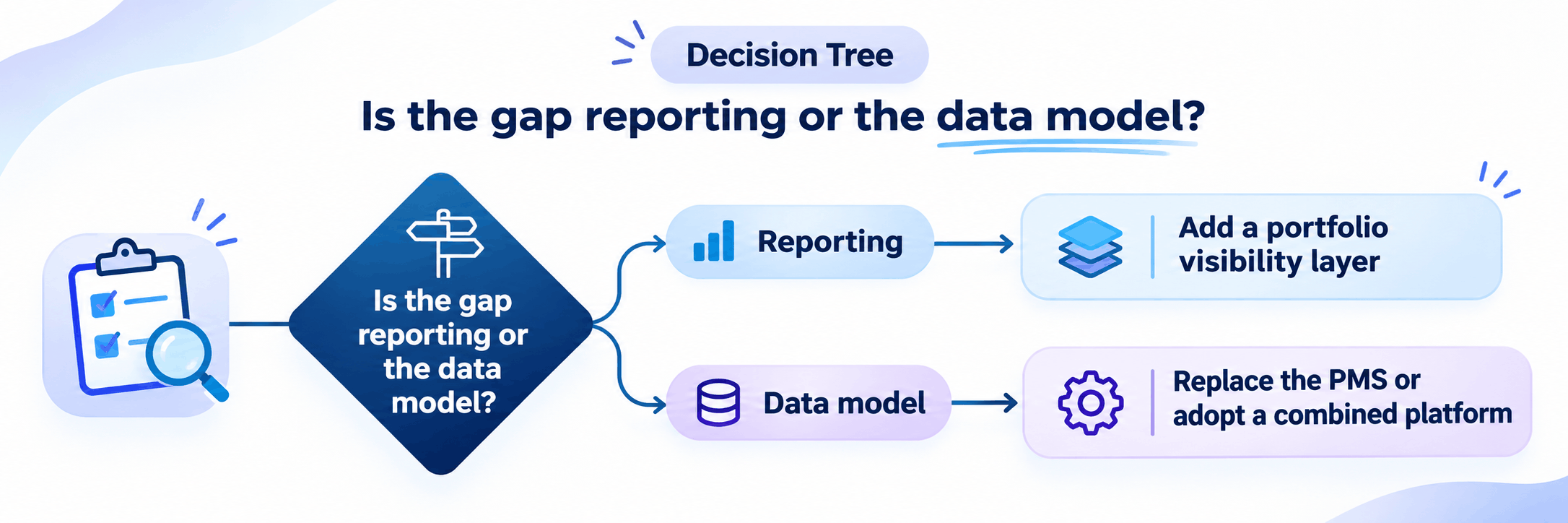
Audit what your PMS can export. Check report coverage, API access and refresh frequency. This audit shows whether your gap is reporting or the data model itself.
Choose the architecture. Pick one of three paths: keep the PMS and add a layer, replace the PMS, or adopt a combined platform.
Build the data pipeline. Load property data into a shared warehouse on Snowflake, Databricks or Microsoft Azure, with one metric definition per KPI. This is where Samta.ai acts as the engineering execution layer. Its data integration consulting services connect PMS exports, accounting and maintenance tools. Its enterprise AI engineering in Singapore team builds models on top.
Set owner level reporting and alerts. Turn metrics into dashboards for asset managers, with alerts for SLA breaches and occupancy drops.
Pilot, then operate. Pilot on five to ten properties before a full rollout. Digital transformation managed services keep pipelines monitored after launch.
Compare property management software: five platforms side by side
Use this property management software comparison chart to build a shortlist. It lists AI native platforms first and established systems of record after, so rows are ordered by architecture rather than by quality.
Platform | Best fit | System of record strength | Portfolio visibility and AI | Where it can fall short |
CORA | Operators of 15 to 60 properties wanting operations and reporting in one AI driven platform | Leasing, work orders and resident workflows | Built in portfolio reporting and AI insights | Newer entrant, so confirm fit for your compliance needs |
Yardi | Large or mixed portfolios needing broad modules | Deep accounting and module coverage | Reporting available; custom cross portfolio analysis often needs extra tooling | Implementation complexity |
AppFolio | Small to mid sized operators valuing ease of use | Straightforward day to day operations | Standard reports; cross portfolio views may rely on exports | Customisation limits at scale |
Entrata | Multifamily operators prioritising resident experience | Unified leasing and resident modules | Analytics through additional modules | Module sprawl and cost |
RealPage | Large multifamily operators wanting a broad suite | Operations and revenue tooling | Analytics across the suite | Contract and integration complexity |
For a detailed head to head, read CORA vs AppFolio. The wider view is in CORA vs traditional property management software.
Measure Your AI Readiness with a Free Assessment
Real world use cases
Regulated sector: a Singapore REIT manager (illustrative scenario). Lenders and unitholders expect consistent NOI and occupancy reporting. When each property exports data differently, finance teams reconcile by hand and audit trails break.
A layer with one metric definition set, versioned reports and access logs makes numbers defensible. It also supports PDPA obligations on tenant data. PropTech AI consulting services help design that data foundation.
General enterprise: a 30 property multifamily operator. The operator runs a capable PMS, but owner reports take days. Work orders and SLA data sit in one tool, leasing data in another.
Adding a visibility layer fixes the reporting delay without a migration. If the operator is consolidating vendors, a combined platform such as the CORA property management platform can replace several tools at once. See Samta.ai case studies for delivery examples.
Key risks and failure modes
Metric drift. Two properties calculating occupancy differently makes portfolio totals meaningless.
Migration for the wrong reason. Replacing a sound PMS to fix a reporting gap adds cost and downtime.
Brittle exports. Pipelines built on manual spreadsheet exports fail silently when a report format changes.
Tenant data exposure. Central warehouses concentrate personal data. Follow the PDPC advisory guidelines on consent, access and retention.
Unexplained AI outputs. Forecasts that owners cannot trace to source data lose trust. The NIST AI Risk Management Framework offers a structure to govern, map, measure and manage that risk.
Demo bias. Vendors present clean sample data. Always test with your own messy data.
When to use each approach
Situation | Best path |
PMS data is sound, but reporting is slow | Add a portfolio visibility layer |
PMS cannot expose data reliably, or core workflows break | Replace the PMS |
You are consolidating vendors or growing fast | Consider a combined platform such as CORA |
You manage fewer than about 15 properties and reports meet needs | Stay with your current stack |
Your portfolio relies on specialised compliance modules your current vendor already covers | Keep that PMS and add only a layer |
Discover Where Your AI Models Are Most Exposed
Conclusion
A wrong software decision costs more than a licence fee. It locks in inconsistent metrics, slow owner reporting and a migration you may not have needed. To compare property management software well, separate the system of record from the visibility layer and decide which one is actually failing. Then test your shortlist on your own data.
About Samta
Samta.ai is a Singapore-headquartered AI Product Engineering & Data Intelligence partner helping enterprises build production-grade AI systems for regulated and data-intensive environments.We help organizations move beyond experimentation by engineering scalable, explainable, and enterprise-ready AI solutions from data foundations and model development to workflow automation and deployment.
Our capabilities combine deep AI expertise, data engineering, and product engineering to deliver measurable business impact across FinTech, BFSI, cybersecurity, regulatory technology, and enterprise operations.
Our enterprise AI products power real-world intelligence systems:
• TATVA : AI-driven data intelligence platform for governed analytics, monitoring, and operational insights
• VEDA : Explainable and audit-ready AI decisioning engine built for compliance-sensitive enterprise workflows
• CORA-Property Management Solutions: : Predictive intelligence platform for real-estate pricing, portfolio optimization, and investment analytics
Backed by ecosystem partnerships with Microsoft, Databricks, Snowflake, and AWS, Samta.ai delivers agile, cost-efficient AI engineering with faster turnaround and enterprise-grade scalability. Trusted by enterprises across FinTech, BFSI, and digital transformation initiatives, Samta.ai embeds AI governance, data privacy, and compliance-by-design principles directly into the AI lifecycle , enabling organizations to scale AI with transparency, accountability, and operational control.
Enterprises leveraging Samta.ai automate 65%+ of repetitive data, analytics, and decision workflows while maintaining governance, explainability, and measurable business outcomes. Samta.ai provides the strategic consulting, AI engineering, and data modernization expertise needed to align enterprise operations with next-generation AI transformation goals.
FAQ
What is the difference between a PMS and a portfolio visibility layer?
A PMS is the system of record that runs daily operations: leases, rent, charges and work orders. A portfolio visibility layer reads data from one or more systems and standardises it into portfolio reporting on occupancy, delinquency, SLA performance and NOI. The PMS records what happened at each property; the layer shows owners how the whole portfolio is performing.
Do I need to replace my PMS to get portfolio reporting?
Usually no. If your PMS stores clean data and exposes it through reports or an API, a visibility layer can pull it into one warehouse and standardise metrics. Replace the PMS only when data quality, missing integrations or broken core workflows are the real problem. Run a data audit first, because reporting gaps can be cheaper to fix than a migration.
How do I compare property management software for 15 to 60 properties?
At this size, compare on five criteria: data export and API access, portfolio reporting depth, work order and SLA tracking, integration effort and total cost across modules. Request the same sample portfolio report from each vendor, then run a property management software demo using your own data. Score each platform against the same scorecard so the decision rests on evidence, not presentation.
What is the best property management software for multifamily?
No single product is best for every operator. Yardi and RealPage are often considered by large portfolios, AppFolio and Entrata by small to mid sized multifamily operators, and CORA by teams that want AI driven operations and portfolio reporting together. Rank options by your portfolio size, reporting needs and integration capacity, then read current property management software reviews before shortlisting.
How much does property management software cost?
Property management software pricing varies by vendor, unit count, modules and contract length, and many vendors quote on request. Source Required: each vendor's current pricing page. Ask for per unit fees, onboarding charges, add on module costs and integration fees, then model total annual cost at your current and planned portfolio size.