
Summarize this post with AI
Most AI projects that reach a working demo never reach production. The reason is rarely the model. It is the absence of a real ai production deployment singapore plan covering infrastructure, monitoring, and governance before the first line of code is written. CTOs across Singapore's regulated and non regulated sectors alike are discovering that a successful pilot creates false confidence, because production carries entirely different demands around uptime, security, and compliance. This guide covers what a CTO actually needs to plan for, in order, before an AI system goes live.
AI Production Deployment Singapore:
AI production deployment in Singapore requires four coordinated layers: infrastructure and MLOps tooling, model monitoring and lifecycle management, security and compliance controls aligned to frameworks such as the NIST AI Risk Management Framework, and integration with existing enterprise systems. Singapore's regulatory environment, including IMDA's Model AI Governance Framework for Agentic AI, adds specific expectations around human accountability and technical controls that CTOs should design for from day one rather than retrofit later.
What AI Production Deployment Actually Means
Production AI systems are fundamentally different from a validated model sitting in a notebook. A production system has defined uptime expectations, a monitoring stack, a rollback plan, and a named owner accountable when something breaks. Production system characteristics in AI typically include automated retraining triggers, drift detection, access controls mapped to specific roles, and audit logging that satisfies both internal risk teams and, where relevant, external regulators. The distinction matters because most enterprise AI budgets are allocated to model development, with production infrastructure treated as an afterthought. A fuller breakdown of what separates a demo from a production system is available in our explainer on what a production system actually requires.
Measure Your Enterprise AI Readiness Today
Why It Matters Now: Singapore AI Adoption Strategy In 2026
Three forces are shaping how CTOs need to approach deployment in Singapore this year.
Regulatory maturity: IMDA's Model AI Governance Framework, first introduced in 2020 and significantly expanded in 2026 to cover agentic AI, now provides specific guidance on risk assessment, human accountability, and technical controls throughout an agent's lifecycle. Enterprises deploying agentic systems should build these expectations into their architecture from the start rather than treating them as a compliance afterthought.
Board level accountability: Boards are asking pointed questions about AI production timelines and risk exposure, particularly in manufacturing and industrial sectors where system failures carry physical consequences. Our piece on what manufacturing boards are asking about AI covers the specific questions CTOs in that sector should be ready to answer.
Agentic architecture complexity: As more enterprises move from single model deployments to multi agent systems, the engineering complexity of AI deployment architecture has increased substantially. Our detailed guide on agentic AI engineering architecture covers how this shift changes infrastructure planning. A broader Singapore ai adoption strategy should sequence these three pressures rather than treating them as separate workstreams, since a governance gap discovered after deployment is far more expensive to fix than one designed for upfront.
The Core Framework: A Four Layer Deployment Architecture
CTOs planning production deployment should sequence their build around four layers, each with distinct tooling and ownership.
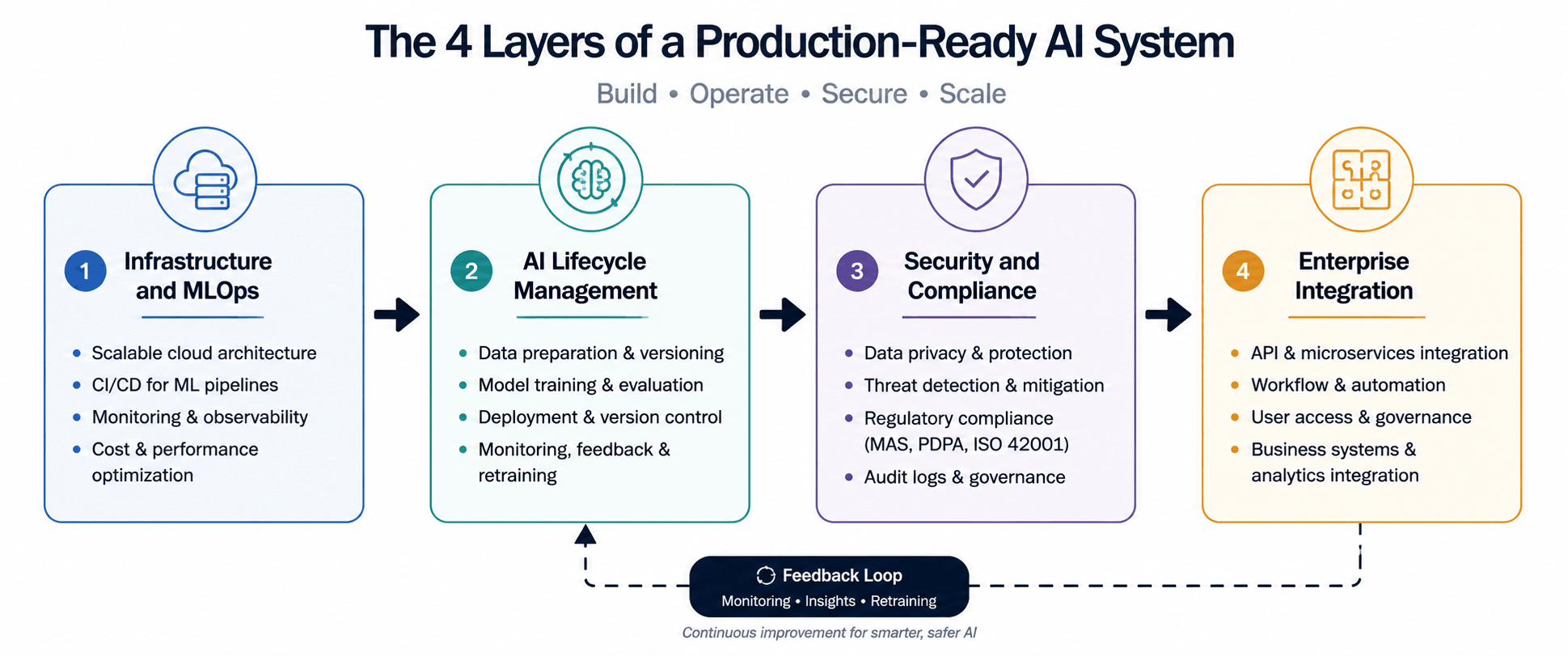
Layer one: Infrastructure and MLOps. The compute, storage, and pipeline orchestration layer. MLOps Singapore specific considerations include data residency requirements for regulated sectors and choosing between cloud native versus hybrid deployment based on latency needs.
Layer two: AI lifecycle management. Versioning, retraining triggers, drift monitoring, and rollback capability. This is where a model's real world performance gets tracked against its original validation baseline.
Layer three: Security and compliance. Access controls, audit logging, and explainability outputs mapped to a named framework. This layer should be designed alongside the architecture, not added after launch.
Layer four: Enterprise integration. The interface layer connecting the AI system to existing business applications, human decision makers, and downstream systems.
Enterprises planning this roadmap in full should also review our AI transformation roadmap template for how these four layers get sequenced against a broader multi quarter plan.
Layer | Primary Owner | Key Risk If Skipped | Typical Tooling | Samta.ai Engineering Role |
Infrastructure and MLOps | Platform Engineering | Scaling failures under real load | Snowflake, Databricks, cloud native pipelines | Infrastructure design and capacity planning |
AI Lifecycle Management | ML Engineering | Undetected model decay | Custom retraining triggers, drift monitors | Automated retraining and monitoring setup |
Security and Compliance | Risk and Compliance | Regulatory findings, audit failure | Role based access, audit logging systems | Governance layer mapped to NIST and IMDA guidance |
Enterprise Integration | Product Engineering | Poor adoption, workflow gaps | Microsoft ecosystem integrations | API design and human in the loop workflows |
Monitoring and Observability | Platform Engineering | Delayed incident response | Custom dashboards, alerting stacks | Ongoing SLA and performance monitoring |
Samta.ai's engineering approach compares directly against a traditional development shop in our comparison of AI engineering versus traditional development companies.
Real World Enterprise Use Cases
BFSI: A bank deploying an AI decision support system. A Singapore financial institution needed a production system that could explain every automated recommendation to its risk committee within a defined turnaround time. The engineering work centered on the security and compliance layer, since the model itself had already been validated months earlier. Samta.ai's VEDA AI decision analytics platform served as the underlying analytics engine, with the full platform capability detailed on our VEDA platform page.
General enterprise: A logistics operator scaling from pilot to fleet wide deployment. A logistics company had a working AI pilot for route optimization but had never planned for what happened when the system needed to run continuously across a full national fleet. The infrastructure and MLOps layer, not the model itself, required the most rework once real world scale hit. Both cases confirm the same lesson: the model validation work is rarely where production deployment risk actually lives.
Measure Your AI Model Risk Before It Scales
Key Risks And Failure Modes
Treating security as a later phase: Enterprises that add access controls and audit logging after a system is already live face significantly higher rework costs than those who design for it upfront. Our AI security and compliance services page covers how this layer should be scoped from the start.
Silent model decay in production: Without drift monitoring, a model's accuracy can degrade for months without detection, since production performance is rarely checked with the same rigor as the original validation testing.
Underestimating agentic system complexity: Gartner's research on enterprise technology adoption consistently finds that AI works best embedded in workflows, not bolted on as a separate module, which is especially true for multi agent systems where failures can cascade across connected tools.
No clear rollback plan: Teams that deploy without a tested rollback path discover, during their first production incident, that reverting to a previous stable version is far harder than anticipated.
Decision Framework: Are You Ready For Production Deployment
Use this checklist before committing to a go live date.
Has your model been validated against real world data variance, not just a static test set?
Does your security and compliance layer map to a named framework, such as NIST or IMDA's Model AI Governance Framework, rather than an internal ad hoc policy?
Do you have a tested rollback plan if the production system underperforms after launch?
Is there a named, accountable owner for post launch monitoring and retraining decisions?
Teams weighing whether to build this capability internally or engage a partner should review our digital transformation managed services page for how a managed engineering partner can fill capability gaps during deployment.
Talk To Samta.ai About Your Deployment Architecture
If you are within a quarter of your planned go live date, talk to Samta.ai about your deployment architecture before finalizing your timeline. Our engineers compare platform choices directly, including in our VEDA versus a generic data intelligence platform comparison, so you can confirm your tooling stack fits your compliance and scale requirements.
Choosing Samta.ai vs Traditional Development For Deployment
Enterprises comparing a specialized AI engineering partner against a traditional development shop should look closely at how each approaches the security and lifecycle management layers, not just the initial build cost. Our detailed comparison of Samta.ai versus traditional development approaches covers this distinction directly, including how each model handles ongoing monitoring once a system is live.
Conclusion
AI production deployment success in Singapore depends on treating infrastructure, lifecycle management, security, and integration as one coordinated architecture, not four separate afterthoughts bolted onto a validated model. Talk to Samta.ai about your deployment plan before you commit to a go live date, so your production system is built to survive contact with real operating conditions and Singapore's evolving governance expectations.
Talk to an Enterprise AI Expert
About Samta
Samta.ai is a Singapore-headquartered AI Product Engineering & Data Intelligence partner helping enterprises build production-grade AI systems for regulated and data-intensive environments.We help organizations move beyond experimentation by engineering scalable, explainable, and enterprise-ready AI solutions from data foundations and model development to workflow automation and deployment.
Our capabilities combine deep AI expertise, data engineering, and product engineering to deliver measurable business impact across FinTech, BFSI, cybersecurity, regulatory technology, and enterprise operations.
Our enterprise AI products power real-world intelligence systems:
• TATVA : AI-driven data intelligence platform for governed analytics, monitoring, and operational insights
• VEDA : Explainable and audit-ready AI decisioning engine built for compliance-sensitive enterprise workflows
• CORA-Property Management Solutions: : Predictive intelligence platform for real-estate pricing, portfolio optimization, and investment analytics
Backed by ecosystem partnerships with Microsoft, Databricks, Snowflake, and AWS, Samta.ai delivers agile, cost-efficient AI engineering with faster turnaround and enterprise-grade scalability. Trusted by enterprises across FinTech, BFSI, and digital transformation initiatives, Samta.ai embeds AI governance, data privacy, and compliance-by-design principles directly into the AI lifecycle , enabling organizations to scale AI with transparency, accountability, and operational control.
Enterprises leveraging Samta.ai automate 65%+ of repetitive data, analytics, and decision workflows while maintaining governance, explainability, and measurable business outcomes. Samta.ai provides the strategic consulting, AI engineering, and data modernization expertise needed to align enterprise operations with next-generation AI transformation goals.
FAQ
What is AI production deployment and how is it different from a pilot?
Production deployment means the AI system runs continuously with defined uptime expectations, monitoring, and a named owner, whereas a pilot is typically a time boxed validation exercise without those operational commitments.
What does MLOps Singapore specific planning need to account for?
Data residency requirements for regulated sectors, integration with existing cloud or on premises infrastructure, and alignment with IMDA's governance expectations for agentic and traditional AI systems.
Do Singapore specific regulations affect AI production deployment?
Yes. IMDA's Model AI Governance Framework, including the 2026 update for agentic AI, provides specific guidance on risk assessment, human accountability, and technical controls that enterprises should design into their production architecture.
Should we deploy AI in house or use a managed partner?
This depends on whether you have existing infrastructure and security expertise in house, how quickly your system needs to scale, and whether your industry carries specific compliance requirements. Full case detail across regulated and general enterprise deployments sits in our case studies.
What Singapore specific engineering considerations should CTOs plan for?
Local talent availability, data residency rules, and alignment with national AI governance frameworks all factor into deployment planning. Our page on enterprise AI engineering in Singapore covers these considerations in detail.