
Summarize this post with AI
Singapore's manufacturing sector is no longer asking whether to adopt AI. In 2026, nobody asks that anymore. The question now is how fast and which bets are worth making. Singapore's technology expenditure is projected to reach nearly S$28 billion in 2026, yet organizations here report spending an average of S$18.9 million per AI initiative with only 23 percent saying those investments delivered expected returns. The boards of Singapore manufacturing enterprises are asking sharper questions than their counterparts were three years ago, and the quality of those questions now determines which organizations turn ai transformation manufacturing singapore into competitive advantage and which turn it into expensive pilots. This guide covers the five questions Singapore manufacturing boards are consistently asking in 2026, the framework for answering them honestly, and the sequencing logic that connects board approval to production outcomes.
AI Transformation Manufacturing Singapore:
ai transformation manufacturing singapore in 2026 is a board-level capital allocation decision shaped by three converging forces: Budget 2026's National AI Council chaired by PM Lawrence Wong with explicit national AI missions in advanced manufacturing; Singapore's five World Economic Forum Global Lighthouse Network facilities demonstrating what AI-native manufacturing operations look like at scale; and the reality that many manufacturing executives are not lacking ideas but struggling to convert pilots into measurable business value, requiring coordination across strategy, governance, operations, data, technology, and workforce adoption. The boards that are making progress have stopped asking whether to invest and started asking how to sequence the investment to produce measurable P&L impact within 18 months.
What AI-Driven Digital Transformation Actually Means for Singapore Manufacturing
How ai is transforming manufacturing in Singapore in 2026 covers six distinct operational domains: predictive maintenance, quality inspection automation, demand forecasting and inventory optimization, production scheduling, supply chain visibility, and workforce augmentation for skilled trades. The challenge is not the shortage of AI applications it is the shortage of the right sequencing logic for deploying them. Ai and digital transformation for Singapore manufacturers rests on several key components: cloud infrastructure providing scalable computing and integration across ERP, MES, and data platforms; data digitisation so operational information is captured, structured, and accessible across the organisation; AI and machine learning integration powering forecasting, classification, and optimisation use cases; process automation using workflow engines, RPA, and AI agents to orchestrate tasks end-to-end; and employee upskilling so staff can use, question, and improve AI-enabled processes in daily work.
The timing for this move is particularly favorable in Singapore. Budget 2026 emphasised deeper adoption of artificial intelligence and digital technologies to support productivity and skills upgrading, and Singapore already has five best-in-class advanced manufacturing facilities in the World Economic Forum's Global Lighthouse Network. For the foundational enterprise architecture these AI deployments require, see the how modern enterprises build AI-ready operations guide. For the governance layer that separates sustainable transformation from costly pilots, see the why AI transformation governance matters guide.
Assess Your AI Capabilities with Expert Insights
Why Board Conversations About Manufacturing AI Have Shifted in 2026
Three structural forces have changed what Singapore manufacturing boards ask about ai transformation manufacturing singapore compared to 2023 or 2024.
1. Budget 2026 created explicit national AI missions in advanced manufacturing: Budget 2026 created a new National AI Council chaired by Prime Minister Lawrence Wong running alongside national AI missions to drive AI-led transformation in advanced manufacturing, connectivity, finance, and healthcare. The S$150 million Enterprise Compute Initiative and the National AI Impact Programme create a direct policy mandate for manufacturing boards to act, not wait.
2. Singapore's Global Lighthouse Network facilities have set a visible benchmark: Singapore has five Global Lighthouse Network facilities where AI-native manufacturing operations are live, including those operated by Coca-Cola and Infineon Technologies. These are not aspirational case studies; they are operating competitors that have demonstrated what governed AI deployment in manufacturing actually produces. Boards that have toured a Lighthouse Network facility are asking different questions than boards that have only seen slide decks.
3. Pilot failure is now visible at the board level: Singapore organizations report spending an average of S$18.9 million per AI initiative in 2025, with only 23 percent saying those investments delivered expected returns. After multiple failed pilots, manufacturing boards are applying more rigorous evaluation criteria: requiring measurable P&L outcomes tied to AI investment before additional capital is approved, and demanding governance frameworks rather than capability demonstrations. For manufacturing enterprises evaluating their AI investment return before board presentation, the AI transformation ROI guide covers the business case framework that connects manufacturing AI investment to P&L-connected outcomes.
The Five Questions Singapore Manufacturing Boards Are Asking in 2026
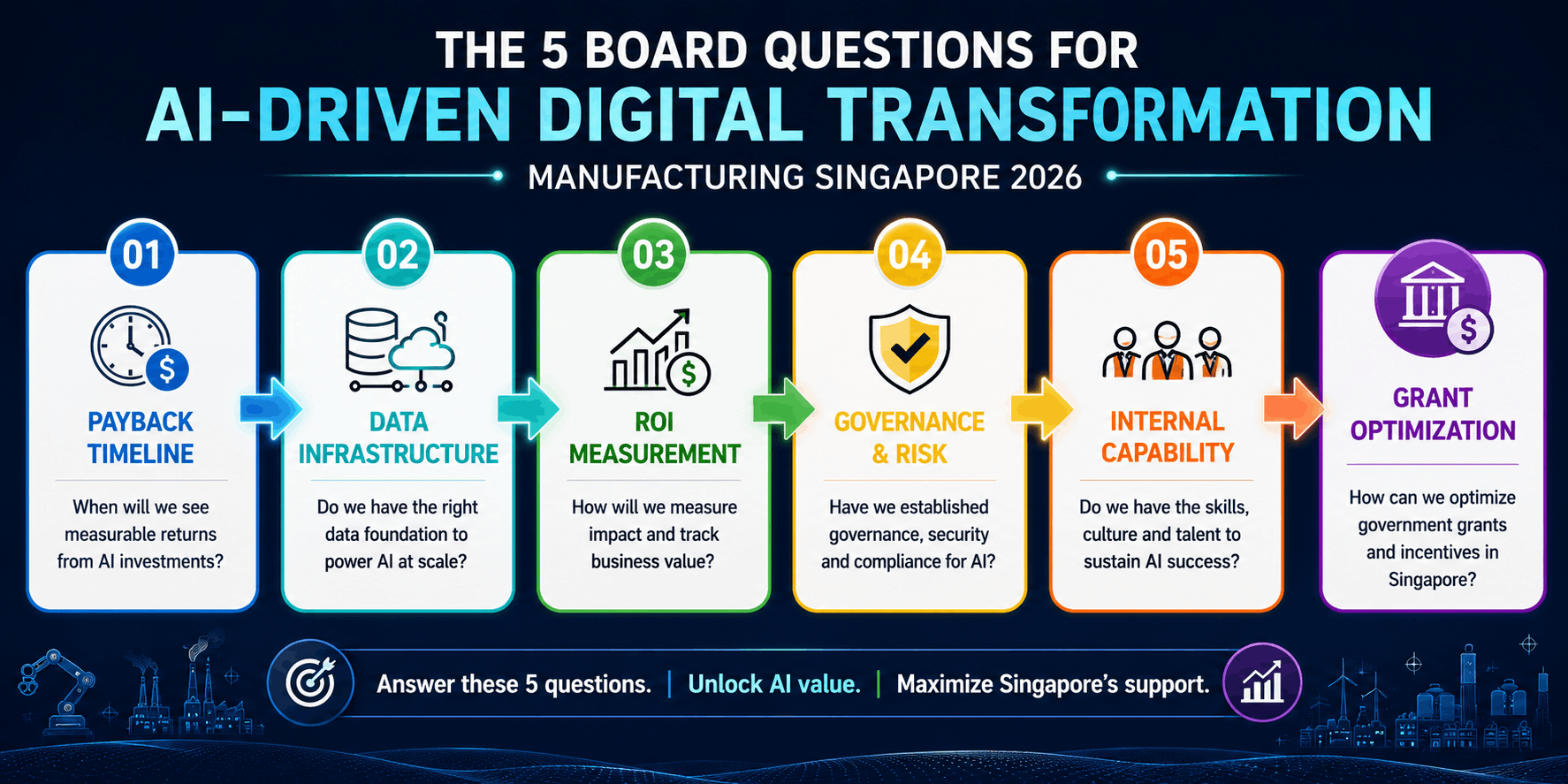
Board Question 1: What Is Our Realistic Payback Timeline?
Manufacturing boards in 2026 are no longer accepting open-ended transformation timelines. They want specific, measurable outcomes within 18 to 24 months. The correct answer framework is: quick wins in predictive maintenance and quality inspection within 6 to 9 months; strategic bets in demand forecasting and production scheduling optimization within 12 to 18 months; and enterprise-wide integration of AI across all six operational domains within 24 to 36 months. Modernization efforts should be governed as business initiatives, anchored in specific outcomes, supported by trusted data, and sequenced through a practical roadmap that balances near-term wins with long-term scalability. A board that approves a three-year AI program without 12-month milestone gates is funding a program without accountability.
Board Question 2: What Data Infrastructure Do We Need First?
Sustainable digital transformation calls for coordination across strategy, governance, operations, data, technology, and workforce adoption. For manufacturing specifically, data readiness requires connecting shop-floor MES data to ERP financial planning data, unifying production telemetry with quality inspection systems, and standardizing data formats across multiple plants or production lines before any AI model can consume those data streams reliably. The AI transformation consulting Singapore guide documents how specialist partners approach this data infrastructure sequencing question for manufacturing enterprises in Singapore specifically.
Board Question 3: How Do We Measure ROI Before Scaling?
Digitally mature enterprises are 2.5 times more likely to achieve top-quartile financial performance, yet 86 percent of executive leaders report their organisations remain unable to operationalise AI inside day-to-day processes. The gap between maturity and operationalization is almost always a measurement gap: AI programs that cannot demonstrate measurable P&L impact within the first 12 months lose board support before they have time to produce strategic returns. The answer is to build the measurement layer before the AI model is deployed, not after. Define the P&L metric the AI will improve (OEE, scrap rate, forecast accuracy, inventory carrying cost), document the pre-AI baseline, and set a 90-day measurement cadence from go-live. The AI transformation roadmap template covers this measurement design as a Phase 1 activity, not a Phase 4 retrospective.
Board Question 4: What Are the Governance and Compliance Requirements?
Manufacturing boards in Singapore increasingly ask about ai digital transformation services governance because their customers particularly in electronics, aerospace, and medical devices are asking the same questions. Vendor AI governance requirements are flowing upstream through supply chains, and Singapore manufacturers supplying to regulated industry customers face AI governance obligations even when they are not themselves regulated entities. For manufacturing enterprises seeking the right partner type to address this governance requirement, the AI vs traditional dev companies comparison documents where AI-native partners deliver governance capability that traditional implementation firms cannot.
Board Question 5: How Do We Build Internal Capability Alongside External Delivery?
The most sophisticated manufacturing boards in Singapore are asking not just what AI the organization will deploy but what AI capability the organization will own. The difference between a consulting engagement that leaves the enterprise dependent on the vendor for every change request and one that builds internal capability alongside delivery is now a board-level evaluation criterion, not just a procurement preference.
Samta.ai's Veda AI decision analytics platform supports this capability-building dimension by connecting manufacturing operational data on Databricks and Snowflake to decision dashboards that operational teams own and can interpret without engineering intermediaries. The Veda AI decision analytics platform and the Veda vs data intelligence platform comparison document how this operational ownership model compares against general-purpose analytics platforms. The AI security compliance services and digital transformation managed services complete the delivery model with ongoing governance and optimization support.
AI Transformation Manufacturing Singapore: A Framework Comparison
Framework Dimension | Pilot-Stage Program | Scaling Program | Governed Transformation | AI-Native Operations | Global Lighthouse Benchmark |
Data Infrastructure | Ad hoc; per-pilot data extraction | ERP and MES integration begun; no unified pipeline | Lineage-tracked, quality-scored unified data layer | Real-time streaming from shop floor to decision layer | Continuous data fabric across all production systems globally |
AI Use Cases in Production | One or two isolated pilots | Three to five use cases in limited production | Multiple use cases in production with shared infrastructure | Six-plus use cases across all operational domains | Full operational AI coverage; autonomous optimization loops |
Governance | No formal governance | Policy drafted; not in deployment process | Lifecycle controls in deployment; board-level AI risk reporting | Automated governance; per-decision audit trails | Governance contributes to industry standard-setting |
ROI Measurement | No pre-AI baseline; anecdotal outcomes | ROI framework designed; baseline documented | P&L-connected outcome measurement from go-live | 5 to 15 percent measurable improvement in key operational metrics | Competitive performance data cited in Global Lighthouse documentation |
Singapore Policy Alignment | No grant optimization; no National AI Mission alignment | EDG application submitted; some grant coverage | EDG and ECI grants stacked; National AI Mission alignment documented | Champions of AI programme alignment; board-level AI governance | World Economic Forum Global Lighthouse Network certification |
Understand Your AI Risk Before It Becomes a Business Risk
Enterprise Use Cases: Manufacturing AI Transformation in Practice
Use Case 1: Singapore Electronics Manufacturer Deploying Predictive Maintenance AI
A Singapore electronics manufacturer deployed predictive maintenance AI across three production lines after a board-mandated requirement for measurable ROI within 12 months. The team documented a pre-AI baseline of unplanned downtime hours per month across the three lines before any model was developed, establishing the measurement framework the board required. The AI model consumed vibration sensor data, thermal imaging outputs, and maintenance log history through a unified pipeline on the manufacturer's existing cloud infrastructure. Within nine months, unplanned downtime across the three lines dropped by 34 percent, translating directly to a quantified cost avoidance figure the CFO could present to the board alongside the AI investment total. This is the format Singapore manufacturing boards are requiring in 2026: specific metric, pre-AI baseline, post-AI outcome, and net P&L impact.
Use Case 2: Precision Engineering Company Deploying Demand Forecasting AI
A Singapore precision engineering company supplying to aerospace customers needed demand forecasting AI that could satisfy customer governance audit requirements as well as internal ROI targets. The customer's procurement team required documentation of the AI model's input data sources, forecasting methodology, and error rate across the previous 12 months before approving the supplier's AI-assisted production planning process. The company selected an AI-native partner over a traditional ERP consultant specifically because the governance documentation requirement from the aerospace customer required the partner to understand both AI model documentation and supply chain compliance a combination that traditional implementation firms rarely carry in one engagement. The ai in digital transformation roadmap for this engagement sequenced governance documentation design before model development, so the compliance documentation existed when the customer audit arrived rather than being reconstructed after the fact.
Key Risks and Failure Modes
Piloting without a board-mandated measurement framework: Many manufacturing executives are not lacking ideas but struggling to convert pilots into measurable business value. The most consistent failure mode in Singapore manufacturing AI is a pilot that produces interesting insights but no measurable P&L impact because the measurement framework was never defined before deployment.
Connecting AI to data before the data is production-ready: Manufacturing data from legacy MES systems is frequently in inconsistent formats, missing timestamps, or missing unit-of-measure standardization that prevents AI models from using it reliably. An AI model is only as reliable as the data it consumes, and shop-floor data quality problems are the most common discovery that stalls manufacturing AI programs after the first demo.
Treating governance as optional because manufacturing is not BFSI: Digital transformation with AI is now a matter of survival rather than optional innovation. Governance requirements from regulated customers are flowing upstream through supply chains. Singapore manufacturers supplying to aerospace, medical devices, or financial services customers face governance documentation requirements that their own sector does not impose.
Building AI programs without internal capability transfer: An AI deployment that leaves the manufacturing team dependent on external engineering support for every operational change creates vendor lock-in and operational fragility. Building internal capability alongside external delivery is not a nice-to-have in 2026; it is the difference between a sustainable program and an ongoing services contract.
Decision Framework: Is Your Manufacturing AI Program Board-Ready?
A pre-AI baseline is documented for every metric the board will use to evaluate AI investment return
Data infrastructure (ERP and MES integration, data quality, pipeline architecture) is assessed before use case selection
Governance requirements from regulated customers are inventoried and included in the program scope
A sequenced roadmap exists with 90-day measurement cadence from go-live, not a 36-month project plan
Internal capability transfer milestones are written into any external delivery engagement
Grant eligibility (EDG, ECI, National AI Mission) has been assessed and stacking applied to net cost
If fewer than four boxes are checked, the program is not yet board-ready and additional scoping work should precede any capital commitment.
See What's Holding Back Your AI Transformation
Conclusion
ai transformation manufacturing singapore in 2026 is a board conversation, not a technology team conversation. The boards asking the right five questions payback timeline, data infrastructure requirements, ROI measurement, governance obligations, and internal capability transfer are the ones approving programs that reach production. The boards asking only about technology capabilities are the ones generating the 77 percent of AI initiatives that fail to deliver expected returns. The frameworks, grants, and Singapore policy support are all in place; the remaining variable is sequencing discipline.
About Samta
Samta.ai is a Singapore-headquartered AI Product Engineering & Data Intelligence partner helping enterprises build production-grade AI systems for regulated and data-intensive environments.We help organizations move beyond experimentation by engineering scalable, explainable, and enterprise-ready AI solutions from data foundations and model development to workflow automation and deployment.
Our capabilities combine deep AI expertise, data engineering, and product engineering to deliver measurable business impact across FinTech, BFSI, cybersecurity, regulatory technology, and enterprise operations.
Our enterprise AI products power real-world intelligence systems:
• TATVA : AI-driven data intelligence platform for governed analytics, monitoring, and operational insights
• VEDA : Explainable and audit-ready AI decisioning engine built for compliance-sensitive enterprise workflows
• CORA-Property Management Solutions: : Predictive intelligence platform for real-estate pricing, portfolio optimization, and investment analytics
Backed by ecosystem partnerships with Microsoft, Databricks, Snowflake, and AWS, Samta.ai delivers agile, cost-efficient AI engineering with faster turnaround and enterprise-grade scalability. Trusted by enterprises across FinTech, BFSI, and digital transformation initiatives, Samta.ai embeds AI governance, data privacy, and compliance-by-design principles directly into the AI lifecycle , enabling organizations to scale AI with transparency, accountability, and operational control.
Enterprises leveraging Samta.ai automate 65%+ of repetitive data, analytics, and decision workflows while maintaining governance, explainability, and measurable business outcomes. Samta.ai provides the strategic consulting, AI engineering, and data modernization expertise needed to align enterprise operations with next-generation AI transformation goals.
Frequently Asked Questions
What is AI transformation manufacturing Singapore and why are boards asking about it now?
ai transformation manufacturing singapore refers to the structured deployment of AI across manufacturing operations — covering predictive maintenance, quality inspection, demand forecasting, production scheduling, supply chain visibility, and workforce augmentation — as a board-level capital allocation decision. Boards are asking now because Budget 2026 created national AI missions in advanced manufacturing, and because failed pilots costing S$18.9 million on average with 23 percent ROI delivery have made governance and sequencing non-negotiable board requirements.
How is AI transforming manufacturing in Singapore specifically?
How ai is transforming manufacturing in Singapore in 2026 operates at the operational and competitive levels simultaneously. At the operational level, AI is reducing unplanned downtime, improving quality inspection accuracy, and optimising demand forecasting. At the competitive level, Singapore's five Global Lighthouse Network facilities are demonstrating AI-native manufacturing benchmarks that are visible to every board in the sector, creating urgency that was not present when AI manufacturing was purely hypothetical.
What are the key components of ai and digital transformation for Singapore manufacturers?
Key components include cloud infrastructure integrating ERP, MES, and data platforms; data digitisation making operational information structured and accessible; AI and ML integration for forecasting, quality, and optimisation; process automation using workflow engines and AI agents; and employee upskilling so staff can use and improve AI-enabled processes in daily work. Singapore's Smart Nation infrastructure, Industry Transformation Maps, and generous grants create a supportive ecosystem for this investment.
What ai digital transformation services do Singapore manufacturers most commonly need?
The most commonly needed ai digital transformation services for Singapore manufacturers are data infrastructure integration (ERP to MES unification), predictive maintenance AI deployment, demand forecasting and inventory optimization, quality inspection automation, and production scheduling optimization. The sequencing of these services matters as much as the technology choice data infrastructure must precede model development, and governance documentation must precede any regulated customer audit.
How do Singapore manufacturing boards evaluate AI transformation partners in 2026?
Singapore manufacturing boards in 2026 evaluate AI transformation partners on four criteria: production case studies with measurable outcomes in manufacturing contexts (not pilot metrics); governance capability covering customer audit documentation requirements as well as internal controls; internal capability transfer commitment written into the engagement structure; and post-delivery monitoring and optimization support that does not require ongoing engineering dependency. The AI transformation consulting Singapore guide covers partner evaluation in depth.