
Summarize this post with AI
Engaging an AI consulting firm when you need AI engineering execution is one of the most common and expensive mistakes enterprise technology leaders make. AI engineering vs AI consulting is not a semantic distinction. It determines whether your AI program produces a strategy document or a deployed, monitored, production AI system that delivers measurable business value. This guide gives CTOs, CIOs, and digital transformation leads in BFSI and enterprise sectors a clear framework for understanding both disciplines, how they differ at the role and deliverable level, and which your organisation needs at each stage of an AI program in 2026.
AI Engineering vs AI Consulting:
AI engineering vs AI consulting differs on output accountability: AI consulting produces strategy, roadmaps, architecture recommendations, and governance frameworks; AI engineering produces working data pipelines, deployed models, MLOps infrastructure, and production AI systems that operate under real load. For enterprise and BFSI organisations in APAC, the most common program failure pattern is engaging consulting without engineering or engineering without consulting, rather than structuring both in the correct sequence. The optimal model for most Singapore enterprises in 2026 is consulting to define and govern, engineering to build and deploy, with a single partner accountable for both rather than two vendors managing a handover gap between strategy and execution.
What AI Consulting and AI Engineering Actually Cover
What Is AI Consulting
What is an AI consultant in practice: a professional or firm that helps organisations define their AI strategy, prioritise use cases, design governance frameworks, select technology platforms, and manage AI program delivery without owning the engineering execution layer directly.
AI consulting for business typically delivers:
AI readiness assessments and maturity benchmarks
Use case prioritisation and ROI hypothesis documentation
AI governance framework design (MAS TRM, PDPA, FEAT alignment for Singapore regulated sectors)
Technology platform selection and architecture recommendations
Program management and vendor oversight
Change management and stakeholder communication
AI and consulting firms range from global system integrators that subcontract engineering to specialist boutiques that combine advisory with engineering execution. The distinction matters enormously for enterprise buyers: a firm that advises on MLOps architecture but cannot build it creates a handover gap that consistently delays production deployment.
What Is AI Engineering
AI engineering is the discipline of building and operating the technical systems that make AI run in production:
Data pipeline design and build on Databricks, Snowflake, or Microsoft Azure
Machine learning model development, training, and validation
MLOps infrastructure: CI/CD pipelines, containerised serving (Kubernetes, Docker), model registry
Inference monitoring, drift detection, and automated alerting
Explainability API development and audit trail infrastructure
Integration layer engineering connecting model outputs to consuming systems
An AI engineering roadmap for an enterprise program sequences these components in a defined build order, with each layer tested before the next is built on top of it.
The AI Architect vs AI Engineer Distinction
Within AI engineering, the AI architect vs AI engineer distinction is also relevant for enterprise buyers structuring their engagement:
An AI architect designs the overall system: data platform architecture, model serving topology, MLOps pipeline structure, governance layer design, and integration patterns. An AI engineer implements that design: writing pipeline code, training models, configuring serving infrastructure, and building monitoring systems. Both roles are required for production AI programs. Organisations that engage only architects get designs that cannot be implemented by their internal teams. Organisations that engage only engineers without architectural oversight build technically functional systems that do not fit together at scale. Review agentic AI engineering architecture to understand how architecture and engineering roles interact specifically in multi agent AI system design, where the gap between the two disciplines creates the most significant production risk.
Take the First Step Toward Enterprise AI Success
Why Getting This Decision Right Matters More in 2026
Three forces have made the consulting versus engineering distinction more consequential:
1. Regulatory obligations require engineering deliverables, not policy documents
MAS TRM guidelines, PDPA obligations, and FEAT requirements in Singapore all mandate specific engineering outputs: audit trails, explainability APIs, lineage documentation, drift monitoring. An AI consulting services engagement that produces a governance framework document without the engineering infrastructure to implement it leaves the enterprise exposed in exactly the areas the regulation covers (Source Required: MAS Technology Risk Management Guidelines).
2. The pilot to production gap is an engineering gap, not a strategy gap
Gartner estimates that 85% of AI proof of concept projects never reach production (Source Required: Gartner AI Deployment Research). The reason is consistently an engineering gap, not a strategy gap. Organisations have sufficient AI strategy. They lack MLOps infrastructure, governed data pipelines, and production deployment capability. Engaging more consulting to address a production engineering failure compounds the problem.
3. AI engineering talent is scarce and expensive in Singapore
ML engineers, MLOps specialists, and AI architects in Singapore command SGD 120,000 to 220,000 base salaries, rising 15 to 20% annually (Source Required: Korn Ferry APAC Talent Report). Organisations that need to access this talent for a defined program period are better served by an engineering engagement partner than by attempting to hire the capability permanently for a program that has a defined end state.
The Framework: When to Use AI Consulting vs AI Engineering vs Both
The decision is not binary. Most enterprise AI programs require both disciplines in a defined sequence:
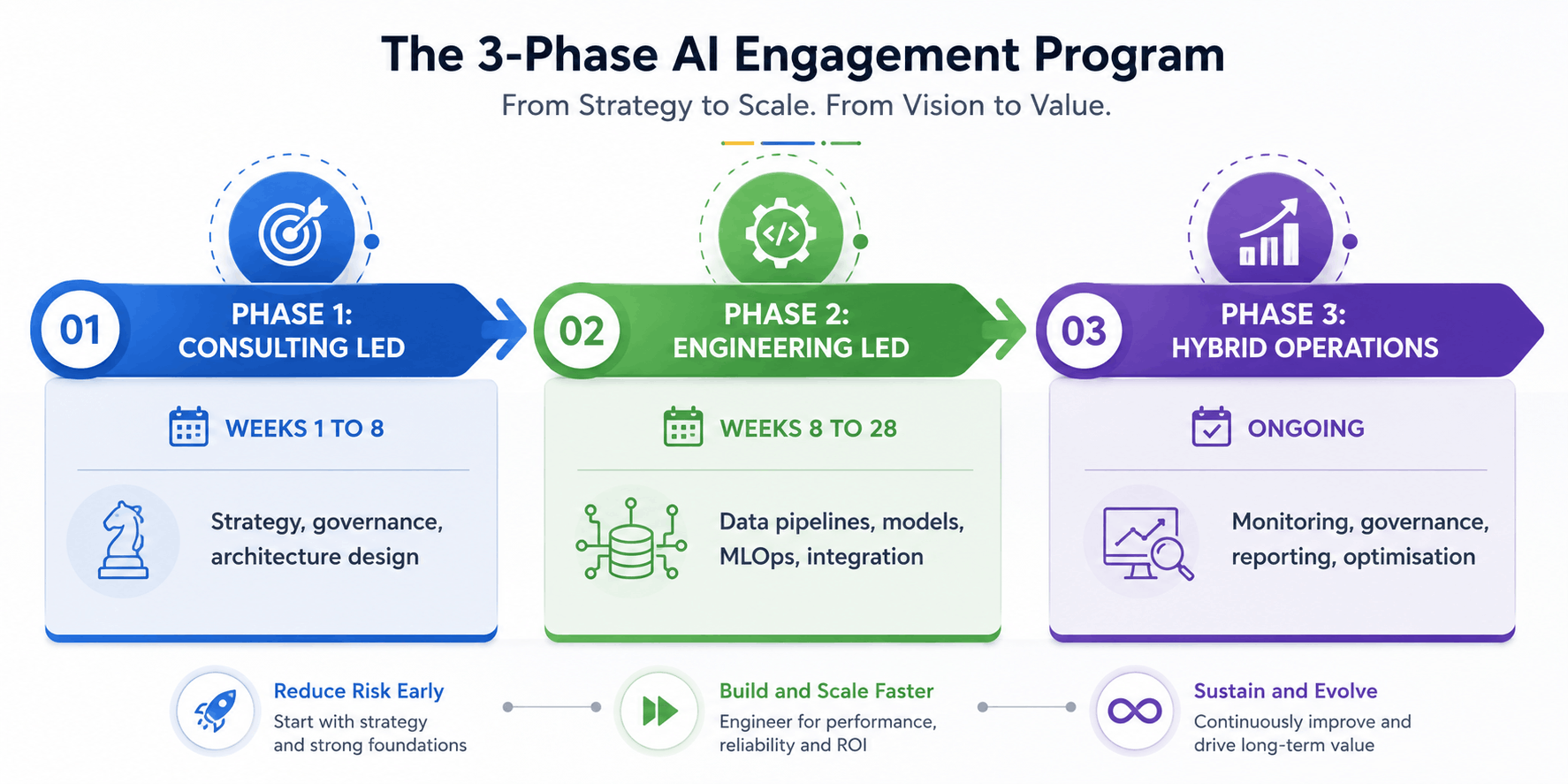
Phase 1: Consulting Led (Weeks 1 to 8)
AI consulting leads when the organisation needs to define what to build before committing to how to build it:
Use case prioritisation against data readiness and business ROI
AI governance framework design mapped to MAS TRM, PDPA, and FEAT
Technology platform selection across Snowflake, Databricks, Azure, and AWS
Architecture design specifying the data, model, MLOps, and governance layers
Program structure and milestone definition
Consulting output that is fit for engineering handover: includes: a use case scoping document with defined data requirements, a technical architecture specification that an engineering team can implement without ambiguity, and a governance framework with specific engineering deliverables mapped to each compliance requirement.
Consulting output that is not fit for engineering handover: includes: strategy decks, maturity benchmarks, and governance policy documents that describe desired outcomes without specifying the engineering controls that will produce them.
Phase 2: Engineering Led (Weeks 8 to 28)
AI engineering leads once the architecture is defined and data readiness is confirmed:
Data pipeline build on the defined platform (Databricks, Snowflake, or Azure)
Model development, training, and validation against defined performance thresholds
MLOps CI/CD pipeline build, containerised serving, and model registry configuration
Governance infrastructure: audit trail generation, explainability APIs, drift monitoring
Integration layer build connecting model outputs to consuming systems
Knowledge transfer to internal team with documentation and hypercare period
Samta.ai's digital transformation managed services operate as the engineering execution layer across all of these components, taking architectural specifications from the consulting phase and delivering production AI systems with embedded governance infrastructure rather than managing a handover gap between two separate vendors. Review what is MLOps to understand the specific engineering components that are required before any AI model can be considered production ready, and therefore what engineering scope an AI program engagement must cover.
Phase 3: Hybrid (Ongoing)
After production deployment, the model requires both consulting oversight (governance reporting, regulatory alignment, use case extension planning) and engineering operations (drift monitoring, retraining, performance management, integration maintenance). This phase is where enterprise AI engineering in Singapore differs most significantly from generic AI delivery: regulatory examination cycles, MAS model risk review, and PDPA compliance monitoring require ongoing consulting expertise sitting alongside ongoing engineering operations, not one discipline replacing the other.
AI Engineering vs AI Consulting: 5 Column Comparison
Dimension | AI Consulting Only | AI Engineering Only | Consulting then Engineering (Sequential) | Samta.ai Integrated Model |
Primary Output | Strategy, governance, roadmap | Working pipelines, models, MLOps | Strategy then build (gap at handover) | Strategy through production in single engagement |
Regulatory Deliverable | Policy documents | Technical audit trails | Split accountability, governance gaps likely | Governance embedded at engineering layer |
Time to Production | N/A (no build) | Fast if scope is clear | 18 to 24 months with handover delays | 6 to 9 months, governed from Day 1 |
Commercial Risk | Strategy without execution | Execution without alignment | Coordination overhead, dual vendor risk | Single SOW, single accountability |
Best Fit | Board strategy, readiness assessment | Defined use case with clear architecture | Large organisations with separate internal teams | BFSI and regulated enterprise needing both |
Strengthen AI Governance with Actionable Risk Insights
Real World Use Cases: Engineering vs Consulting in Practice
Use Case 1: Credit Risk AI Program, Singapore Bank (BFSI)
A Singapore bank engaged a global consulting firm to design an AI credit risk program. The consulting engagement produced a detailed architecture specification, a governance framework mapped to MAS TRM, and a use case roadmap. When the bank attempted to hand the specification to its internal IT team for implementation, the team lacked MLOps capability, Databricks engineering experience, and model governance tooling. The program stalled for 11 months. Engaging Samta.ai as the engineering execution partner resolved the stall: the architecture specification was handed over directly and implementation began within 3 weeks. Production deployment was achieved 8 months after engineering engagement start. The consulting output was excellent. The gap was the absence of an engineering layer beneath it. Explore similar BFSI AI program outcomes in Samta.ai case studies and compare how AI consulting for business differs from AI engineering at the engagement structure level.
Use Case 2: Workflow Automation AI, Regional Insurance Group (General Enterprise)
A regional insurance group hired two data scientists directly to build an AI claims processing model. Without consulting input on use case scope and without MLOps engineering infrastructure, the data scientists produced a notebook model that performed well in evaluation but could not be deployed to production: no serving infrastructure, no drift monitoring, no audit trail, and no integration with the claims management system. Restructuring the engagement to include architectural consulting for the first 6 weeks and engineering execution for the subsequent 20 weeks resolved the production readiness gap. The model deployed to production 26 weeks after restructuring, with all governance infrastructure in place before the first live claim was processed. This is the inverse failure mode: engineering without consulting produces technically functional work that is architecturally misaligned with the production environment it must operate in. Review the AI lifecycle vs MLOps framework to understand how consulting and engineering responsibilities are sequenced across the full AI program lifecycle.
Key Risks in Getting the Consulting vs Engineering Balance Wrong
Consulting without engineering accountability: produces strategies that cannot be implemented by the organisations that commission them. The strategy quality is irrelevant if the engineering gap prevents deployment.
Engineering without consulting alignment: produces models that are technically functional but architecturally disconnected from the business systems they must integrate with, the regulatory frameworks they must satisfy, and the use case ROI they were built to deliver.
Sequential consulting then engineering with a vendor handover: creates a gap at the handover point where governance documentation does not translate into engineering controls, architecture specifications are interpreted differently by the engineering vendor, and accountability for the integrated outcome is split between two commercial relationships.
In house AI team without external engineering capability: during the build phase consistently extends time to production beyond 18 months because internal team formation, tooling selection, and methodology establishment consume the first year. Review in house AI engineering versus external engagement tradeoffs to determine whether internal capability building or external engagement is the faster path to your first production use case.
Compare how AI compares to traditional development companies on these dimensions to understand where the most common structural gaps arise in AI program delivery versus standard software development engagements.
Decision Framework: Which Model Does Your Organisation Need
Engage AI consulting led with engineering execution when:
No formal AI strategy or use case prioritisation exists
Regulatory obligations (MAS TRM, PDPA, FEAT) have not been mapped to engineering deliverables
Multiple use cases are competing for investment and require prioritisation against data readiness
Your board requires a structured business case before approving engineering investment
Engage AI engineering led when:
A validated architecture specification exists and data readiness has been confirmed
A specific use case has been scoped, approved, and is blocked only by engineering capacity
An existing AI program needs MLOps, monitoring, or governance infrastructure added to models already in development
Engage an integrated consulting and engineering partner when:
Time to production is the primary constraint and a sequential model would add 6 to 12 months
Regulatory examination is imminent and governance must be embedded at the engineering layer, not documented separately
Your organisation lacks both strategic AI leadership and production engineering capability simultaneously
The VEDA AI Decision Analytics Platform and Samta.ai's workflow automation consulting services operate within this integrated model, ensuring that platform deployment and workflow integration are governed from the same engagement rather than managed as separate consulting and engineering tracks. Review how VEDA compares to other data intelligence platforms to understand how platform selection decisions intersect with the consulting versus engineering engagement model.
Ready to Turn AI Strategy into Business Results?
Conclusion
AI engineering vs AI consulting is not a choice between two alternatives. It is a sequencing decision that determines how quickly and how sustainably your AI program reaches production. Consulting without engineering produces strategies that stall. Engineering without consulting produces systems that are architecturally misaligned or regulatorily non compliant. Both disciplines, structured correctly and accountable to a single production outcome, are what enterprise AI programs require in 2026. Define the governance before you build. Build to the architecture before you deploy. Monitor from production day one. That sequence is what separates programs that deliver from programs that document.
About Samta
Samta.ai is a Singapore-headquartered AI Product Engineering & Data Intelligence partner helping enterprises build production-grade AI systems for regulated and data-intensive environments.We help organizations move beyond experimentation by engineering scalable, explainable, and enterprise-ready AI solutions from data foundations and model development to workflow automation and deployment.
Our capabilities combine deep AI expertise, data engineering, and product engineering to deliver measurable business impact across FinTech, BFSI, cybersecurity, regulatory technology, and enterprise operations.
Our enterprise AI products power real-world intelligence systems:
• TATVA : AI-driven data intelligence platform for governed analytics, monitoring, and operational insights
• VEDA : Explainable and audit-ready AI decisioning engine built for compliance-sensitive enterprise workflows
• CORA-Property Management Solutions: : Predictive intelligence platform for real-estate pricing, portfolio optimization, and investment analytics
Backed by ecosystem partnerships with Microsoft, Databricks, Snowflake, and AWS, Samta.ai delivers agile, cost-efficient AI engineering with faster turnaround and enterprise-grade scalability. Trusted by enterprises across FinTech, BFSI, and digital transformation initiatives, Samta.ai embeds AI governance, data privacy, and compliance-by-design principles directly into the AI lifecycle , enabling organizations to scale AI with transparency, accountability, and operational control.
Enterprises leveraging Samta.ai automate 65%+ of repetitive data, analytics, and decision workflows while maintaining governance, explainability, and measurable business outcomes. Samta.ai provides the strategic consulting, AI engineering, and data modernization expertise needed to align enterprise operations with next-generation AI transformation goals.
Frequently Asked Questions
What is the difference between AI engineering and AI consulting?
AI engineering vs AI consulting differs on what is delivered: AI consulting produces strategy, architecture, governance frameworks, and program management; AI engineering produces data pipelines, deployed models, MLOps infrastructure, and production AI systems. Both are necessary for enterprise AI programs. The failure mode is treating them as alternatives rather than as sequential and interdependent disciplines that must be coordinated within a single engagement structure.
What is an AI consultant and what do they deliver?
What is an AI consultant: a professional or firm that helps organisations define AI strategy, prioritise use cases, design governance frameworks, select technology platforms, and manage AI program delivery. The deliverable is a structured decision or design output. The implementation of that output requires AI engineering capability that many consulting firms do not own internally and therefore subcontract, creating handover risk.
What does an AI architect do versus an AI engineer?
AI architect vs AI engineer: an AI architect designs the overall system, including data platform architecture, model serving topology, MLOps pipeline structure, governance layer design, and integration patterns. An AI engineer implements that design, writing pipeline code, training models, configuring serving infrastructure, and building monitoring systems. Both roles are required for production AI programs; architecture without engineering produces unimplemented designs, and engineering without architecture produces systems that do not scale.
What are AI consulting services and when should enterprises use them?
AI consulting services cover AI readiness assessment, use case prioritisation, governance framework design, technology platform selection, and program management. Enterprises should use them when no formal AI strategy exists, when regulatory obligations need to be mapped to engineering deliverables, or when multiple use cases require prioritisation before engineering investment is committed. They should not be used as a substitute for engineering when the organisation already has a validated architecture and confirmed data readiness.
How is an AI engineering roadmap different from an AI consulting roadmap?
An AI engineering roadmap sequences specific technical build phases: data pipeline build, model development, MLOps infrastructure, governance layer implementation, integration build, and production deployment with monitoring. An AI consulting roadmap sequences strategic and governance decisions: readiness assessment, use case prioritisation, architecture design, platform selection, and program milestone definition. Both roadmaps are necessary; the engineering roadmap should be derived from the consulting roadmap, not created independently.