
Summarize this post with AI
Most Singapore enterprises budget for a data engineering project the same way they budget for a website. That is the first mistake. Data engineering services cost Singapore wide varies by a factor of five or more depending on data volume, compliance scope, and whether the work is a one time migration or an ongoing managed function. This guide breaks down what actually drives the number on your quote, what a realistic 2026 price range looks like, where hidden costs typically appear after signing, and how to compare a quote against the actual scope of work rather than a headline number alone.
Data Engineering Services Cost Singapore:
Data engineering services in Singapore typically range from a project based engagement of a few tens of thousands of Singapore dollars for a scoped integration, to six figure annual retainers for ongoing managed pipelines with governance and monitoring included. Cost is driven primarily by data volume, number of source systems, compliance scope, and whether the engagement is project based or a continuous managed service. Singapore's tech wage base, where median monthly tech salaries sit well above the general economy median according to IMDA's Singapore Digital Economy Report, is a major reason local rates differ from offshore alternatives.
What Data Engineering Services Cost Singapore Actually Covers
Data integration engineering services is the umbrella term for the work of connecting, cleaning, and moving data between systems so it is usable for analytics or AI. This is different from a single data migration project, which is a one time task with a defined end date, a fixed data volume, and a scope that does not change once the contract is signed.
Cost of data engineering consulting typically includes several distinct cost centers, each priced differently:
Discovery and architecture design. Mapping every source system, understanding data quality issues, and designing the target pipeline architecture before any code is written.
Pipeline build. The actual engineering work of connecting systems, writing transformation logic, and testing the pipeline end to end.
Ongoing pipeline maintenance. Monitoring, fixing broken connections when source systems change, and adjusting logic as business rules evolve.
Governance layer implementation. Access controls, audit logging, and documentation needed to satisfy internal risk teams or external regulators.
Enterprises that only budget for the build phase are frequently surprised by the maintenance cost that follows, which industry benchmarks generally place at fifteen to twenty five percent of the original build cost per year, though this varies significantly by pipeline complexity. If your team is asking what is a data integration engineer and whether you need one on staff or on retainer, our AI ready data engineering guide walks through the skill set required, how it differs from a general software engineering role, and where that role sits relative to a broader data team structure.
Unlock Actionable Insights with a Free AI Assessment
Why It Matters Now: 2026 Cost Pressures In Singapore
Three distinct cost pressures are shaping data engineering budgets in Singapore this year, and each affects pricing differently.
Local wage pressure: IMDA's most recent data shows tech roles command a median monthly wage of roughly S$7,950, well above the broader economy median, which directly affects in house hiring cost versus outsourced engagement cost. This gap has widened as demand for AI and data specific skills has outpaced general tech hiring.
Global vendor rate pressure: Worldwide IT spending is accelerating sharply, with Gartner forecasting global IT spending growth of over 10 percent in 2026, which is pushing up vendor rates across the region as demand for engineering talent grows faster than supply, particularly for specialists in Snowflake, Databricks, and cloud native pipeline tools.
Complexity pressure from AI initiatives: AI initiatives are increasing the volume and complexity of data pipelines that need to be built, since most AI projects fail or stall without a proper data systems software integration layer underneath them. Enterprises that treat data engineering as an afterthought to an AI project consistently see cost overruns once the AI team discovers the underlying data is not usable. A clear view of what this means for a full year roadmap and where to sequence data work relative to AI initiatives sits in our AI transformation roadmap template. A closely related question, how the financial return on this spend gets measured, is addressed in our data engineering ROI guide.
The Core Framework: What Actually Drives The Price
Five factors determine where your quote lands on the cost spectrum, and each deserves a closer look before you sign a contract.
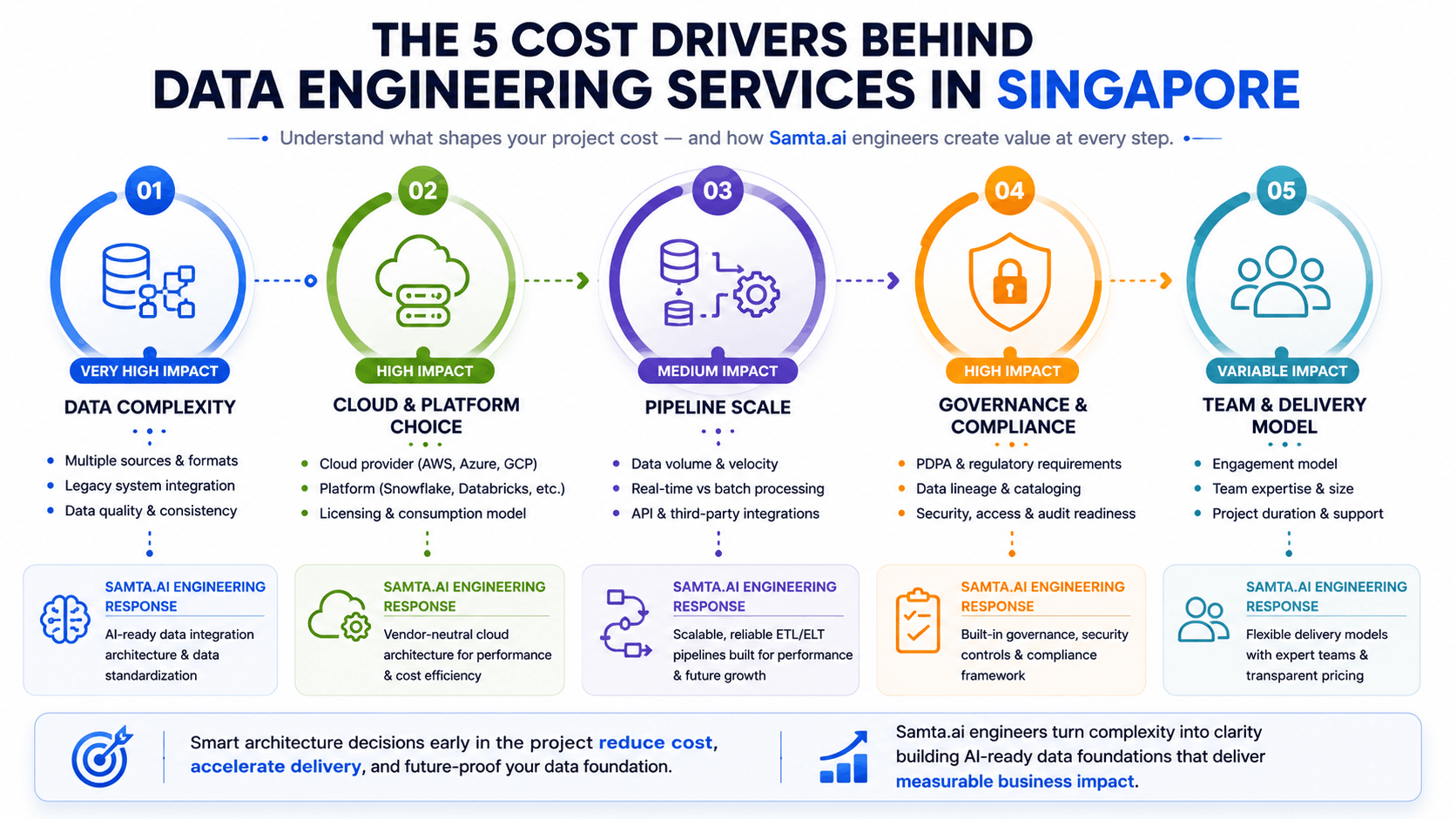
1. Data volume and source count: More systems to connect means more integration points, and each integration point carries its own engineering, testing, and maintenance cost. A pipeline connecting three systems is fundamentally simpler to price than one connecting fifteen, even if the total data volume looks similar on paper.
2. Compliance scope: BFSI and healthcare clients pay more because of audit trail and governance requirements, which often require dedicated engineering time separate from the core pipeline build. This is frequently the single largest cost variable between two projects that otherwise look similar in data volume.
3. Engagement type: Project based work has a defined end cost and a clear delivery date. Managed services carry a recurring monthly cost but reduce the risk of an unmaintained pipeline degrading silently over time, which is a real and underappreciated cost in itself.
4. Tooling stack: Costs shift depending on whether the build uses Snowflake, Databricks, or a custom stack, and whether existing Microsoft infrastructure can be reused rather than replaced. Reuse of existing licenses is one of the fastest ways to bring a quote down without cutting scope.
5. Internal capability: Enterprises with an existing in house team pay less for ongoing work but more for initial architecture guidance, since experienced consultants are typically brought in for the design phase even when the build itself is handled internally.
Cost Driver | Low Cost Scenario | High Cost Scenario | Typical Timeline | Samta.ai Engineering Approach |
Data Volume and Sources | Single source, low volume | Ten plus sources, high volume | 4 to 12 weeks | Phased integration prioritized by business value |
Compliance Scope | General enterprise, no regulator | BFSI with audit trail requirements | Adds 3 to 6 weeks | Governance layer built in from architecture phase |
Engagement Type | One time migration project | Ongoing managed pipeline retainer | Retainer is continuous | Flexible engagement models based on internal capacity |
Tooling Stack | Reuse of existing Microsoft or cloud tools | New Snowflake or Databricks deployment | 2 to 8 weeks setup | Partner certified builds on Snowflake and Databricks |
Internal Capability | Mature in house data team | No internal data engineering function | Ongoing | Managed services fill the capability gap |
For teams comparing platform level costs rather than services costs, our comparison of VEDA versus a generic data intelligence platform breaks down where licensing cost and services cost diverge, since these two budget lines are frequently confused in early stage vendor conversations. A separate look at how discovery work specifically affects total project cost, including how to scope it so it does not become an open ended expense, sits in our data discovery for AI guide.
Real World Enterprise Use Cases
BFSI: A regional bank scoping a compliance driven pipeline. A Singapore bank needed a pipeline that could produce an audit trail for every data transformation feeding its credit risk models. The initial quote reflected the compliance layer, not the raw data volume, since governance work made up close to half the total engineering cost. The bank had originally budgeted based on data volume alone and had to revise its budget upward once the audit trail requirement was fully scoped. Samta.ai's VEDA AI decision analytics platform sat underneath this build as the analytics layer, with the engineering team building the governance and lineage tracking directly into the pipeline rather than adding it afterward.
General enterprise: A manufacturing group consolidating plant data. A manufacturer with data spread across a dozen legacy plant systems needed a single integration layer before any AI use case could be built. The bulk of the cost went into source system mapping and cleaning, not the eventual analytics layer, because several of the legacy systems had inconsistent data formats and no existing documentation. This discovery phase alone accounted for a larger share of the budget than the client had anticipated. Full detail on comparable builds, including how discovery findings changed the final scope, is available in our case studies. Both cases show the same pattern: the number on the quote reflects data complexity and compliance scope far more than the size of the final dashboard or model that sits on top of the pipeline.
Protect Your AI Investments with a Model Risk Assessment
Key Risks And Failure Modes In Budgeting
Underbudgeting for maintenance: A pipeline that costs S$40,000 to build can cost S$15,000 a year to maintain, and this maintenance line is the one most frequently left out of an initial budget request submitted to finance.
Choosing the cheapest quote without checking governance scope: A quote that excludes compliance and audit trail work will look cheaper until a regulator asks a question the pipeline cannot answer, at which point the remediation cost is typically higher than if governance had been built in from the start.
Building in house without the right skill mix: Gartner's research on the data and analytics software market shows this segment growing at close to fourteen percent annually, which means the specialized in house talent needed to keep pace is also getting harder and more expensive to hire directly, particularly for niche skills in specific cloud data platforms.
No clear exit plan from a vendor: A managed service without data portability built in creates a switching cost that only becomes visible when you try to leave, often in the form of proprietary data formats or undocumented transformation logic that a new vendor has to reverse engineer.
Treating discovery as free: Some vendors quote a low headline number because the discovery phase is priced separately and disclosed only after the contract is signed. Always confirm whether discovery is included in the initial quote or billed as a separate phase.
Decision Framework: In House Team, Managed Service, Or Hybrid
Use this checklist to decide which model fits your budget and risk profile.
Do you have more than two data engineers on staff already? If not, a fully in house build will likely cost more per pipeline than a managed service, once recruitment and onboarding time are factored in.
Is your data volume growing quickly? If yes, a managed retainer absorbs scaling cost more predictably than repeated project quotes, since the vendor can plan capacity ahead of demand.
Do you operate in a regulated sector? If yes, governance cost should be scoped separately from integration cost, not bundled invisibly into a single line item that is hard to audit later.
Do you already have Microsoft, Snowflake, or Databricks licenses? If yes, ask any vendor how much of your existing stack they can reuse before quoting a new build, since reuse can meaningfully reduce setup cost.
Is this a one time need or an ongoing function? A single migration project rarely justifies a full time hire, while a continuously evolving data environment usually does.
Our digital transformation managed services page and data integration consulting services page both outline pricing models and engagement structures for teams weighing a managed versus in house approach.
Talk To Samta.ai About Your Data Engineering Budget
Before you commit budget to an internal hire or a vendor contract, talk to Samta.ai about your data engineering budget so the number reflects your actual data complexity, not a generic estimate. Enterprises weighing whether to build a team internally versus engaging a partner should also review our in house AI team guide before finalizing headcount plans, since the hiring timeline alone can add months to a project that a managed service could start immediately.
Conclusion
Data engineering cost in Singapore is not a single number. It is a function of data volume, compliance scope, engagement type, and tooling choices, and enterprises that budget for build cost alone consistently underestimate total spend once maintenance, governance, and discovery are properly scoped. Get a data engineering cost assessment from Samta.ai before locking in a budget based on a rough estimate.
Accelerate Your Enterprise AI Journey with a Free Consultation
About Samta
Samta.ai is a Singapore-headquartered AI Product Engineering & Data Intelligence partner helping enterprises build production-grade AI systems for regulated and data-intensive environments.We help organizations move beyond experimentation by engineering scalable, explainable, and enterprise-ready AI solutions from data foundations and model development to workflow automation and deployment.
Our capabilities combine deep AI expertise, data engineering, and product engineering to deliver measurable business impact across FinTech, BFSI, cybersecurity, regulatory technology, and enterprise operations.
Our enterprise AI products power real-world intelligence systems:
• TATVA : AI-driven data intelligence platform for governed analytics, monitoring, and operational insights
• VEDA : Explainable and audit-ready AI decisioning engine built for compliance-sensitive enterprise workflows
• CORA-Property Management Solutions: : Predictive intelligence platform for real-estate pricing, portfolio optimization, and investment analytics
Backed by ecosystem partnerships with Microsoft, Databricks, Snowflake, and AWS, Samta.ai delivers agile, cost-efficient AI engineering with faster turnaround and enterprise-grade scalability. Trusted by enterprises across FinTech, BFSI, and digital transformation initiatives, Samta.ai embeds AI governance, data privacy, and compliance-by-design principles directly into the AI lifecycle , enabling organizations to scale AI with transparency, accountability, and operational control.
Enterprises leveraging Samta.ai automate 65%+ of repetitive data, analytics, and decision workflows while maintaining governance, explainability, and measurable business outcomes. Samta.ai provides the strategic consulting, AI engineering, and data modernization expertise needed to align enterprise operations with next-generation AI transformation goals.
FAQ
What does data engineering services cost in Singapore typically range from?
Project based engagements often start in the low tens of thousands of Singapore dollars for a narrowly scoped integration, while ongoing managed pipeline services with governance and monitoring included can run into six figures annually, depending on data volume, compliance scope, and the number of source systems involved.
What is a data integration engineer and do I need to hire one?
A data integration engineer builds and maintains the pipelines connecting your source systems to analytics or AI tools, handling everything from connection logic to data quality checks. Many enterprises use a managed service instead of hiring directly, especially early on, to avoid the cost and hiring timeline of a full time role before data volume clearly justifies it.
Why do BFSI data engineering projects cost more than general enterprise projects?
Compliance and audit trail requirements add engineering work that non regulated projects do not need, including lineage tracking, access logging, and documentation for regulator review, often accounting for close to half of total project cost in heavily regulated engagements.
How do I know if I should build a data team in house or use a managed service?
Assess whether you have existing data engineering staff, how quickly your data volume is growing, whether your industry carries compliance requirements, and whether you can absorb the hiring cost and timeline of specialized roles in a competitive Singapore tech labor market. CTOs planning for 2026 budgets can find a fuller decision framework in our AI readiness guide for CTOs.
What is data systems software integration and why does it affect my quote?
It refers to the work of making disparate software systems exchange data reliably despite differing formats, update frequencies, and access controls. The number of systems involved, and how inconsistent their data formats are, is one of the strongest predictors of total project cost. Singapore specific engineering considerations, including local talent availability and typical vendor rate ranges, are covered in our page on enterprise AI engineering in Singapore.