

Summarize this post with AI
Most enterprise AI trials are structured to fail quietly, and the 7 day VEDA decision proof exists specifically because of how badly that pattern has played out industry wide. Gartner predicts at least 30% of generative AI projects will be abandoned after proof of concept, citing poor data quality, unclear business value, and escalating costs as the main causes. A seven day proof avoids all three by design, one specific business question, direct connection to your existing data, and a bounded scope that either produces a working answer or tells you clearly why it did not. This is what actually happens during those seven days.
7 Day VEDA Decision Proof:
A 7 day VEDA decision proof connects VEDA directly to a company's existing data infrastructure and answers one specific, pre defined business question within a bounded, one week window, rather than running an open ended pilot with no fixed scope or success criteria. Gartner's research into generative AI project failure points to poor data quality, inadequate risk controls, and unclear business value as the leading causes of abandonment after proof of concept, and a seven day structure addresses all three directly, using real production data, a single defined question, and a clear yes or no outcome by day seven rather than a slow drift toward an inconclusive multi month pilot.
What a decision proof actually is, and how it differs from a typical trial
What is decision AI? It is AI built specifically to answer a business question and recommend an action, not just present a dashboard or a chart requiring further human interpretation. Our guide on AI decision intelligence platforms covers this distinction from traditional reporting tools in more depth.
A decision proof differs from a typical vendor trial in one structural way, scope. Most AI trials either run open ended against a broad, loosely defined use case, or they run a canned demo against sample data that never touches your actual systems. Our overview of AI powered insights platforms covers the broader category VEDA sits within, and our comparison of VEDA against Power BI covers how a conversational, question first approach differs from a traditional dashboard tool from day one of any evaluation.
See How VEDA Turns Data Into Decision-Ready Insights
Why a bounded 7 day structure matters more than an open ended pilot
Business question analytics demo experiences fail for predictable reasons, and a seven day structure is designed around avoiding each one specifically.
Poor data quality derails most open ended pilots. Gartner's research names this as a leading cause of proof of concept abandonment, and a seven day proof addresses it immediately by connecting directly to your production data on day one rather than working from a sanitized sample.
Unclear business value keeps projects stuck in an endless evaluation loop. Gartner's April 2026 research found organizations with successful AI initiatives invest significantly more in their underlying data and analytics foundations, and a decision proof forces that value question to be answered explicitly, with one specific business question defined before the proof even starts.
Escalating costs from open ended pilots erode executive confidence. A seven day, fixed scope structure caps the investment and the timeline before either party commits further, which our comparison of VEDA against traditional BI tools covers in more depth from a total cost perspective.
Our comparison of VEDA against Snowflake's predictive capabilities covers how a decision proof differs from evaluating a data warehouse's native analytics features specifically.
What happens during the 7 day VEDA decision proof
What does a 7 day proof of concept look like for an AI decision analytics platform? The structure below shows what happens across the week.
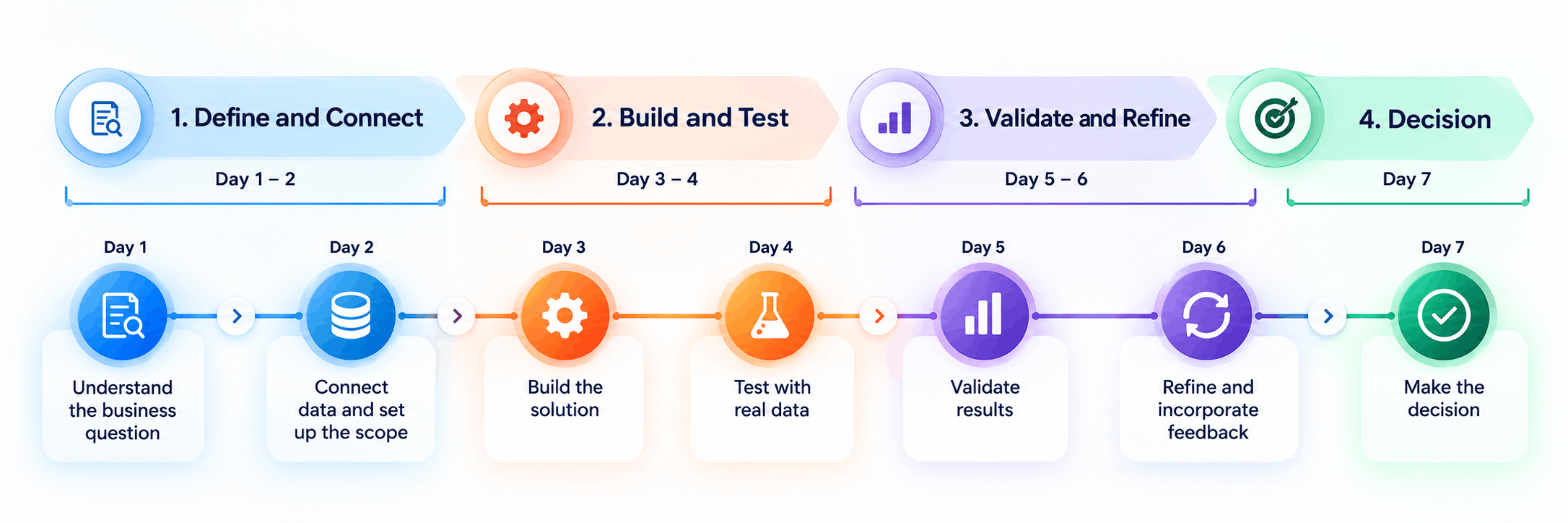
Days 1 and 2, define and connect. The specific business question gets scoped precisely, and VEDA connects directly to the relevant data sources, whether that is Databricks, Snowflake, Microsoft infrastructure, or another existing system, through our data integration consulting services.
Days 3 and 4, build and test the first answers. VEDA generates initial answers to the defined question, and the team reviews whether the conversational interface is surfacing the right data correctly against known, verifiable outcomes.
Days 5 and 6, validate and refine. Edge cases and follow up questions get tested, checking whether the platform handles the genuinely complex version of the question, not just the simplest form of it. Our comparison of VEDA against ThoughtSpot and other natural language platforms covers what this validation stage typically reveals about querying depth.
Day 7, decision. The proof concludes with a clear outcome, whether VEDA answered the defined business question reliably using your actual data, giving a definitive basis for the next decision rather than an open ended continuation.
This is where the engineering execution layer matters. Samta.ai built the VEDA AI decision analytics platform specifically to make this seven day structure achievable, since the platform connects to existing enterprise data infrastructure directly rather than requiring a separate data warehouse build before any proof can begin. Institutions weighing whether a general data platform can support a proof this fast should see how VEDA compares to other data intelligence platforms, and the VEDA platform itself is architected around exactly this rapid connection and query pattern rather than a slower data warehouse build cycle. Our workflow automation consulting team supports organizations that want the proof to extend into an automated decision workflow once the initial question is answered successfully.
AI proof of concept approaches compared
POC Approach | Typical Duration | Scope | Data Requirement | Failure Risk |
Traditional multi month AI pilot | 3 to 6 months or longer | Broad, often loosely defined use case | Extensive, frequently requires a full data warehouse build first | High, Gartner reports 30% of generative AI projects are abandoned after proof of concept |
Generic vendor sales demo | A single session, typically under an hour | Pre built sample data, not your own business question | None, uses vendor demo data rather than your systems | Low commitment but low proof value, does not test your actual data |
Self built internal sandbox trial | Weeks to months, dependent on internal resourcing | Defined by internal team bandwidth and priority | Requires internal engineering time to connect data | Moderate, often stalls due to competing internal priorities |
VEDA 7 day decision proof | 7 days | One specific, defined business question | Direct connection to existing data infrastructure | Low, bounded scope and defined success criteria from day one |
DIY proof of concept with open source tools | Weeks, highly variable | Defined by internal technical capability | Requires internal data science and engineering resourcing | Moderate to high, dependent entirely on internal AI expertise |
Discover Your AI Readiness With a Free Assessment
Real world enterprise use cases
Regulated industry: a bank testing a specific credit risk question
A bank wanted to know whether a conversational analytics layer could answer a specific portfolio concentration question faster than its existing quarterly reporting cycle allowed. Running the question through a seven day proof, connected directly to the bank's existing data infrastructure, gave the risk team a definitive answer within the week, rather than committing to a multi month pilot before knowing whether the platform could handle that specific question at all.
General enterprise: a logistics company testing route profitability visibility
A logistics company wanted to test whether VEDA could answer route level profitability questions live during a planning meeting, rather than waiting on a scheduled report. Supported by enterprise AI engineering in Singapore and the region's broader logistics analytics practice, the seven day proof confirmed the platform could answer the specific question reliably before the company committed to a wider rollout.
Key risks and failure modes
Choosing a vague or overly broad question for the proof. A seven day window works because the question is specific, and a loosely defined goal reintroduces the same ambiguity that causes longer pilots to stall.
Using sample or sanitized data instead of real production data. A proof run against clean sample data does not test what actually happens against your organization's real data quality issues.
Treating day seven as the end of the evaluation rather than a decision point. The proof is designed to produce a clear answer, continue, adjust scope, or stop, not to be extended indefinitely without a defined reason.
Skipping the preparation work on data access before day one. A proof's seven day window assumes data connection can begin immediately, so any delay in granting appropriate access shortens the actual testing time available.
Not involving the actual decision maker in reviewing results. A proof intended to inform a specific business question needs that question's owner reviewing the output directly, not a proxy reviewer several steps removed.
When a 7 day decision proof is the right approach
A seven day decision proof is the right approach when:
You have one specific, well defined business question that current tools answer too slowly
Your data is accessible enough to connect within the first two days of the proof
You need a clear go or no go signal before committing to a broader evaluation
A different evaluation approach may be better when:
You are evaluating a broad platform capability rather than one specific business question
Data access requires extensive internal approval processes that cannot clear within a week
The organization needs a longer, phased evaluation involving multiple stakeholder teams before any single proof can begin
Reviewing Samta.ai's case studies alongside your own candidate business question gives a useful sense of which kinds of questions have produced the clearest seven day results for other organizations.
Assess Your AI Model Risk With Confidence
Conclusion
A 7 day VEDA decision proof works because it is deliberately bounded, one specific question, real data, and a clear decision point at the end of the week. Organizations that scope a proof this way avoid the ambiguity that leads roughly a third of generative AI projects to be abandoned after proof of concept industry wide.
About Samta
Samta.ai is a Singapore-headquartered AI Product Engineering & Data Intelligence partner helping enterprises build production-grade AI systems for regulated and data-intensive environments.We help organizations move beyond experimentation by engineering scalable, explainable, and enterprise-ready AI solutions from data foundations and model development to workflow automation and deployment.
Our capabilities combine deep AI expertise, data engineering, and product engineering to deliver measurable business impact across FinTech, BFSI, cybersecurity, regulatory technology, and enterprise operations.
Our enterprise AI products power real-world intelligence systems:
• TATVA : AI-driven data intelligence platform for governed analytics, monitoring, and operational insights
• VEDA : Explainable and audit-ready AI decisioning engine built for compliance-sensitive enterprise workflows
• CORA-Property Management Solutions: : Predictive intelligence platform for real-estate pricing, portfolio optimization, and investment analytics
Backed by ecosystem partnerships with Microsoft, Databricks, Snowflake, and AWS, Samta.ai delivers agile, cost-efficient AI engineering with faster turnaround and enterprise-grade scalability. Trusted by enterprises across FinTech, BFSI, and digital transformation initiatives, Samta.ai embeds AI governance, data privacy, and compliance-by-design principles directly into the AI lifecycle , enabling organizations to scale AI with transparency, accountability, and operational control.
Enterprises leveraging Samta.ai automate 65%+ of repetitive data, analytics, and decision workflows while maintaining governance, explainability, and measurable business outcomes. Samta.ai provides the strategic consulting, AI engineering, and data modernization expertise needed to align enterprise operations with next-generation AI transformation goals.
Frequently asked questions
What happens during a 7 day VEDA trial?
A seven day VEDA decision proof connects the platform directly to your existing data infrastructure on days one and two, generates and tests initial answers to a defined business question on days three and four, validates edge cases on days five and six, and concludes with a clear decision on day seven.
How quickly can a business question be answered using VEDA?
Once VEDA is connected to the relevant data source, most defined business questions can be answered within the same conversation, in minutes rather than the days or weeks a traditional report request typically requires.
What is required from a company to run a VEDA decision proof?
A company needs one specific, well defined business question, access to the relevant data sources, whether Databricks, Snowflake, Microsoft infrastructure, or another system, and the actual decision maker available to review results during the seven day window.
What does a 7 day proof of concept look like for an AI decision analytics platform?
It typically spans data connection and question definition in the first two days, initial answer generation and testing in the middle days, edge case validation toward the end of the week, and a clear decision outcome on the final day, rather than an open ended evaluation with no fixed timeline.
What should a company prepare before starting a trial of an AI business intelligence tool?
A company should prepare a specific business question rather than a general capability test, confirm data access can be granted quickly, and ensure the actual decision maker for that question is available to review results throughout the trial period.
Unlock Verifiable Insights Across All Data Stores
VEDA connects siloed data sources and empowers business leaders with real-time, governed AI decision analytics.
Explore VEDA Platform >