
Summarize this post with AI
Most enterprise AI pilots never reach production. The gap is rarely the model. It is the absence of disciplined product engineering ai systems thinking during the build phase. Teams choose a vendor, wire up a proof of concept, and only discover the missing data pipeline, governance layer, or monitoring stack once the board asks for a rollout date. Product engineering ai systems work is what separates a demo from a system that survives an audit, a regulator review, and three years of data drift. This piece breaks down the architecture decisions that matter and where most teams get them wrong.
Product Engineering AI Systems:
Product engineering for AI systems is the discipline of designing, building, and operating AI capabilities as production software, not as one off experiments. It combines data engineering, model lifecycle management, governance controls, and observability into a single delivery pipeline. In APAC enterprises, this typically means aligning the build with frameworks such as the NIST AI Risk Management Framework and, for regulated sectors, MAS expectations on model governance from day one rather than retrofitting them later.
What Product Engineering For AI Systems Actually Means
AI product engineering is not data science with extra steps. Data science answers whether a model works. Product engineering answers whether it keeps working, at scale, under real traffic, with real users, for years. The distinction matters because most enterprise AI failures are not accuracy failures. They are engineering failures: no versioning for training data, no rollback path when a model degrades, no clear owner when an output causes a compliance incident. A working definition, useful for a CTO or a Gartner analyst reviewing your architecture: product engineering for enterprise AI is the set of practices that turn a validated model into a system with defined SLAs, audit trails, access controls, and a maintenance plan. You can review the practical breakdown of what a production system in AI actually requires in our detailed explainer on production AI systems.
Start Your AI Journey with a Data-Driven Assessment
Why It Matters Now: 2026 Context And Regulatory Pressure
Three forces are converging on enterprise AI teams in 2026.
First, boards have stopped funding pilots without a production timeline attached. Second, regulators across APAC, particularly in Singapore's financial sector, have moved from guidance to active supervisory review of AI governance. Third, the volume of AI systems inside a single enterprise has grown faster than the governance capacity to manage them.
Gartner's own research on enterprise AI adoption confirms this shift toward accountability and measurable return, noting that organizations are now expected to tie AI investment to defined governance and operating model maturity rather than experimentation alone. For manufacturing and industrial clients, ai systems for manufacturing carry an added layer of complexity: sensor data volume, latency requirements on the shop floor, and integration with legacy MES and ERP systems that were never designed for real time inference. Enterprises planning this shift should start with a documented AI transformation roadmap template before committing engineering resources.
The Core Framework: A Four Layer Production Architecture
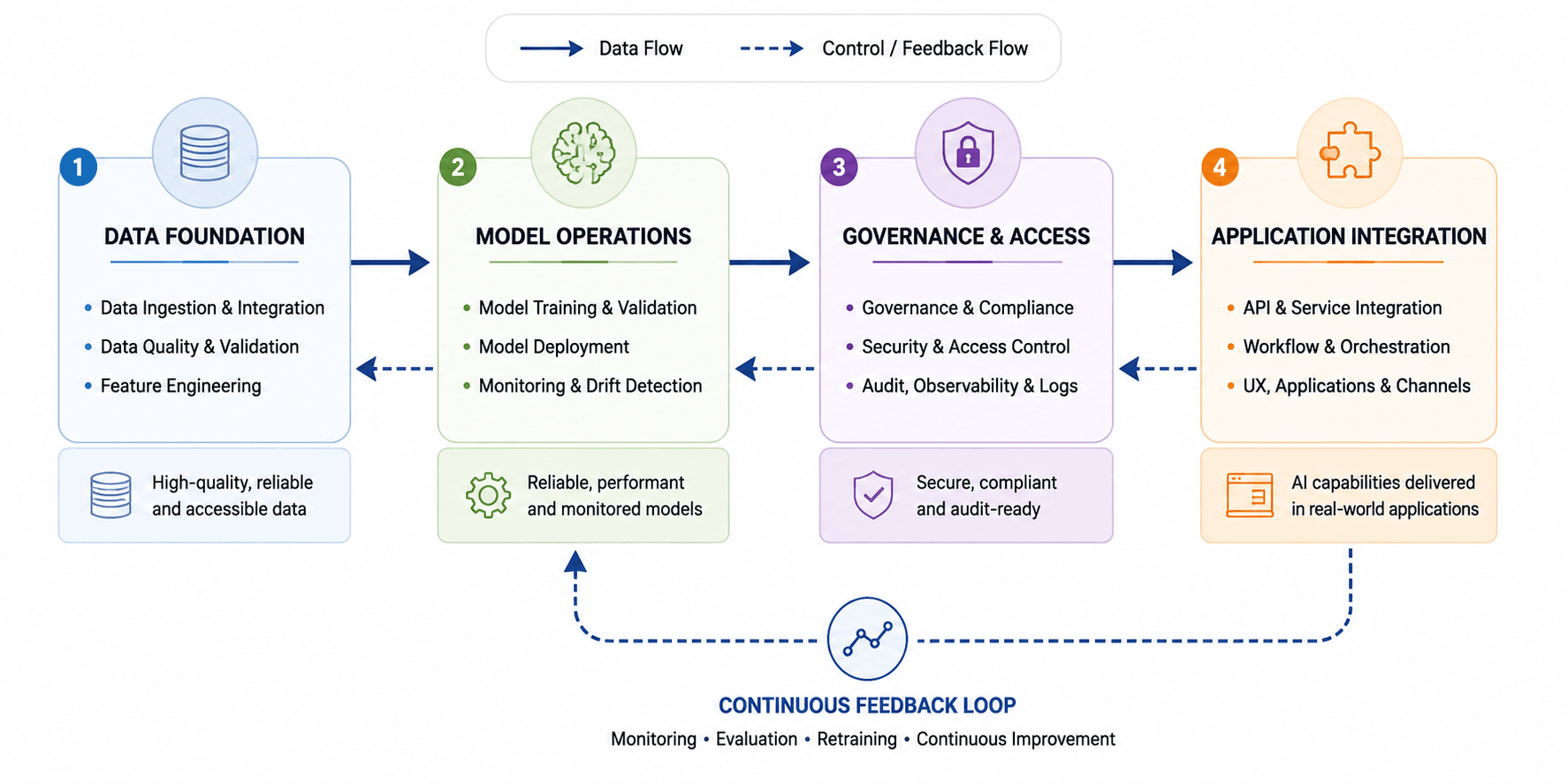
Enterprises that succeed at moving AI from pilot to production consistently build around four layers.
Layer one: Data foundation: Clean, governed, lineage tracked data pipelines. Without this layer, every downstream layer inherits the same errors.
Layer two: Model operations: Versioning, retraining triggers, drift detection, and rollback. This is where how to build production AI systems gets tested against real world variance rather than a static test set.
Layer three: Governance and access: Role based access, audit logging, and explainability outputs mapped to a named regulatory framework, not a generic ethics statement.
Layer four: Application and integration: The interface layer where the AI output meets a human decision maker or a downstream system, with clear escalation paths when confidence is low. A step by step AI implementation roadmap for enterprise teams, covering exactly how these four layers get sequenced during a real build, is available in our enterprise AI implementation roadmap.
Layer | Primary Owner | Key Risk If Skipped | Typical Tooling | Samta.ai Engineering Role |
Data Foundation | Data Engineering | Silent data drift, biased outputs | Snowflake, Databricks pipelines | Pipeline design and lineage tracking |
Model Operations | ML Engineering | Undetected model decay | MLflow, custom retraining triggers | Retraining automation, drift alerts |
Governance and Access | Risk and Compliance | Regulatory findings, audit failure | Role based access control systems | Governance layer mapped to MAS and NIST guidance |
Application Integration | Product Engineering | Poor adoption, shadow workarounds | Microsoft ecosystem integrations | API design, human in the loop workflows |
Monitoring and Observability | Platform Engineering | Delayed incident response | Custom dashboards, alerting stacks | Ongoing SLA and performance monitoring |
You can see how this framework compares against traditional development approaches in our comparison of AI engineering versus traditional development companies, and against alternative tool choices in our guide to tools and frameworks for AI delivery.
Real World Enterprise Use Cases
BFSI: Credit decisioning at a regional bank. A Singapore based bank needed to explain every credit decision to its regulator within 48 hours of a query. The engineering challenge was not the scoring model. It was building an explainability layer that mapped each score to a documented rule set, in line with MAS FEAT principles on fairness, ethics, accountability, and transparency. The production system reduced query response time from days to hours by automating the audit trail generation.
General enterprise: Property operations at scale. A regional property portfolio manager needed a single system to flag maintenance anomalies across hundreds of buildings. The win was not the anomaly detection model, which existed already. It was the integration layer connecting building sensor data, work order systems, and a decision support dashboard that facility managers actually used daily. Samta.ai's VEDA AI decision analytics platform served as the analytics layer underneath this build. Both cases illustrate the same lesson: the model is rarely the hard part. Explain production system in AI work correctly, and the engineering layer is where enterprise value actually gets captured. Detailed breakdowns of these and other builds sit in our case studies.
Identify AI Risks Before They Affect Performance
Key Risks And Failure Modes
Silent model decay: Without drift monitoring, a model can degrade for months before anyone notices, because accuracy metrics are rarely checked in production the way they were checked in testing.
Governance retrofitting: Teams that add compliance controls after launch face far higher rework costs than teams that design for the NIST AI Risk Management Framework from the architecture phase.
Vendor lock without an exit plan: Choosing a platform without a data portability plan creates a dependency that is expensive to unwind two years later.
Shadow AI: When the official system is too slow or too rigid, business users build their own workarounds in spreadsheets or unsanctioned tools, creating an unmanaged risk surface the compliance team does not know exists.
Decision Framework: When To Build, Partner, Or Buy
Use this checklist before committing budget to any AI production build.
Do you have in house data engineering capacity to maintain pipelines long term? If not, a managed partner reduces risk.
Is the use case in a regulated domain like BFSI? If yes, governance architecture must be designed first, not last.
Does the system need to integrate with legacy ERP, MES, or core banking systems? If yes, integration complexity should drive vendor selection, not model accuracy alone.
Is there an internal owner accountable for model performance after launch? If no owner exists, do not launch.
For teams evaluating whether to build internally or engage a partner, our digital transformation managed services page and data integration consulting services page outline where a managed engineering partner typically adds the most value.
Talk To Samta.ai About Your Production Architecture
Enterprises asking what is AI engineering in practice, beyond the model layer, typically need a partner who owns the full stack from data pipeline to governance to deployment. Talk to Samta.ai about your production architecture before your next AI initiative moves past the pilot stage. See why regulated and non regulated enterprises across the region choose Samta.ai for exactly this kind of build.
Conclusion
Production success in enterprise AI is an engineering outcome, not a modeling outcome. The teams that win design governance, monitoring, and integration into the architecture from day one, rather than bolting them on after a pilot succeeds. Samta.ai's engineering teams, supported by partnerships with Microsoft, Snowflake, and Databricks, build this layer so your AI initiative survives contact with production.
Ready to Move Your AI Project from Pilot to Production?
About Samta
Samta.ai is a Singapore-headquartered AI Product Engineering & Data Intelligence partner helping enterprises build production-grade AI systems for regulated and data-intensive environments.We help organizations move beyond experimentation by engineering scalable, explainable, and enterprise-ready AI solutions from data foundations and model development to workflow automation and deployment.
Our capabilities combine deep AI expertise, data engineering, and product engineering to deliver measurable business impact across FinTech, BFSI, cybersecurity, regulatory technology, and enterprise operations.
Our enterprise AI products power real-world intelligence systems:
• TATVA : AI-driven data intelligence platform for governed analytics, monitoring, and operational insights
• VEDA : Explainable and audit-ready AI decisioning engine built for compliance-sensitive enterprise workflows
• CORA-Property Management Solutions: : Predictive intelligence platform for real-estate pricing, portfolio optimization, and investment analytics
Backed by ecosystem partnerships with Microsoft, Databricks, Snowflake, and AWS, Samta.ai delivers agile, cost-efficient AI engineering with faster turnaround and enterprise-grade scalability. Trusted by enterprises across FinTech, BFSI, and digital transformation initiatives, Samta.ai embeds AI governance, data privacy, and compliance-by-design principles directly into the AI lifecycle , enabling organizations to scale AI with transparency, accountability, and operational control.
Enterprises leveraging Samta.ai automate 65%+ of repetitive data, analytics, and decision workflows while maintaining governance, explainability, and measurable business outcomes. Samta.ai provides the strategic consulting, AI engineering, and data modernization expertise needed to align enterprise operations with next-generation AI transformation goals.
FAQ
What is product engineering for AI systems?
It is the discipline of building AI capabilities as maintainable production software, covering data pipelines, model operations, governance, and application integration, rather than treating AI as a one time data science exercise.
How is AI product engineering different from data science?
Data science validates whether a model works on a test set. AI product engineering ensures the model keeps working reliably in production, with monitoring, rollback paths, and governance controls attached.
What does ai systems for manufacturing require differently?
Manufacturing environments demand low latency inference, integration with legacy MES and ERP systems, and resilience to noisy sensor data, which general purpose AI platforms rarely handle out of the box.
How do BFSI companies handle AI governance requirements?
Regulated financial institutions typically map their AI systems to a named framework such as MAS FEAT and document explainability at the point of decision, not retroactively.
Should we build our AI platform in house or use a partner?
It depends on internal data engineering capacity, regulatory exposure, and integration complexity with existing enterprise systems. Enterprises operating out of Singapore specifically should also review our page on enterprise AI engineering in Singapore for region specific build considerations.